
Blog
Junk volume: which of your sets actually stopped counting
Published July 20, 2026 · 11 min read
You finished the ninth set of chest work. It went on the log. It cost you four minutes and a little more soreness the next day. The honest question is whether it did anything at all, and nothing about the way it felt at the time will tell you.
That is the whole problem with junk volume. It does not announce itself. A wasted set looks exactly like a productive one from the inside: same bench, same rep count, same tired feeling walking away from it. The difference only shows up in the record, and only if the record captured effort and not just numbers.
Most articles on this answer the question by handing you a cap. Six to eight sets per muscle per session, and anything past that is junk. That is a reasonable-sounding rule that quietly assumes your sets and mine are worth the same thing, which they are not. This post takes the other route: what junk volume actually is, why the myth accusation is half right, and the four tells that let you find it in your own log instead of guessing from someone else's number.
What is junk volume?
Junk volume is training volume that adds fatigue without adding a meaningful growth stimulus. The set happens, the recovery bill arrives, and the adaptation does not.
The word "junk" is doing a lot of work there, and it is worth being precise. A junk set is rarely a set that did literally nothing. It is a set whose stimulus-to-fatigue ratio is bad enough that it was a poor use of the recovery budget it consumed. You would have been better off spending that recovery capacity on a harder set, on a different day, or not at all.
Three things push a set into that territory:
- The set was too easy. You stopped five or more reps short of failure, so the hardest and most stimulating reps never happened. Effort is the gate, and a comfortable set does not open it. That is the opposite error from grinding everything out, and deciding when failure is worth the fatigue is the same judgement pointed the other way. It is also the exact trap a cluster set that finishes fresh falls into: heavy, fast, technically clean, and too far from failure to have earned its spot on the tally.
- The set came too late in the session. Local fatigue has accumulated to the point where you can no longer reach a meaningful effort at a meaningful load. The RIR you write down says 2, but the load that produced it has fallen off a cliff.
- The volume was spread too thin across too many movements. Two sets each on six chest machines fragments your effort across setups instead of concentrating it where it can drive progression.
Those three are the mechanism. Notice that none of them is a number.
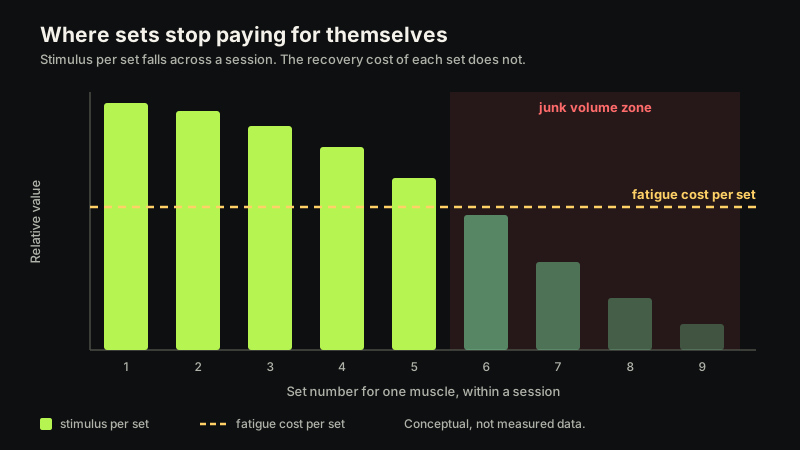
The shape above is the intuition, and it is conceptual rather than measured. Early sets buy a lot of stimulus for their recovery cost. Later sets in the same session buy less and less, while the cost of doing them barely moves. Junk volume is the region where those two lines have crossed. Where the crossing happens is personal, which is the part the fixed caps cannot capture.
Is junk volume a myth?
The pushback is common enough to have its own search term, and it deserves a fair hearing rather than a dismissal.
The steelman goes like this. Volume is one of the more reliable drivers of hypertrophy, and the dose-response research keeps finding that more weekly sets tend to produce more growth, with diminishing rather than negative returns across the ranges most people train in. A systematic review and meta-analysis of weekly set volume reported a graded relationship between weekly sets and muscle gain, and Greg Nuckols' review of the same literature at Stronger by Science lands in a similar place. If the curve flattens but never turns down, then "junk" is the wrong word. A low-stimulus set is not a zero-stimulus set. It is just an inefficient one.
That is largely correct, and it is why the absolutist framing you see elsewhere overshoots. An extra easy set at the end of a session is not sabotage. It does not undo the work you did.
The honest verdict sits in the middle. Junk volume is real as an efficiency problem and overstated as a danger. The cost is not that the set hurts you directly. The cost is that it consumes recovery, session time, and joint stress that a better-placed set could have used, and that it inflates your set count so your log tells you you are training harder than you are. If you count nine sets and four of them were coasting, your weekly total is a fiction, and every programming decision you make from it inherits that error. That is the real damage: not the fatigue, the bad bookkeeping. A drop set logged as three separate sets is the same fiction in miniature, one hard set wearing the costume of three, and a pre-exhaustion pairing counted as two clean sets is the same trap from the other direction.
Why the set cap is the wrong answer
"Cap it at six to eight sets per muscle per session" is convenient, and it is also a guess made on your behalf by someone who has never seen your training.
A cap has to assume every set inside it counted. It cannot know whether your first five sets were taken close to failure or whether all eight were a comfortable jog. Two lifters can both do eight sets of chest, and one of them accumulated eight hard sets while the other accumulated maybe three. The cap treats them identically. It is the wrong instrument, because the underlying quantity you care about, what counts as a hard set, is not the same thing as a set you performed.
That also means the per-session ceiling is a real thing but a personal one. There genuinely is a point where a muscle stops responding within a session, and it moves with your training age, the exercise, and how the rest of the week is loaded. Working out how many sets a session can actually hold starts from your weekly target and your frequency, not from a number you read.
So the useful question is not "how many sets is junk volume." It is "which of my sets, this week, stopped counting." That question has an answer, and the answer is in your log.
The four tells that a set stopped counting
Each of these is visible in a training record that captures load, reps, and effort per set. None of them is visible in a record that captures only load and reps, which is precisely why proximity to failure belongs in the log.
| Tell | What you see in the log | What it means |
|---|---|---|
| Effort drift | Set 1 at 2 RIR, set 6 logged at 2 RIR, but the load dropped 20 percent to get there | You are chasing a number with reduced load. The stimulus is falling even though the RIR column looks stable. |
| The comfortable set | Sets logged at 4 or 5 RIR consistently | The hardest reps never happened. These are the clearest junk candidates in most logs. |
| Rep collapse | Set 1 gets 10 reps, set 5 gets 4 reps at the same load | Local fatigue, not stimulus. The last sets are paying full recovery cost for a fraction of the work. |
| The fragmented muscle | Six exercises, two sets each, none of them progressing week to week | Effort spread so thin that no single movement accumulates enough to overload. |
The first tell is the one people miss, and it is the strongest argument for logging effort in the moment rather than reconstructing it afterwards. A set at 2 RIR with 80 kg and a set at 2 RIR with 60 kg both read as "2" in a spreadsheet. Only one of them was the set you meant to do. If you want the underlying scale to be reliable, reps in reserve has to be estimated set by set while the set is still fresh, not filled in at the end of the session from memory.
The second tell needs one qualifier. Sets at 4 or 5 RIR are not automatically junk. Warm-up sets are not junk either, provided they stay out of your hard-set total, and deliberately submaximal work in the early weeks of a block is a planned choice rather than an accident. The problem is unintentional easiness: sets you believed were hard that the log says were not. This is exactly how the early sets of an ascending pyramid pad a weekly total: they are warm-ups by design, so logging all of them as working sets counts easiness as effort.
What to do once you have found it
The fix is almost never "add more sets," and it is usually not "cut everything" either.
Raise effort before you cut volume. If your logged RIR sits at 4 or 5 across the board, you do not have a volume problem, you have an intensity problem, and cutting sets would only shrink an already small stimulus. Take your working sets to 1 to 3 RIR first, hold your set count, and see what happens over two or three weeks. High-volume templates make this failure mode easy to see: why 10x10 buys fatigue instead of stimulus is the same problem written into a program. The mirror image is a program that keeps almost nothing but hard sets, which trades all that junk volume for a handful of all-out sets. The meta-regressions on proximity to failure suggest hypertrophy keeps improving as sets are taken closer to failure, which is exactly the lever an easy log is leaving unused. This is where why a small buffer usually wins matters: close to failure, not at it, is where the stimulus-to-fatigue trade is best on most exercises.
Cut the tail, not the front. When effort drift and rep collapse both show up, the last one or two sets of a muscle are the ones to remove. Move them to another day rather than deleting them if your weekly target still needs the volume. Spreading the same weekly sets across more sessions is the standard fix for a session that has run past its useful length.
Consolidate movements. If your log shows six exercises at two sets each, cut to three exercises at four sets. Progression is easier to see and easier to drive when the same movement recurs with enough sets to matter. The count follows from your weekly volume, which is the logic behind how many exercises per muscle group.
Check your rest before you blame your programming. Rep collapse across sets is frequently a rest-period problem masquerading as a volume problem. If you are giving a compound 60 seconds, the next set is short-changed before it starts, and no amount of set-count tuning fixes that. How long to rest between sets is the cheapest variable to correct here.
Work through them in that order. Effort, then placement, then concentration, then rest. Most logs that look like a volume problem turn out to be an effort problem with a volume-shaped shadow.
Making it visible instead of guessing
None of the four tells requires a study or a spreadsheet formula. They require one thing: a record where every working set carries an honest effort estimate next to its load and reps, captured while the set is still in your hands.
That is the case for logging effort at all, and it is why RIRLift asks for RIR on every working set rather than treating it as an optional field. Load, reps, and RIR come pre-filled from last time, so confirming a set is a tap on your wrist and dialling a different value is a turn of the Digital Crown. It is fast enough that you actually do it on set six, when you are tired and it matters most. You can see how a session runs from your wrist if you want the mechanics.
Afterwards, the weekly review is where junk volume stops being a theory. Hard sets per muscle for the week, what your effort looked like across a session rather than at the start of one, and whether a movement is actually progressing. Those three views turn "did that ninth set do anything" from a shrug into something you can answer.
You do not need a set cap. You need a log honest enough to tell you which sets you already wasted, and then the discipline to stop repeating them next week.