
Blog
Drop sets for hypertrophy: do they work, and how to log them
Published July 22, 2026 · 12 min read
You have one set left on the leg extension. You take it to the point where the next rep is not happening, and instead of racking it and walking away, your hand is already on the pin. You strip a quarter of the load, you go again, you strip again, you go again. Thirty seconds of pain that a normal set never touches, and you leave the machine convinced that has to count for something extra.
That is a drop set, and the feeling it gives you is exactly why it is misunderstood. A drop set is brutal, it produces a pump you can see, and it takes a working set well past the point most people stop. All of that reads as "more growth" to the part of your brain that equates suffering with results. The research tells a calmer story, and the useful version of this technique lives in the gap between how a drop set feels and what it actually does.
What is a drop set?
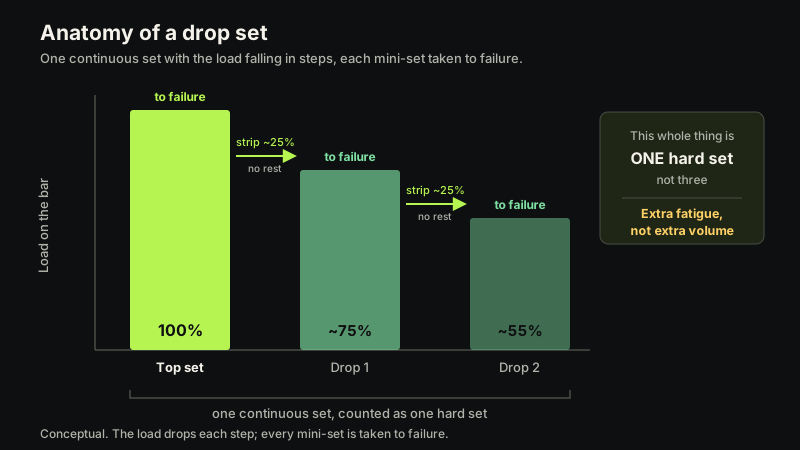
A drop set is a single exercise performed as one continuous effort: you take a set to failure or close to it, immediately reduce the load, and keep going with little or no rest, then usually repeat the reduction once or twice more. The whole thing is one extended set with the weight falling in steps, not several separate sets with full rest between them.
A typical version drops the load by roughly 20 to 30 percent at each step. You will see it written as "10-10-10," which just means ten reps at the top weight, a drop, ten more, another drop, ten more, with the reps landing wherever failure lands rather than being fixed. The "3-3-3 rule" people ask about is the same idea with a different rep target, not a separate technique. The number of drops is the only real variable: one drop, two, or three.
It is worth separating a drop set from rest-pause, because lifters often lump them together. In a rest-pause set you keep the same load and take short rests to squeeze out more reps at that weight; myo-reps are a structured, higher-rep version of that same idea. In a drop set the load comes down and the reps continue almost immediately. Both extend a set past the first failure point; a drop set does it by making each mini-set easier so the muscle can keep working as it fatigues. One member of this family runs the opposite way: cluster sets break up the set to avoid failure, not chase it, which is why they belong in heavy strength work rather than as a hypertrophy finisher.
Do drop sets build more muscle?
This is the question the technique lives or dies on, and the honest answer is no, not more, but not less either.
A 2023 systematic review and meta-analysis pooled the controlled studies comparing drop sets against traditional straight sets and found no significant difference in muscle growth between them (a standardized mean difference of 0.155, with a confidence interval crossing zero). A more recent 2026 meta-analysis in Sports Medicine - Open reached the same verdict in plainer words: drop-set training "offers a time-efficient alternative" that yields "comparable long-term gains in muscle hypertrophy and strength." Comparable. Not superior.
What drop sets reliably do is save time. In the 2023 review, some drop-set protocols took half to one-third of the time of the matched straight-set work. The clearest single example is a six-week triceps study by Fink and colleagues, covered well in this Stronger by Science breakdown: one drop set to failure grew the triceps about as much as three straight sets, and the drop-set group finished training roughly 54 percent faster.
The mechanism is not mysterious. Growth is driven heavily by hard reps taken close to failure, the ones where fibers are firing at full recruitment because the muscle is fatigued. A drop set is a device for cramming more of those near-failure reps into one continuous burst. By dropping the load, you let a tired muscle keep reaching failure a few more times when it could no longer do so at the original weight. That is the same lever a normal set pulls, which is why the outcome is the same. If you want the underlying idea, the case for training near but not at failure is laid out in our reps in reserve guide. A drop set is just a way to keep hitting that zone as fatigue sets in.
So the framing that sells drop sets as a growth hack is backwards. They are not a way to get more out of a session. They are a way to get a similar amount out of a session in less time.
What a drop set actually costs
Nothing about a set gets extended past failure for free, and drop sets charge their bill in fatigue.
The 2026 meta-analysis that found equal growth also found that drop sets are meaningfully harder on you in the moment. They produced significantly higher ratings of perceived exertion (a large effect), higher blood lactate, and more neuromuscular fatigue, measured as bigger drops in jump height, peak force, and maximal contraction right after training. In short: the same muscle-building signal, delivered with a bigger recovery tax attached.
That tax is the whole reason a drop set is a finishing tool and not a training style. If you ran every exercise as a triple drop set, you would accumulate fatigue far faster than stimulus, and the later work in your session would suffer for it. This is the stimulus-to-fatigue ratio problem in a concentrated form: a drop set buys you a good chunk of stimulus, but it buys a lot of fatigue alongside it, so you want to spend it where the trade is worth it and nowhere else.
The head-to-head against normal straight sets comes out like this:
| Traditional straight sets | Drop set | |
|---|---|---|
| Muscle growth | Baseline | Comparable, not more |
| Time to complete | Longer | Up to half to a third less |
| Fatigue per set | Lower | Higher (perceived exertion, lactate, neuromuscular) |
| Best use | Your everyday working volume | A finisher on the last set of an exercise |
| Counts toward weekly volume as | One hard set each | One hard set total |
It also changes how you should think about failure. A normal working set left at 1 to 2 reps in reserve keeps the stimulus high while keeping the fatigue manageable, which is why a small buffer usually wins on most of your sets. A drop set deliberately throws that buffer away and drives repeatedly into failure. That is fine as an occasional choice on the right exercise. It is a poor default for a whole session, because failure taken again and again is exactly what your weekly plan is usually trying to ration.
Do the drops count as extra sets?
Here is the part almost no article addresses, and it is the part that actually corrupts your training log if you get it wrong.
When you finish that triple drop on the leg extension, how many hard sets did you just do? It is tempting to write it down as three, because you reached failure three times. That inflates your volume and quietly wrecks your bookkeeping. A drop set is not three independent hard sets. Each drop happens on an already-fatigued muscle at a reduced load, so the second and third mini-sets carry less mechanical tension than a fresh set at a real working weight would. Counting them as three full sets tells your weekly total you did more effective work than you did.
The conservative way to account for it is to treat a drop set as roughly one hard set for volume purposes, perhaps a touch more, but nowhere near the number of times you actually hit failure. If you are tracking weekly volume by muscle, a triple drop on quads counts as one quad set on your tally, not three. The same undercount applies to any same-muscle chain, which is why a four-exercise giant set is not four hard sets either. Otherwise your log will say you are running twenty sets a week when the honest, effective number is closer to fourteen, and every progression decision you make from that number inherits the error.
This matters most when you are deciding how many sets a session can actually hold. A drop set is a way to add near-failure stimulus without adding much to your set count, which is genuinely useful when you are near your per-session ceiling and want one more hard effort without stacking on two or three more full sets of fatigue. Read that way, a drop set is a volume-efficient tool, as long as you count it honestly. The same bookkeeping care applies to pyramid sets versus straight sets, where the light early sets can pad your total from the other direction, and to counting supersets honestly, where pairing two exercises tempts you to log a same-muscle pair as two clean sets when it was closer to one and a bit.
How to program a drop set
Used deliberately, a drop set is a clean way to add intensity to the end of an exercise. Used everywhere, it is a fatigue generator. A few rules keep it on the right side of that line.
- Only on the last set of an exercise. The drops leave the muscle too fatigued to do quality work afterward, so a drop set that is not your final set of that movement sabotages the sets that follow it.
- Drop the load 20 to 30 percent per step. Enough to let a fatigued muscle keep reaching failure, not so much that the reps become endurance filler. One to three drops is plenty; past that you are training a pump, not a stimulus.
- Pick exercises you can fail safely. Machines, cables, and single-joint isolation work (leg extensions, lateral raises, curls, pushdowns, machine presses) are ideal, because you can hit failure and change load instantly with no spotter and no bar to bail. Save it for those, not for free-weight squats or bench, where repeated failure is a safety problem.
- Use it sparingly. One or two exercises per session at most, and not on every session. It is a seasoning, not the meal.
- Skip it when you are managing fatigue. During a deload or the back half of a hard training block, the extra recovery cost is the last thing you want. Drop sets belong in accumulation weeks when you have recovery capacity to spend.
A worked example on a single exercise looks like this:
| Step | Load | Reps | Rest before next step |
|---|---|---|---|
| Top set | 100% (your normal working weight) | To ~1 RIR or failure | ~0 seconds |
| Drop 1 | ~75% | To failure | ~0 seconds |
| Drop 2 | ~55% | To failure | Done |
Three trips to failure, one continuous effort, maybe forty seconds of total work. On your log, that is one hard set for the target muscle, performed as a drop set, not three.
How to log a drop set without lying to your log
A drop set only helps if your record survives it. The common failure is entering it as three normal sets, which double- or triple-counts the volume and hides the fact that the load was falling. Six weeks later your log says you were progressing when you were mostly just adding drops, and you cannot tell the productive weeks from the padded ones.
The fix is to record a drop set as what it is: one set of an exercise, run as a final-set intensity technique, with the effort noted honestly. This is where a logbook built for the way lifters actually train earns its place. In RIRLift you program a drop set (or a rest-pause finisher) as a final-set technique on the exercise itself, instead of faking a stack of straight sets, so it counts as one hard set toward your weekly volume rather than inflating the total. You log the effort on the top portion of the set the same way you log any set, so the intensity is visible without pretending each drop was a fresh working set.
The practical mechanics matter too, because a drop set is a race against rest. The point is to reduce the load and keep going with almost no pause, which is hard to do while you fumble with your phone. Running the session from your wrist keeps your hands on the weight and your head in the set; the full workflow is built so logging a set and moving to the next load is a tap or a turn of the Digital Crown, and the rest timer knows the difference between a real rest and the near-zero gap inside a drop set. The record stays honest and you never break the technique to keep it.
Everything you log this way also feeds the number that actually decides whether the drop set earned its spot: your effective weekly volume, counted once per drop set, not once per drop. If a movement keeps progressing with a drop set finisher and your fatigue stays manageable, keep it. If your logged effort is drifting and recovery is slipping, the drop sets are the first thing to cut, and an honest log is the only thing that will tell you which it is.
The honest verdict on drop sets
A drop set is a scalpel, not a hammer. It matches straight sets for growth while taking less time, at the price of more fatigue per set, which makes it a good finisher on isolation and machine work and a bad idea as a way of life. Do not expect extra muscle from the suffering, do not run it on your heavy compounds, and above all do not let it triple-count in your log.
Treat it as one honest hard set that happens to hurt more than most, place it where recovery allows, and record it as such. Slowing your reps down and chasing a pump feels productive for the same reason a drop set does, and time under tension turns out to be a proxy for effort rather than a driver of it. The same lesson applies here. Judge a drop set by what your log says it did over a block, not by how much it burned on the day.