
Blog
Myo-reps for hypertrophy: do they work, and how to log them
Published July 27, 2026 · updated September 23, 2026 · 17 min read
You take the lateral raise to the point where a clean rep is no longer happening, and instead of setting the dumbbells down, you count five deep breaths and go again. Three reps, five more breaths, three reps, five more breaths, until you cannot get three anymore. Ninety seconds of work with the same little dumbbells, a burn that runs from your delts to your teeth, and you walk away certain that has to count for more than a normal set.
That is a myo-rep set: one hard activation set taken close to failure, then a string of short, breath-paced mini-sets at the same load until you can no longer hit the target reps. The feeling it gives you is exactly why it gets oversold. Myo-reps cram a lot of near-failure reps into a short window with almost no rest, so they burn, they pump, and they feel like a shortcut to extra growth. The research tells a quieter story. The useful version of this technique lives in the gap between how a myo-rep set feels and what it actually does to your weekly total.
What are myo-reps?
Myo-reps are a rest-pause technique: you perform one hard "activation" set close to failure, then take repeated short rests and squeeze out small clusters of reps at the same load until you can no longer hit the target. The Norwegian coach Borge Fagerli popularized the method in the mid-2000s as a way to reach a lot of stimulating reps without doing several full sets with long rests between them.
The standard protocol is simple once you see the shape of it. Pick a load you can take for a moderate to high number of reps, run the activation set to roughly 1 to 2 reps in reserve, then rest only long enough to recover a few reps and continue in short bursts.
| Part of the set | What you do | Typical numbers |
|---|---|---|
| Activation set | One set to near failure at a light-to-moderate load | 12 to 20 reps, stop at about 1 to 2 RIR |
| Rest | Just long enough to buy back a few reps | 20 to 30 seconds (3 to 5 deep breaths) |
| Mini-sets | Small clusters at the same load, repeated | 3 to 5 reps each |
| When to stop | When the load, and your fatigue, wins | When you can no longer hit the target reps |
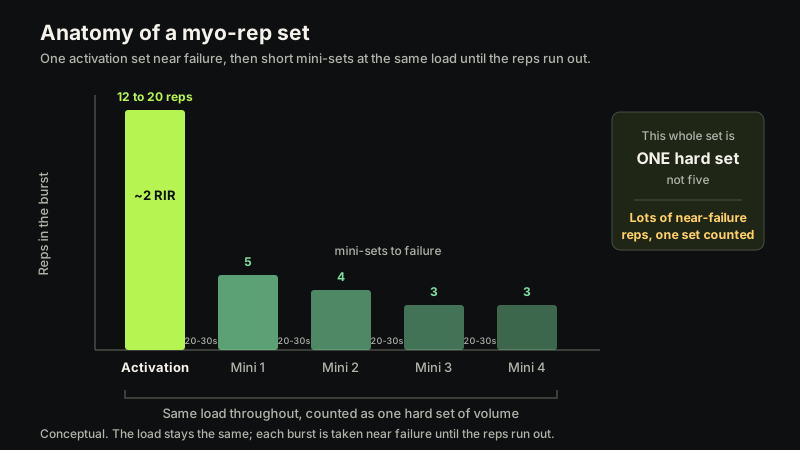
The activation set does the real work of fatiguing the muscle and getting you close to failure. The mini-sets keep you parked in that near-failure zone, letting a tired muscle keep reaching failure a few reps at a time instead of resting all the way back to fresh. Because the activation set decides how hard the whole thing is, getting that first set to a genuine 1 to 2 RIR matters more than the exact number of mini-sets that follow. If you are unsure how to read that buffer, our reps in reserve guide covers how to judge it honestly.
How to do a myo-rep set, step by step
- Pick a light-to-moderate load you can take for 12 to 20 clean reps. Use it on isolation or machine work, lateral raises, curls, leg extensions, or cable presses, never a heavy compound where fatigue makes failure unsafe.
- Run the activation set to about 1 to 2 RIR. This first set does the real work of fatiguing the muscle. Stop when a clean rep is one or two away, judged by effort rather than by a fixed rep count.
- Rest 20 to 30 seconds. Long enough to buy back a few reps, short enough to keep the muscle near failure. Three to five deep breaths is the field version.
- Do a mini-set of 3 to 5 reps at the same load, then rest again. Repeat the short rest and the small cluster, staying parked in the near-failure zone.
- Stop when the clusters fall apart. When you can no longer hit the target reps, usually after three to five mini-sets, the set is done. If you are still clearing five reps on the fifth cluster, the activation load was too light; add weight next time.
The whole sequence, the activation set plus its mini-sets, is one hard set, not five. That single fact is where most myo-rep logging goes wrong, and much of the rest of this guide is about getting it right.
Do myo-reps build more muscle?
This is the claim the technique lives or dies on, and the honest answer is no, not more, but not less either.
The cleanest test to date is a 2026 study in the Journal of Strength and Conditioning Research by Bradshaw and colleagues. Twenty-two resistance-trained men trained flat and incline barbell bench press and a seated cable fly twice a week for eight weeks, one group with traditional straight sets and one group with myo-reps. Both groups saw statistically significant gains in muscle size and strength, with no significant difference between them. The myo-rep group got there while performing about 30 percent less total volume load, in significantly shorter sessions. A separate acute test in the same paper found no difference in muscle activation or bar speed between the two styles.
So the picture matches what we already see with other intensity techniques. Myo-reps are not a growth hack. They are a way to reach a similar amount of growth in less time and with less total tonnage, which is a real benefit if your bottleneck is the clock rather than the stimulus.
The usual explanation is the "effective reps" idea: that the reps closest to failure, where recruitment is highest, are the ones that drive growth, so a myo-rep set stacks up more of those per minute. That story is intuitive, and it is roughly how the technique earns its keep. It is also worth holding loosely. Stronger by Science has argued that the evidence for the effective-reps model is thinner than it sounds, and that proximity to failure matters without the tidy rep-counting mechanism being settled science. The practical takeaway survives either way: take the set close enough to failure and the growth follows, whether you deliver those reps as one long set or as an activation set plus clusters.
What myo-reps actually cost
Nothing about extending a set past its first failure point comes for free, and myo-reps charge their bill in fatigue and in the quality of your effort read.
The metabolic cost is obvious the first time you try them: high burn, high breathlessness, and a muscle that is thoroughly cooked by the last cluster. That is a lot of local fatigue for one exercise, which is the whole reason myo-reps are a tool for one or two movements late in a session, not a way to run your entire workout. Chain them across every exercise and you accumulate fatigue faster than stimulus, and the later work in your session pays for it. That is the stimulus-to-fatigue tradeoff in a concentrated form.
The subtler cost is that myo-reps make your effort harder to read. On a normal set you can gauge how many reps you had left. Across a string of breath-paced mini-sets, every cluster feels maximal, so a self-reported RIR on the back end means less than it does on a clean straight set. This is a general truth about pushing repeatedly into failure, and it is why a small buffer usually beats grinding every set to zero: the buffer keeps both the stimulus high and the reading trustworthy. With myo-reps, anchor your effort judgment to the activation set, where the RIR call is still meaningful, and treat the mini-sets as bonus reps rather than data points.
This is also why the technique fits isolation and machine work far better than heavy compounds. The Bradshaw study used a cable fly and bench variations, and Barbell Medicine explicitly steers myo-reps toward supplemental lifts rather than your competition or priority movements. Taking a light lateral raise or leg extension to repeated failure is safe and easy to reload. Taking a heavy squat there is neither.
Myo-reps vs rest-pause and drop sets
Lifters lump these three together, and they are cousins, but the differences change how you program them. All three extend a set past the first failure point. They just do it in different ways.
| Technique | What changes between bursts | Load | Feels like |
|---|---|---|---|
| Rest-pause | Short rests (15 to 30s), same load | Unchanged | A heavy set broken into pieces |
| Myo-reps | Short rests (20 to 30s), same load, from a lighter activation set | Unchanged, lighter to start | Many small near-failure clusters |
| Drop set | No rest, load drops 20 to 30% each step | Falls each step | One continuous set with the weight melting |
Myo-reps are best understood as a structured, higher-rep form of rest-pause: you start lighter, take a defined activation set, and use fixed small clusters instead of grinding out whatever you can at a heavy weight. A drop set reaches the same "keep failing as fatigue builds" goal by cutting the load instead of resting. All three are finishers, all three trade extra fatigue for time savings, and, importantly, all three count the same way on your weekly tally. The one technique that looks identical on paper but works in reverse is the cluster set, which uses the same short intra-set rests to stay well short of failure instead of to keep reaching it. If you want to see the heavy rest-pause version scaled into a full routine, the DC training program is built almost entirely on it.
There is also a stricter cousin of the standard method, the myo-rep match. Instead of running fixed clusters until they fall below three reps, you treat the rep count from your activation set as a target and try to match it in later sets. Do the activation set to 1 to 2 RIR and note the number, then aim to hit that same number again in one go; if you cannot, rest 5 to 15 seconds and accumulate short mini-sets until you have matched the target. The point of the extra bookkeeping is a hard, repeatable stopping rule that pushes you to failure a few more times per exercise. For most lifters the plain version is enough; reach for the match only when you want a stricter progression target and are logging the reps closely enough to hold yourself to it.
Do the mini-sets count as extra sets?
Here is the part almost no myo-rep article addresses, and it is the part that quietly corrupts your training log.
When you finish a myo-rep set with an activation set and four mini-sets, how many hard sets did you just do? You reached failure five times, so it is tempting to write down five. That inflates your volume and wrecks your bookkeeping. A myo-rep set is not five independent hard sets. Every mini-set happens on an already-fatigued muscle at a light load, so it carries far less mechanical tension than a fresh working set would. Counting each cluster as a full set tells your weekly total you did several times more effective work than you actually did.
The conservative way to account for it is to treat the whole myo-rep sequence as roughly one hard set, maybe a touch more, for weekly volume purposes. A myo-rep set on side delts counts as one delt set on your tally, not five. Get this wrong and your log will claim 25 sets a week for a muscle when the honest, effective number is closer to 12, and every progression call you make from that inflated number inherits the error.
Read the right way, that is exactly what makes myo-reps useful. They are a way to add a big dose of near-failure stimulus to a muscle without adding much to your set count, which is genuinely handy when you are near your per-session ceiling and want one more hard effort without stacking on several full sets of fatigue. The same honest-counting discipline applies to drop sets and to pairing exercises in a superset: the technique helps only if the number it leaves in your log is true.
How to program myo-reps
Used deliberately, a myo-rep set is a clean way to buy a lot of stimulus in a short window. Used everywhere, it is a fatigue machine. A few rules keep it on the right side of that line.
- Save them for isolation and machine work. Lateral raises, leg extensions, curls, pushdowns, leg curls, and cable or machine presses let you fail safely and continue instantly. Keep them off heavy free-weight squats, deadlifts, and bench.
- Run the activation set to 1 to 2 RIR, not to a rep count. The effort target is what matters. A load you can take for about 12 to 20 reps before that buffer usually lands in the right zone.
- Rest only 20 to 30 seconds between clusters. Long enough to buy back 3 to 5 reps, short enough to keep the muscle near failure. Counting 3 to 5 breaths is the field-expedient version.
- Stop when the clusters shrink. When you can no longer hit your target reps (often around the fourth or fifth mini-set), the set is done. If you are still hitting 5 reps for five clusters straight, the activation load was too light; add weight next time.
- Use them on one or two exercises, not the whole session. They are a finisher on the last movement or two, not a training style. The rest between your normal working sets exists for a reason; myo-reps deliberately remove it, so spend that cost sparingly.
- Pull them during a deload or the back half of a hard block. The extra recovery tax is the last thing you want when you are already managing fatigue.
A worked example on a single exercise looks like this:
| Step | Load | Reps | Rest before next step |
|---|---|---|---|
| Activation set | Your ~15-rep weight | To ~1 to 2 RIR (about 12 to 20 reps) | 20 to 30 seconds |
| Mini-set 1 | Same | 3 to 5 | 20 to 30 seconds |
| Mini-set 2 | Same | 3 to 5 | 20 to 30 seconds |
| Mini-set 3 | Same | 3 to 5 | 20 to 30 seconds |
| Mini-set 4 | Same | Whatever you get (stop under 3) | Done |
For a concrete case, take a dumbbell lateral raise. Pick a weight you can press for about 15 clean reps, run the activation set to a 1 RIR finish at those 15 reps, rest five breaths, then work mini-sets of 5, 4, 3, and 3, stopping the moment you can no longer clear three. That whole sequence is one myo-rep set.
Four or five trips to failure, one to two minutes of total work, and on your log it is one hard set for the target muscle, run as a myo-rep set, not five.
How to log myo-reps without inflating your volume
A myo-rep set only helps if your record survives it, and the record is where this technique usually goes wrong. Enter it as five straight sets and you double or triple your counted volume while hiding the fact that four of those "sets" were 3-rep clusters at a light load. Six weeks later your log says a muscle is drowning in volume when the effective number is a fraction of that, and you cannot tell the productive weeks from the padded ones.
The fix is to record a myo-rep set as what it is: one set of an exercise, run as a final-set intensity technique, with the effort noted on the activation set. This is where a logbook built for how lifters actually train earns its place. In RIRLift you program a rest-pause or myo-rep finisher as a final-set technique on the exercise itself instead of faking a stack of straight sets, so it counts as one hard set toward your weekly volume by muscle rather than inflating the tally. You log the activation set's load, reps, and RIR the way you log any set, so the intensity is visible without pretending each cluster was a fresh working set.
The mechanics matter too, because a myo-rep set is a race against a 20-second clock. You cannot recover reps and fumble with a phone at the same time. Running the whole session from your wrist keeps your hands near the weight and your head in the set. The full workflow is built so confirming a set is a tap or a turn of the Digital Crown, and the rest timer can tell the difference between a real rest and the near-zero gap inside a cluster. The record stays honest and you never break the technique to keep it.
All of that feeds the one number that decides whether a myo-rep set earned its spot: your effective weekly volume, counted once per myo-rep set, not once per cluster. If an exercise keeps progressing with a myo-rep finisher and your recovery holds, keep it. If your logged effort is drifting and fatigue is piling up, the myo-reps are the first thing to cut, and only an honest log will tell you which.
Frequently asked questions about myo-reps
What is a myo-rep? A myo-rep is a rest-pause set: one activation set taken to roughly 1 to 2 reps in reserve, then repeated short rests of 20 to 30 seconds with small 3 to 5 rep clusters at the same load, continued until you can no longer hit the target reps. The whole sequence is one hard set, not several.
Are myo-reps effective? Yes, for their actual purpose, which is efficiency rather than extra growth. The cleanest trial to date matched myo-reps against straight sets for muscle and strength gains while the myo-rep group did about 30 percent less total volume load in shorter sessions. They build a similar amount of muscle in less time, not more muscle.
Can you give me an example of a myo-rep set? On a dumbbell lateral raise, pick a weight good for about 15 clean reps, take the activation set to a 1 RIR finish at 15, rest five breaths, then do clusters of 5, 4, 3, and 3, stopping when you cannot clear three. That is one myo-rep set on side delts, and it counts as one set on your weekly tally.
How many sets of myo-reps should I do? Keep them to one or two myo-rep sets per exercise, on only one or two isolation or machine movements late in a session. They are a finisher, not a training style; because each set carries a heavy fatigue cost, stacking them across a whole workout accumulates fatigue faster than stimulus.
What is a myo-rep match? A stricter variant where the reps you hit on the activation set become a target you try to match on later sets, resting 5 to 15 seconds and accumulating mini-sets until you reach that number. It pushes you to failure a few more times per exercise at the price of more bookkeeping; the standard version is enough for most lifters.
The honest verdict on myo-reps
A myo-rep set is a scalpel, not a hammer. It matches straight sets for growth while taking less time and less total load, at the price of more fatigue and a noisier effort read, which makes it a strong finisher on isolation and machine work and a poor way to run a whole session. Do not expect extra muscle from the burn, do not put it on your heavy compounds, and above all do not let it count as five sets in your log.
Treat a myo-rep set as one honest hard set that happens to deliver a lot of near-failure reps, place it where your recovery can afford it, and record it as such. Like every intensity technique, judge it by what your log says it did across a block, not by how much it burned on the day.