
Blog
Cluster sets: do they build muscle, and how do they count?
Published August 15, 2026 · updated September 22, 2026 · 17 min read
You load the bar with a weight you would normally get five hard reps with. You do three, rack it, and stand there. Twenty seconds later you unrack and do three more. Rack, wait, three more. Nine reps at a load you could not have touched for nine straight, and the last rep of the last cluster moved about as well as the first.
That is a cluster set, and it feels like cheating in the best way. The bar speed stays honest, your technique does not fall apart, and you walk away having handled a heavy weight for real reps instead of grinding out a sloppy set. The obvious next thought is that all of this must be great for building muscle too.
That is the part worth slowing down on. Cluster sets are one of the few techniques in this family that run in the opposite direction from the rest. Drop sets, myo-reps, and rest-pause sets use short rests to keep you at failure. Cluster sets use short rests to keep you away from it. That single inversion changes what they are good for, and it changes how the set should count on your weekly tally.
What are cluster sets?
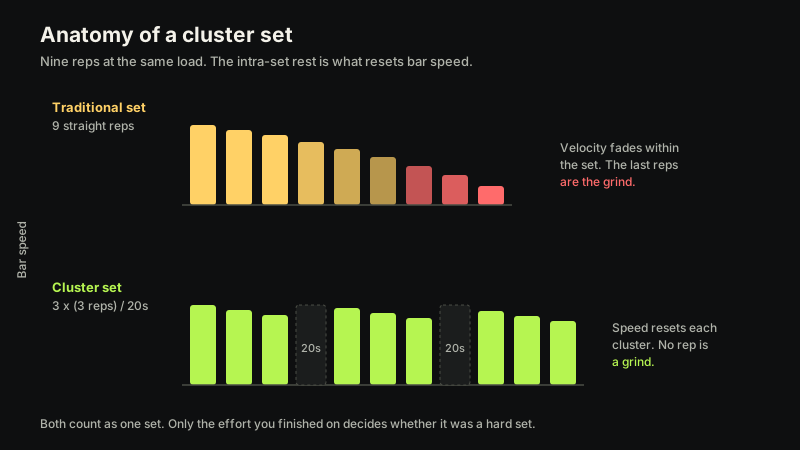
A cluster set is one set broken into smaller mini-sets separated by short intra-set rest periods, usually 10 to 40 seconds, with the full rest period taken only after all the mini-sets are done. Instead of nine continuous reps, you perform three mini-sets of three, resting briefly between each, and treat the whole thing as one set in your program.
The notation you will see in a program looks like 3 x (3 x 3) / 20s, which reads as three cluster sets, each made of three mini-sets of three reps, with 20 seconds of intra-set rest.
| Part of the set | What you do | Typical numbers |
|---|---|---|
| Mini-set (the "cluster") | A small group of reps at a heavy load | 2 to 5 reps |
| Intra-set rest | Rack the weight, stay at the station, breathe | 10 to 40 seconds |
| Repeat | Same load, same rep target | 2 to 4 mini-sets |
| Full rest | Only after the last mini-set | 2 to 3 minutes |
| Load | Heavier than you could use for the same total reps straight | Often 80 to 90% of 1RM |
The variation you will also run into is rest redistribution, which keeps the total rest for an exercise the same and just chops it up differently. Three sets of six with three minutes between them becomes six sets of three with about 70 seconds between them. Same reps, same load, same total rest, spread thinner and more often. It is the same idea as a cluster set with the accounting done from the other end.
Both are set-structure tools. Neither adds reps, load, or exercises to your session. They only move the rest around, which is exactly why their effects are narrower than the technique's reputation suggests. If you want the general case for how rest length protects the quality of what follows, we covered how long to rest between sets separately.
What intra-set rest actually changes
Twenty seconds is not enough to recover. It is enough to partially restock phosphocreatine, clear a little of the metabolite buildup, and let the nervous system reset before the next effort. That is a small window, and it buys one specific thing: force output on the next rep.
In a normal heavy set of nine, rep one is fast and rep nine is a grind. Fatigue accumulates within the set, velocity drops off, and the last reps happen with degraded technique at a lower speed. Break that same nine reps into three clusters and every mini-set starts from a partially restored state, so rep nine looks a lot more like rep one.
This is the best-established finding on the technique. A 2020 systematic review and meta-analysis in Sports Medicine by Jukic and colleagues pooled the acute evidence on cluster and rest-redistribution structures and found they preserve movement velocity and power output, and produce lower blood lactate and lower perceived exertion, compared to traditional sets with the same work.
Read that list again, because it is the whole story of the technique. Higher velocity, less metabolic stress, less perceived effort. Those are excellent properties if your goal is to move fast and lift heavy without frying yourself. They are a mixed bag if your goal is to grow, because "less perceived effort" for the same reps means you finished further from failure than you would have otherwise.
Do cluster sets build more muscle?
No. When effort is matched, they build about the same amount, and the technique's honest selling point is what it does to fatigue, not to growth.
The cleanest test comes from a 2025 study in the European Journal of Applied Physiology by Vargas-Molina and colleagues, which is notable for what it fixed. Most earlier cluster-set research matched volume load (sets times reps times weight) between conditions, which quietly stacks the deck: to hit the same tonnage, the traditional-set group ends up doing fewer reps, and fewer reps near failure is a weaker growth stimulus. That is a confound, not a finding.
This study matched effort instead. Ten resistance-trained participants trained leg press and leg extension twice a week for eight weeks, with both conditions taken to 0 to 1 reps in reserve. The cluster group did 3 clusters of 4 reps with 20 seconds of intra-set rest. The traditional group did 5 sets of 12. Rectus femoris thickness went up 0.24 cm in the cluster group and 0.17 cm in the traditional group, and there was no statistically significant difference between conditions. Lean tissue mass told the same story in the other direction, 171.8 g versus 201.1 g, again with no significant difference.
Ten people is a small sample and one study is not a literature, so hold the specific numbers loosely. The direction, though, matches everything else we know: set structure is not the lever. Effort and weekly volume are.
Strength is the same story over a longer horizon. A 2025 meta-analysis in Frontiers in Physiology by Cui and colleagues pooled 21 articles and 583 participants and found no significant overall difference between cluster training and traditional training for maximal strength (SMD = 0.10, 95% CI -0.14 to 0.33). Cluster structures looked slightly better over 4 to 8 week blocks and worse over 9 to 12 weeks, which is roughly what you would expect from a tool that manages fatigue well in the short run and accumulates a little less stimulus in the long run.
Why clusters help strength and power more than size
The mechanism that makes cluster sets useful is also the mechanism that caps their hypertrophy value, and it is worth being precise about why.
Growth is driven by high tension in the target muscle across enough reps, and the reps that generate that tension reliably are the ones near failure, when fatigue has forced full motor unit recruitment. That is why the load on the bar is not the same as the tension on the muscle. A fast, fresh, technically perfect rep at 85% of 1RM is a wonderful rep for a powerlifter or an athlete. For hypertrophy it is a warm-up rep with a heavy weight on it.
Cluster sets systematically produce more of those reps. By resetting fatigue every few reps, they let you accumulate heavy, high-quality, high-velocity work while spending less time in the fatigued end of the set where the growth stimulus concentrates. That is a feature when you want to practise a movement fast and heavy. It is a leak when you want to grow.
This is why the technique earns a permanent place in strength and power work:
- Technique under load. Heavy triples with clean bar speed beat a heavy set of eight where the last three reps drift.
- Velocity work. If you train for rate of force development, fatigue is the enemy of the whole session.
- High-skill lifts. Olympic variations, heavy squats, and anything where a fatigued rep is a risky rep.
- Sneaking in heavy volume. More total reps at 85% than you could manage straight, without the fatigue bill.
And why it is a lateral move for size. If you are deciding where each of these belongs in your week, the split between training for size versus training for strength is the useful frame: clusters slot into the strength side by default, and have to be deliberately modified to serve the other one.
Cluster sets vs myo-reps, rest-pause, and drop sets
These four get lumped together as "techniques where you break up a set," and that grouping hides the thing that actually matters. Three of them chase failure. One runs from it.
| Technique | Intra-set rest | Load | Where the set ends | Primary use |
|---|---|---|---|---|
| Cluster set | 10 to 40s | Heavy, unchanged | Well short of failure | Strength, power, technique |
| Rest-pause | 15 to 30s | Heavy, unchanged | At failure, repeatedly | Hypertrophy finisher |
| Myo-reps | 20 to 30s | Lighter, unchanged | At failure, repeatedly | Hypertrophy in less time |
| Drop set | None | Falls 20 to 30% each step | Past failure, repeatedly | Hypertrophy finisher |
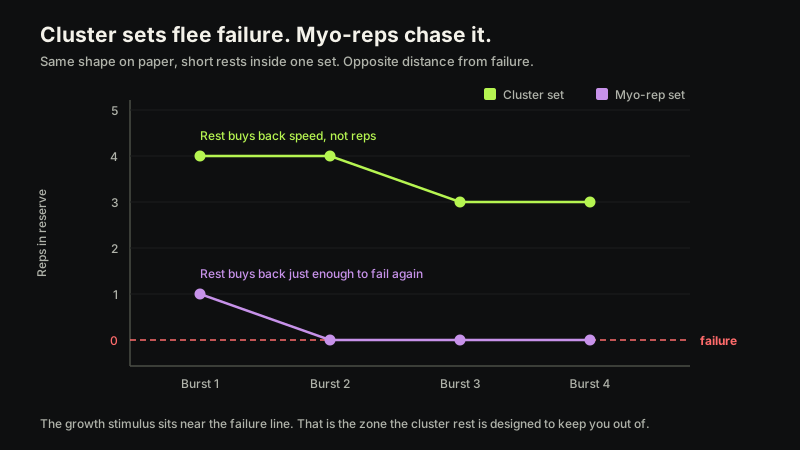
The confusion with myo-reps is the most common one, and it is understandable: both are a set chopped into small bursts with 20 to 30 second gaps. But a myo-rep set starts with an activation set taken to about 1 to 2 RIR and uses the short rests to buy back just enough capacity to keep reaching failure again. A cluster set starts fresh and uses the short rests to make sure you never get there. Same shape on paper, opposite intent, opposite result.
A drop set sits at the far end: no rest at all, load cut instead, failure reached over and over. If your goal is a hypertrophy finisher, that family is what you want. If your goal is clean heavy reps, clusters are.
Does a cluster set count as one hard set?
This is where the technique quietly distorts a training log, and the answer is a conditional one:
- One hard set, if the cluster finished near failure. If your last mini-set ended at 1 to 2 RIR, you did the work. Count it as one hard set for the muscle, the same way you would count a myo-rep set or a drop set as one.
- Not a hard set at all, if it finished fresh. A cluster of three triples at 85% that ended with four good reps still in the tank is quality strength work, and it is not a growth stimulus you should be adding to a weekly hypertrophy total.
- Never three sets. The mini-sets are not sets.
3 x (3 x 3)is three sets, not nine, no matter how it is written.
That middle case is the one that matters, because it is the default way the technique is used. The whole point of the classic cluster protocol is to stay far from failure, which means the honest entry in your log for most cluster work is "heavy, easy, good speed," not "hard set for quads."
Counting those as hard sets is how a program starts looking productive on paper while stalling in the mirror. You add three cluster sets of squats, your weekly quad total reads 18 instead of 15, and none of the three extra sets got close enough to failure to contribute anything. It is a cousin of sets that add fatigue without stimulus, with a twist: cluster sets are not even especially fatiguing, so they do not announce themselves. They just sit in the total, inflating it.
The fix is not to stop doing them. It is to record the effort, not just the structure, so you can tell later which category the set landed in. If reading your own buffer is the shaky part, how to judge that buffer honestly is the skill this all rests on.
How to program cluster sets
Use them where fatigue is the limiting factor and quality reps are the goal. Keep them off the exercises where you are trying to accumulate growth stimulus.
| Goal | Protocol | Load | Intra-set rest | Notes |
|---|---|---|---|---|
| Strength, heavy compounds | 3 to 5 x (3 x 2) | 85 to 90% 1RM | 20 to 30s | Stop well short of failure. Bar speed is the readout. |
| Power and velocity | 3 to 4 x (4 x 2) | 60 to 75% 1RM | 20 to 40s | Every rep intentionally fast. |
| Technique under fatigue | 3 x (3 x 3) | 75 to 85% 1RM | 15 to 20s | Useful after a form breakdown shows up in your log. |
| Hypertrophy (the modified version) | 2 to 3 x (3 x 4) | Load allowing 0 to 1 RIR on the last mini-set | 20s | The only version with hypertrophy evidence behind it. |
A few practical rules that keep the technique honest:
- Pick the exercise deliberately. Clusters belong on your main barbell lifts, where fatigue costs technique. On a leg extension there is nothing to protect; just do a normal set.
- Time the rest, do not estimate it. Twenty seconds feels like forty when you are breathing hard. Drifting to a minute turns your cluster set into three straight sets with short rests, which is a different (and more fatiguing) thing entirely.
- Stay at the station. Racking the bar and wandering off defeats the point.
- Do not stack them with a hypertrophy block's peak volume. Clusters are a fatigue-management tool. Adding them on top of an already-high weekly total is the wrong problem to solve.
- If you want growth from them, take the last mini-set close to failure. That is the Vargas-Molina protocol, and it is the only cluster configuration the hypertrophy evidence actually supports.
- Use them on one or two lifts a session, not the whole workout. Clusters belong on the lift where fatigue is the constraint, usually your main barbell compound. Once or twice a week on a given movement is plenty. Spreading them across every exercise turns a short intra-set rest habit into a much longer session for no extra stimulus, which is the drawback every ranking guide names and the reason to keep them targeted.
Cluster set examples: three sessions you can copy
A protocol table is abstract until you put real numbers on it, so here are three worked cluster sets, each aimed at a different goal. Read the RIR column as the honest answer to how the set should count, and pair it with the load logic in the programming table above.
| Session | Notation | Load | Intra-set rest | What it looks like | Log it as |
|---|---|---|---|---|---|
| Heavy squat, strength | 4 x (3 x 2) | ~87% 1RM (a weight you get 5 straight) | 25s | Four cluster sets, each 6 reps in three fast doubles; rack, breathe, repeat | 4 sets, ~3 RIR, heavy practice not quad volume |
| Weighted pull-ups, skill and strength | 1 x (5 x 2) | Bodyweight + a load you get ~6 straight | 20s | Ten clean reps in five crisp doubles instead of a set that turns into a grind at rep six | 1 set, ~2 RIR |
| Leg press, the hypertrophy version | 3 x (3 x 4) | A weight you would normally get 12 straight | 20s | Three cluster sets of 12, each in three quartets, last mini-set taken to the edge | 3 hard sets, 0 to 1 RIR |
The first two are the classic use: heavy, fast, well short of failure, so they build strength and protect technique but do not belong in a weekly hypertrophy tally. The third is the only one that does, because the last mini-set actually reaches failure. That single difference, visible in the RIR column and nowhere in the notation, is the whole reason the same set structure can be strength work or growth work depending on how it finishes.
The pull-up example is worth calling out, because clusters solve a specific bodyweight problem: a straight set of weighted pull-ups falls apart in the back half, and cutting it into doubles keeps every rep clean at a load you could not otherwise handle for the same total.
How to log cluster sets honestly
The logging problem with clusters is real and most apps handle it badly. Log nine reps at 85% as a single set and your future self reads it as a set of nine, which you cannot do. Log it as three sets of three and your weekly volume triples for a technique that may not have produced any growth stimulus at all.
What you actually need to preserve is three things: the load, the total reps, and how close the thing finished to failure. The structure is context; the effort is the data.
In RIRLift, the practical approach is to log the cluster as one set at the working load with the total reps, and record the RIR you finished on. The whole set-logging flow is built around that third number, so an honest entry takes the same tap as any other set: confirm the set from your wrist with the load and reps pre-filled from last time, then dial the RIR to what actually happened on the final mini-set. Two seconds, and the record is true.
The payoff shows up weeks later. Because RIRLift rolls your logged sets into weekly hard sets per muscle, a cluster set that finished at 4 RIR reads exactly as what it was, which is heavy practice rather than growth work. When your quad volume looks high but your quad growth does not, the log will tell you why instead of leaving you to guess. That is the difference between a workout diary and something you can reason from.
The honest verdict on cluster sets
Cluster sets are a genuinely good tool aimed at a goal most people reading about them do not have. They preserve bar speed, protect technique, cut perceived effort, and let you handle heavy loads for more total reps than you otherwise could. For strength, power, and skill work, that is worth having in the toolbox.
For hypertrophy, they are neutral. Matched for effort they grow about as much muscle as straight sets, and used the classic way, far from failure to keep every rep fast, they grow less, because the reps that drive growth are exactly the ones the intra-set rest is designed to prevent you from reaching.
So use them on your heavy compounds when quality is the constraint. Skip them when accumulating stimulus is the goal. And whichever way you use them, log the effort rather than the structure, because a cluster set that ended at 4 RIR and a cluster set that ended at 0 RIR are two different sets wearing the same notation, and only one of them belongs in your weekly total.