
Blog
Mechanical tension: what actually builds muscle
Published July 28, 2026 · updated September 2, 2026 · 15 min read
Two lifters finish the same machine chest press on the same afternoon. One pushed 40 kilos for 15 reps and stopped when the fifteenth rep slowed to a crawl. The other pushed 80 kilos for 6 and racked it with about one clean rep left. Twice the load, less than half the reps, and over a training block both of them add a similar amount of muscle.
Every hypertrophy article explains that outcome with the same sentence: mechanical tension is the primary driver of muscle growth. Then most of them mistranslate it in the very next paragraph, into "so lift heavy." That translation is where the concept stops being useful, because the weight on the bar and the tension on the fibers are not the same quantity, and the gap between them is exactly where lifters lose progress.
Mechanical tension is worth understanding properly, because it explains why the rep range matters less than you think, why the last reps of a set do the work, and why a heavier weight through half a range of motion can be a downgrade. It also comes with an awkward catch: you cannot measure it. What you can do is train in a way that reliably produces it and keep a record honest enough to tell you whether you did.
What is mechanical tension?
Mechanical tension is the force a muscle fiber experiences while it is generating force against resistance. It is produced by the muscle, not delivered by the dumbbell. The load is just the thing the muscle has to push against.
Two factors decide how much tension a working muscle actually experiences:
- How many motor units are recruited. A fiber under no command produces no force. Recruitment climbs as a set gets harder, so more of the muscle ends up doing real work in the later reps.
- How much force each recruited fiber produces. This is governed by the force-velocity relationship: a fiber shortening quickly produces less force than one shortening slowly. Fast, easy reps generate less tension per fiber than the grinding ones at the end of a set.
Put those together and you get the practical version. High tension across a lot of the muscle happens when most of the fibers are recruited and moving slowly, which is a fairly precise description of the last few reps of a hard set. That is why a Reddit answer summarizing mechanical tension as "your muscle's proximity to failure" is closer to useful than most of the polished articles ranking above it.
The framing comes from Brad Schoenfeld's 2010 review of hypertrophy mechanisms, which proposed three candidate drivers: mechanical tension, muscle damage, and metabolic stress. Fifteen years of follow-up work has been unkind to two of the three, and generous to tension. The reason tension holds up is mechanistic. The fiber senses mechanical load through a process called mechanotransduction and converts it into the intracellular signals, the mTOR pathway chief among them, that switch on muscle protein synthesis. The burn and the soreness are not what those sensors read, which is the first hint that they were never the main event.
Why heavy weight is not the same as high tension
Here is the part the supplement blogs get wrong. Several of the pages currently ranking for this term define mechanical tension as lifting roughly 80 to 90 percent of your one-rep max for 3 to 5 reps. If that were true, the 15-rep lifter in the opening should have grown noticeably less than the 6-rep lifter. They do not.
The best evidence on this is a systematic review and meta-analysis of low-load versus high-load training by Schoenfeld and colleagues. Pooling the available trials, muscle growth was similar whether people trained with light loads or heavy ones. Maximal strength was a different story and clearly favored heavier training, which makes sense because strength is partly a skill at a given load. The important caveat is that the low-load groups in these studies generally took their sets to or very near failure. Light weights are not magic. Light weights taken close to failure are equivalent.
That result only looks strange if you think the barbell supplies the tension. Once you accept that the muscle supplies it, the picture resolves. A heavy set starts at high recruitment, so it delivers high-tension reps almost immediately. A light set starts easy and has to work its way there, spending its early reps building the fatigue that forces full recruitment. Both arrive at the same destination. The light set just takes a longer road, with more junk mileage on the way.
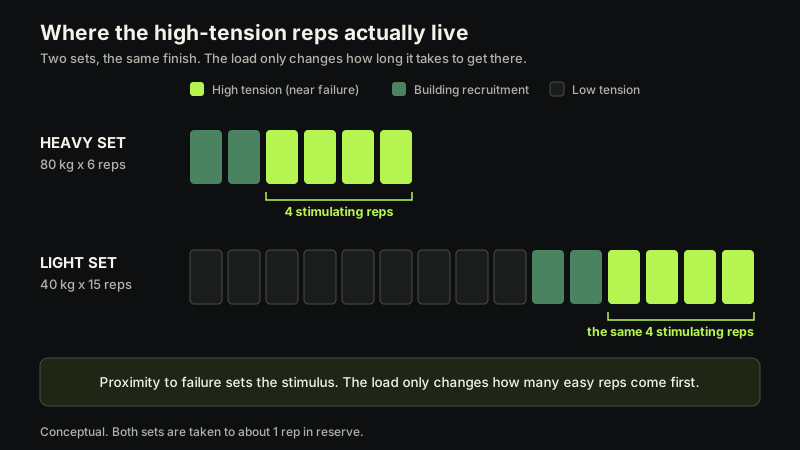
This is the single most useful consequence of understanding tension properly: the stimulating reps in any set are the ones near the end of it. It is why which rep range to train in is a much smaller decision than lifters treat it as, and why how hard each set should be is a much bigger one. Load selection changes how many reps you spend getting to the productive part. Proximity to failure decides whether you arrive at all.
It also explains a mistake you can watch happen in any gym. Somebody adds 20 kilos to the leg press and quietly cuts the range of motion in half to move it. The load went up, the tension on the working muscle across the range it can actually be loaded in went down, and the log will record it as progress.
Mechanical tension vs metabolic stress and muscle damage
The 2010 paper proposed three mechanisms, and lifters still talk about all three as if they carry equal weight. They do not, and the way each one has aged is a useful sanity check on training advice you read.
| Mechanism | What it claims | Where the evidence stands now |
|---|---|---|
| Mechanical tension | Force on the fibers, driven by recruitment and per-fiber force, signals the muscle to grow | The primary driver. Most researchers now treat the other two as, at best, contributors that work by increasing tension |
| Metabolic stress | The burn: accumulated metabolites from hard, continuous work independently stimulate growth | Downgraded to a probable indirect effect. Metabolite build-up causes fatigue, fatigue forces recruitment, recruitment raises tension. The pump is a passenger, not the engine |
| Muscle damage | Micro-tears from training trigger repair and growth | Largely abandoned as a driver. Damage now looks like a cost of unfamiliar training rather than a growth signal, which is consistent with the fact that you keep progressing long after soreness stops |
That table is also a decent filter for training fads. Anything sold on burn, soreness, or novelty is arguing from the two weak mechanisms. It is the same weak-mechanism thinking that props up the sarcoplasmic versus myofibrillar pathway myth: the pump does not route growth into a separate "size" compartment, because tension is still what drives the adaptation. This is precisely why time under tension is a proxy for effort, not a driver of growth. Seconds under load correlate with tension only because slow, hard reps take longer. Chase the clock directly, by deliberately slowing everything down, and you cut the load you can use without any guarantee of raising tension where it counts.
How to increase mechanical tension
None of this leads anywhere exotic. The practical instructions for maximizing tension are boring, which is a good sign that the theory is right.
- Take working sets close to failure. This is the lever. Most evidence-based guidance lands around 0 to 3 reps in reserve for the bulk of your hard sets, with the tighter end reserved for exercises you can push safely. Below that buffer the returns flatten and the fatigue bill climbs.
- Use a full range of motion, especially the stretched position. A muscle under load at long lengths is a well-supported way to accumulate tension across the whole muscle, because the stretch adds passive tension, the force a loaded muscle carries simply from being lengthened, on top of the active tension it produces by contracting. Half reps with more weight are usually a trade down, though the picture changes when the half you keep is the stretched one: see what lengthened partials actually do.
- Control the lowering phase, but do not perform it. Two to three seconds of controlled eccentric keeps tension on the muscle. Five-second negatives on everything just cost you reps and load.
- Pick exercises where you can actually push. Machines, cables, and stable free-weight movements let you approach failure without your balance or lower back becoming the limiting factor. A set that ends because you got wobbly ended before the target muscle was done.
- Progress the load or reps over time. Tension is relative to what the muscle can currently produce. A weight that used to demand near-maximal recruitment eventually stops doing so, which is the entire argument for progressive overload.
- Do not confuse pace with tension. Short rests, drop sets, and metabolite-heavy finishers raise the burn and lower the load you can handle on the next set. They have a place, but they are not tension maximizers.
Notice what is absent: a magic rep range, a required tempo, and any instruction that involves counting seconds. That absence is also the honest answer to whether feeling the muscle actually builds it: an internal focus can help point the tension at the right muscle on isolation work, but the feeling is a cue for aiming the stimulus, not the thing that creates it.
How much mechanical tension is enough?
If tension drives growth, more tension should mean more growth, and up to a point it does. The limit is recovery. High-tension sets are the expensive ones, and you can only produce so many of them per week before the later ones stop being high-tension at all.
That is the honest reframe of weekly volume. Your set target is not really a count of sets. It is a count of sets you were able to take near failure with good execution, which is what how many sets per week for growth actually means when it talks about hard sets. A tenth set for a muscle at the end of a long session, performed with a load you can no longer drive and an effort you can no longer read, is not producing the thing you are training for.
This is which sets stopped counting in mechanistic terms. Junk volume is not a mystery: it is sets that failed to reach the high-tension zone because the muscle, or the lifter, was already spent. They still cost recovery. They just do not buy anything with it.
The practical shape that falls out of this is a moderate number of hard sets per muscle per week, spread across sessions so each one gets a genuine effort, rather than a heroic pile of sets in one session where the last third are tension-free.
You cannot measure tension, so measure its proxies
Here is the awkward truth that no article on this topic seems willing to state plainly: you have no way to measure mechanical tension while you train. There is no wearable for it. There is no number on a screen. It is a physiological quantity happening inside your muscle fibers, and every practical training decision has to be made from proxies.
The proxies are not mysterious, but only two of them are any good.
| Proxy | How well it tracks tension | Why |
|---|---|---|
| Proximity to failure (RIR) | Good | Directly reflects recruitment and rep speed, the two things that set tension |
| Weekly hard sets per muscle | Good | Counts how many times you reached the productive zone |
| Load on the bar | Poor on its own | Says nothing about how hard the set was for you today |
| Time under tension | Poor | Correlates only because hard reps are slow reps |
| Soreness and pump | Poor | Track the two downgraded mechanisms |
Which means the whole of this article reduces to two numbers worth writing down: how close to failure each set was, and how many such sets each muscle got this week. Everything else on that list is either downstream of those two or noise.
That is a logging problem, and most lifting apps make a mess of it because they record load and reps and treat effort as an afterthought. RIRLift is built the other way around. You set a target RIR per exercise when you build the routine, then log actual load, reps, and RIR for every set while the set is still fresh, so your effort record is a measurement rather than a memory. Those logged efforts roll up into weekly volume by muscle, which turns the abstract question "am I generating enough tension for my back?" into a number you can look at on a Sunday.
Logging effort only works if capturing it does not interrupt the set, which is why the whole session runs from your wrist. Values pre-fill from last time, so confirming a set is a tap or a turn of the Digital Crown, and the rest timer starts itself. See how a session runs from your wrist and the pattern is clear: the numbers go in where your attention already is, and nothing about recording an honest RIR requires you to break the set you just finished.
The payoff comes a block later. A planned 2 RIR that keeps landing at 4 says you have been leaving tension on the table and should add load. A string of 0 RIR sets alongside stalling reps says the opposite. If you are new to reading that buffer, the guide on how to judge that buffer honestly is the place to start, because a proxy is only as good as your calibration on it.
One caveat worth keeping: the tidy mental model where you count individual "effective reps" near failure is more popular than it is proven. Stronger by Science has argued that the evidence for the effective-reps model is thinner than it sounds. The broad claim survives the criticism, since proximity to failure clearly matters. The precise rep-by-rep accounting does not need to be true for the training advice to hold.
The honest verdict on mechanical tension
Mechanical tension is the real driver of muscle growth, and the phrase is worth keeping. What is not worth keeping is the conclusion most people attach to it. Tension is not the weight on the bar, it is not the burn, and it is not the seconds your set lasted. It is force the muscle produces, and it peaks when a large fraction of the muscle is recruited and grinding.
So train with a load you can handle in full range, take your working sets close enough to failure that the last reps are genuinely slow, accumulate a sensible number of those sets per muscle per week, and add load or reps over time. That is the entire prescription, and it has been the entire prescription for a long time. The mechanism just explains why it works.
Then write down the two things that actually proxy for tension. A log full of loads and reps tells you what you lifted. A log that also carries an honest RIR for every set, totalled by muscle across the week, tells you whether any of it was hard enough to matter.
Frequently asked questions about mechanical tension
What is mechanical tension in simple terms?
It is the force your muscle fibers produce while working against a resistance, not the weight on the bar itself. Tension is highest when a large fraction of the muscle is recruited and the fibers are shortening slowly, which is a precise description of the last few hard reps of a set.
What does mechanical tension feel like?
Like a rep that has slowed down and taken real effort to finish while your form still holds. The early reps of a set feel easy because tension is low. The reps where bar speed drops and you have to grind are the high-tension ones, and how many of those you reach is set by how close to failure you take the set.
What is the difference between active and passive tension?
Active tension is force the muscle generates by contracting against the load. Passive tension is force created by stretching a loaded muscle, carried largely by the structural protein titin, and it peaks in the lengthened position at the bottom of a rep. Both contribute, which is why a full range of motion that loads the stretch matters and why chopping range to add weight usually trades tension away.
Is mechanical tension the same as time under tension?
No, and treating them as the same is a common mistake. Time under tension is only how long a set lasts. It tracks tension loosely because hard, slow reps take longer, so deliberately slowing every rep to run up the clock cuts the load you can use without any guarantee of more tension where it counts. The seconds are a symptom of hard reps, not the cause of growth.
Do muscles grow from mechanical tension alone?
Tension is the primary driver, but growth still needs enough hard sets to add up and enough recovery to repeat them. One high-tension set produces little on its own, and piling on sets past the point where you can drive them hard just adds fatigue. The target is a sensible number of high-tension sets per muscle per week, recovered well enough to keep producing them.
What kills muscle gains the most?
Training so far from failure that your sets never reach the high-tension zone, and burying the real work under junk volume, sets so late in a fatigued session that you can no longer drive them. Both feel like training and neither builds much. The fix is the same: fewer, harder sets you can actually push, logged honestly so you can see which ones counted.