
Blog
The best rep range for muscle growth is a range
Published July 12, 2026 · 10 min read
Ask "what is the best rep range for muscle growth" and you want one number back. Eight to twelve, probably, because that is what every chart has said for thirty years. The honest answer is less tidy and more useful: the best rep range for muscle growth is a wide band, roughly 5 to 30 reps, and which slice of it you train in matters far less than how hard you take the set.
That is not a dodge. It is one of the more freeing things to learn about training for size. Once you stop hunting for a magic number, the real levers become obvious: pick a range that fits the exercise, take the set close enough to failure to count, and add reps or load over time. Whether you frame it as the best rep range or simply how many reps for muscle growth, the answer runs through effort. This post gives you the range, the reasoning, and a way to pick your own by movement, then shows how to make sure each set actually earns its place.
What is the best rep range for muscle growth?
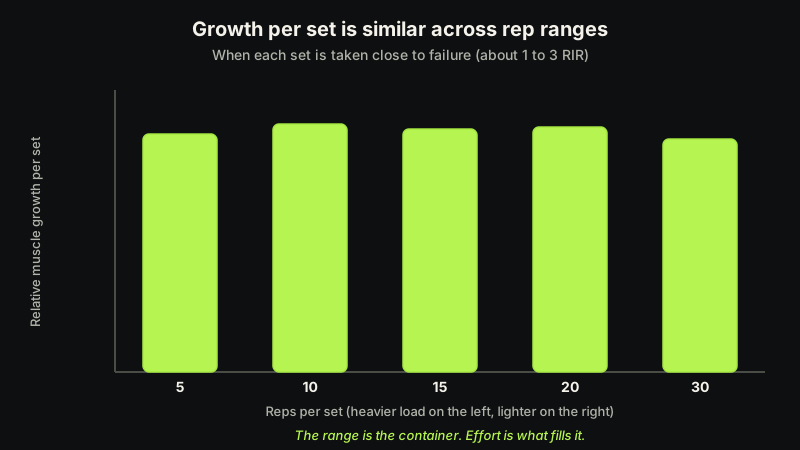
For most lifters, 6 to 12 reps is a sensible default, but muscle grows across a much wider range: roughly 5 to 30 reps when the set is taken close to failure. Heavier sets (5 to 8) and lighter sets (15 to 20 plus) build muscle about as well as the classic middle, as long as effort is high. The old "hypertrophy zone" is a good starting point, not a boundary.
The evidence here is fairly settled. A widely cited re-examination of the repetition continuum concluded that similar muscle growth occurs across a wide spectrum of loads when sets are taken near failure, and that the classic 8 to 12 zone is best read as a practical, time-efficient default rather than a uniquely anabolic range (Schoenfeld et al., 2021). Practical summaries reach the same place: Stronger by Science on the hypertrophy rep range concludes that anywhere from about 5 to 30 reps produces similar growth per set taken near failure. So the "best" range is less a target and more a menu.
Why the rep range matters less than you think
If 8 reps and 20 reps grow a muscle about equally, then the number on the bar is not the thing doing the work. Proximity to failure is. A set of 10 stopped four reps early is a fraction of the stimulus of the same set taken to within a rep or two of failure. The range is just the container. Effort is the contents. It is also why the old belief that low reps and high reps build two different kinds of muscle, the sarcoplasmic versus myofibrillar hypertrophy story, does not survive a training log: both grow from the same effort across the range. It is the same reason the heavy weight versus light weight debate resolves the way it does. The clock tells the same story: whether slowing your reps down builds muscle comes back to effort, not the seconds a set takes.
This is where reps in reserve earns its keep. RIR counts backward from failure, so a set you log at 2 RIR, which is exactly what RIRLift records for every set, means you believe you had about two clean reps left. It is the same effort scale whether you are doing 6 reps of a heavy row or 20 reps of a cable curl (the same effort you may have seen written as an RPE score), which is exactly why it travels across rep ranges better than load alone. Two lifters can both "do 12 reps" and get completely different results because one stopped at a hard 12 and the other stopped at a comfortable one.
So the useful question is not "which rep range is optimal" but "am I taking these sets hard enough for the range to matter." For most working sets, that means finishing around 1 to 3 RIR. Chase zero on everything and the fatigue cost usually outruns the extra stimulus, a tradeoff we covered in how hard each set should be.
Rep ranges by goal and exercise
The wide band splits into practical zones. The rep ranges for hypertrophy, strength, and endurance overlap more than the old charts imply, and effort still decides which one grows muscle. Use this as a map, not a rulebook.
| Goal / use | Rep range | Rough load (%1RM) | Best-fit lifts | Notes |
|---|---|---|---|---|
| Strength, heavy compounds | 1 to 5 | 85% and up | Squat, deadlift, bench, weighted pulls | Builds muscle, but needs more sets to match the volume of moderate work; taxing on joints and focus |
| Hypertrophy sweet spot | 6 to 12 | ~70 to 85% | Most barbell, dumbbell, and machine compounds | The efficient middle: enough load to matter, enough reps to accumulate volume, easy to recover from |
| Hypertrophy, higher rep | 12 to 20 | ~60 to 70% | Machines, single-joint accessories, unilateral work | Same growth when hard; lighter on the joints, so useful for high-volume muscles |
| Metabolite, pump, isolation | 15 to 30 | ~50 to 65% | Curls, extensions, lateral raises, cable work | Grows muscle if taken very close to failure; the last reps are uncomfortable, which is the point |
Two things fall out of this table. First, "best rep range for strength" and "best rep range for hypertrophy" are different questions: strength lives at the heavy end (1 to 5), muscle grows across the whole thing. Second, the higher you go in reps, the closer to failure you have to train for the set to count, because the early reps of a set of 25 are nowhere near hard. The heavy end also demands more recovery between efforts, one reason how long to rest between sets shifts with the load you pick.
How to pick your rep range per exercise
You do not train every lift in one range. Match the range to the movement, and the choice mostly makes itself. The reason they sit in different ranges comes back to how compound and isolation exercises load a muscle differently: compounds carry heavy loads across many muscles, while isolations concentrate a lighter load on one.
- Heavy compounds go lower. Squats, deadlifts, presses, and weighted pulls are where you can load safely and progress on the bar. Train most of them in roughly 5 to 10 reps. This is also where progressive overload is easiest to see, because adding a rep or a small plate is unambiguous.
- Most hypertrophy work sits in the middle. Machine presses, rows, hack squats, and the bulk of your accessory compounds do well in 8 to 15. Enough load to drive tension, enough reps to bank volume without grinding your joints.
- Isolations and joint-sensitive movements go higher. Lateral raises, curls, leg extensions, and cable work belong in 12 to 20 plus. Loading a lateral raise like a deadlift turns it into a shrug, beats up the shoulder, and misses the delt. Higher reps let you take these to failure safely.
A worked example: on chest day you might run an incline press for 3 sets of 6 to 10, a machine press for 3 sets of 10 to 15, and a cable fly for 2 sets of 15 to 20. Three exercises, three ranges, one muscle, and every set taken to about 1 to 2 RIR. That covers the spectrum without any of it being a guess. If you are unsure how many movements to run in the first place, we walk through that in how many exercises per muscle group.
The rep range only works if the set is hard
Here is the part the charts leave out. A rep range is a promise you only keep by taking the set close to failure. Pick 8 to 12 and stop at 5 RIR every time and you will grow slowly no matter how "optimal" the range looks on paper. This is why counting reps without tracking effort is half a measurement.
It is also why the range and your volume are linked. A hard set is the unit you count when you tally weekly training volume, and a set only counts as hard if it was actually near failure. Ten sloppy sets at 5 RIR are not ten hard sets; they are closer to warm-ups you paid recovery for. Get the effort right and a surprisingly small number of genuine hard sets, spread across a couple of sessions, does the job.
So the full picture is three decisions, in order: choose a range that fits the exercise, take each set to about 1 to 3 RIR, then progress within the range by adding reps before load. Miss the middle decision and the other two do not matter.
How RIRLift makes your rep range honest
The catch is that effort is easy to intend and easy to fudge from memory. You will swear that set of 12 was a hard 12. Your logbook, if it captured effort, might disagree.
That is the gap RIRLift is built to close. When you build a routine on iPhone, you set a target rep range and a target RIR for each exercise. Then on Apple Watch, during the set, you log the actual load, reps, and RIR while it is fresh, in a tap or a turn of the Digital Crown. Because effort is recorded live, a planned 2 RIR that came in at 4 is visible: it tells you to add load or push harder next time, instead of quietly stalling for a month. RIRLift also totals your hard sets by muscle across the week, so you can see whether your rep-range choices are actually adding up to enough stimulus. You can see how a session runs from your wrist, or how the weekly review turns each logged set into volume by muscle.
That is the honest version of "the best rep range for muscle growth." Pick a range that suits the lift, take the set close enough to failure to count, log what actually happened, and progress from real numbers instead of a good feeling.
FAQ
Is 3 sets of 12 reps enough to build muscle?
It can be, if the sets are hard and you do enough of them across the week. Three sets of 12 taken to 1 to 2 RIR is a real stimulus, especially if the muscle is trained twice a week. What matters is not the 3x12 but whether those sets are close to failure and your weekly total lands in a productive range.
What is the best rep range for strength versus hypertrophy?
Strength lives at the heavy end, roughly 1 to 5 reps at high load, because it trains force production. Muscle grows across a much wider band, about 5 to 30 reps, as long as sets are near failure. For both, anchor your compounds at 5 to 8 reps and fill in volume with moderate and higher-rep accessory work. If you are weighing the two goals against each other, we go deeper in how training for size and strength differ.
Do higher reps build muscle as well as lower reps?
Yes, when taken close to failure. Sets of 20 grow muscle about as well as sets of 8 in most studies, provided effort is high. The practical difference is that lighter, higher-rep sets are easier on the joints but more uncomfortable near failure, while heavier, lower-rep sets are joint-taxing but progress cleanly on the bar. Use both, matched to the exercise.