
Blog
What is RPE in lifting? The effort scale, explained
Published July 18, 2026 · 12 min read
Open almost any modern training program and you will find sets prescribed like this: 3 sets of 5 at RPE 8. Not a percentage of your max, not "go heavy," but a target for how hard the set should feel. RPE has quietly become the default language for prescribing effort, and for good reason. It travels across exercises, it bends to how you feel on the day, and it does not need a fresh 1RM test to work. When you do want the number, you can estimate a one-rep max from a set you already did instead of working up to a true single.
It also has a problem the charts never mention. Two lifters can do the exact same set and rate it differently. The same lifter rates a set higher when tired than when fresh, and higher on an exercise they hate than one they love. RPE is genuinely useful and genuinely noisy at the same time, and most explainers only tell you about the first half.
This post covers both halves: what RPE means, what each number on the scale stands for, how it maps onto reps in reserve, when to trust it, and the practical question underneath it all, which effort measure to log for every set.
What is RPE in lifting?
RPE stands for rating of perceived exertion. In lifting, it is a rating from 1 to 10 of how hard a set felt, where 10 means an all-out set with nothing left and lower numbers mean more in the tank.
The modern strength version is anchored to reps: your RPE is set by how many more reps you believe you could have done. An RPE 8 set means you think you had about two clean reps left.
That reps-based anchor is what separates the lifting scale from the vague "rate your effort" version. It gives the number something concrete to attach to instead of leaving it a pure gut feeling.
Where RPE came from
The idea started outside the weight room. Rating of perceived exertion was developed by the Swedish researcher Gunnar Borg for endurance work, originally as a 6 to 20 scale meant to track roughly with heart rate. If you have ever seen an RPE chart on a treadmill or in a cardiac-rehab handout, that is the lineage. The Cleveland Clinic's overview of the RPE scale still describes this general-exercise version.
Borg's scale was never a great fit for lifting, where a hard set of five is over in fifteen seconds and heart rate tells you almost nothing. So strength researchers adapted it. In 2016, Zourdos and colleagues published a resistance-training-specific RPE scale built on repetitions in reserve, pinning the top of the scale to a specific number of reps left in the tank. That is the version serious lifters mean today, and it is the one worth learning.
The RPE scale from 1 to 10
Because the lifting scale is anchored to reps in reserve, you can read it directly as "reps left." Strength training mostly lives in the top of the scale, from about 6 to 10, because sets much easier than that contribute far less per set for a trained lifter.
| RPE | Reps in reserve | What it feels like |
|---|---|---|
| 10 | 0 | Maximal. Nothing left. A missed rep if you tried one more. |
| 9.5 | 0 | No more reps at this load, but you could have gone slightly heavier. |
| 9 | 1 | One clean rep left. Bar speed has clearly slowed. |
| 8 | 2 | Two reps left. Hard, but rep quality is still good. |
| 7 | 3 | Three reps left. Moving well, working but not near the edge. |
| 6 | 4 | Four reps left. A committed warm-up feel; speed is fast. |
| 5 and below | 5+ | Warm-up and technique work. Little growth stimulus. |
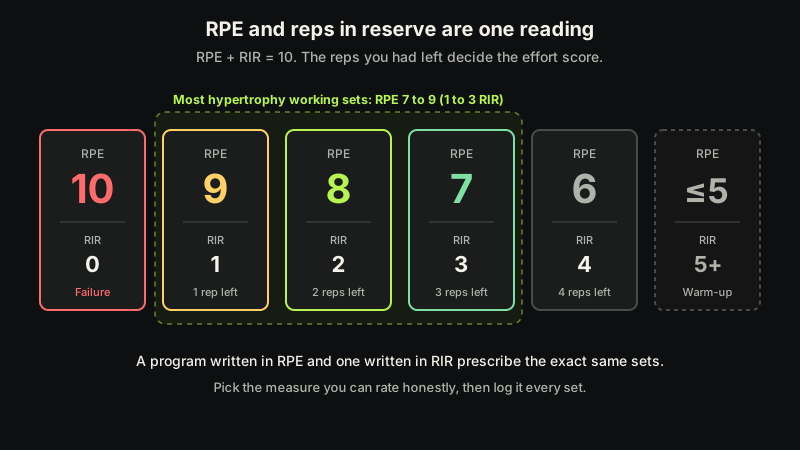
Read the right two columns together and the whole scale collapses into one sentence: your RPE is ten minus the number of reps you had left. That is not a coincidence, and it is the single most useful thing to understand about RPE.
RPE vs RIR: the same information in two languages
Reps in reserve (RIR) is the number of reps you believe you could still have completed with good form at the end of a set. RPE, in the lifting sense, is just that same information written as an effort score. Across the working range, the two translate cleanly:
RPE = 10 minus RIR.
An RPE 8 is 2 RIR. An RPE 9 is 1 RIR. An RPE 10 is 0 RIR, which is failure. They are not competing systems. They are two dials showing the same reading, and any program written in one can be rewritten in the other without losing anything. If you want the two placed side by side, with the one spot they genuinely differ and a note on when to use each, we cover that in a full RPE vs RIR comparison. And if RIR is new to you, our guide to reps in reserve covers how to estimate it honestly, which is the skill both scales actually depend on.
So why does the difference matter at all? Because one of the two is easier to be honest about. "Two reps left" is a countable claim. You can check it: every so often, take a comparable set all the way to failure and see whether the reps you thought you had left really matched your estimate. "RPE 8" is a rating you assign to a sensation. For most lifters, counting reps left is a more concrete question than scoring a feeling, which is why the reps-in-reserve framing tends to be the more reliable of the two to record. We come back to that at the end.
Why lifters use RPE: autoregulation
The reason RPE spread from powerlifting into hypertrophy programming is autoregulation, which is a formal word for a simple habit: let the day set the weight.
A percentage-based program tells you to squat 80 percent of your max for 5 reps, full stop, whether you slept four hours or nine. An RPE-based program tells you to squat a 5-rep set at RPE 8, and lets the load float. On a strong day, RPE 8 for five might be a heavier bar than usual. On a beaten-up day, it is lighter, and you have automatically pulled back the exact right amount instead of grinding a fixed number into the ground. Helms and colleagues laid out how to apply the RIR-based RPE scale for resistance training with this use in mind.
This is also how effort is supposed to move across a training block. Early sessions sit lighter, at 3 to 4 RIR, and the same RPE target creeps to heavier loads as you accumulate fitness, before a deload resets it. That week-to-week logic is the heart of how you autoregulate across a training block, and RPE is the unit that makes it portable from one exercise to the next.
Why RPE is noisy (the part the charts skip)
Here is the honest caveat almost no explainer includes: RPE is a subjective estimate, and subjective estimates have error bars.
The error is not random, either. It runs in predictable directions:
- Beginners overshoot. New lifters routinely call a set RPE 9 when they had several reps left. It genuinely felt maximal, because everything does when the movement is new. Reading proximity to failure is a learned skill: in the 2016 scale study, experienced squatters rated a true one-rep max closer to RPE 10 than novices did.
- Accuracy improves closer to failure. People are much better at telling 1 rep left from 2 than at telling 4 from 5. The far end of the scale, RPE 6 and below, is where estimates get the loosest.
- Everything feels harder when you are tired. Late in a session, or deep in a hard training week, a given RPE drifts to a lighter true load. That is partly the point of autoregulation, but it also means your RPE ratings are only as steady as your ability to read fatigue.
None of this makes RPE useless. It makes it a skill. The fix is calibration: train close enough to failure often enough that you learn what one, two, and three reps left actually feel like, then check your calls against reality. This is the same reason we argue that how hard each set should be is a question you answer with logged data, not memory. An estimate you never verify does not get better; it just gets more confident.
What RPE to train at for hypertrophy vs strength
The right RPE target depends on what you are training for, but the useful ranges are narrower than the full scale suggests.
| Goal | Typical RPE | Reps in reserve | Why |
|---|---|---|---|
| Hypertrophy (most working sets) | 7 to 9 | 1 to 3 | Close enough to failure to drive growth without wrecking recovery. |
| Strength (main lifts) | 8 to 9+ | 0 to 2 | Heavier loads, fewer reps, high effort on the money sets. |
| Technique / speed work | 5 to 7 | 3 to 5+ | Move well, groove the pattern, keep fatigue low. |
For building muscle, most evidence-based guidance lands on keeping the bulk of your working sets around 1 to 3 RIR, which is RPE 7 to 9. That is close enough to failure that the reps count, with enough of a buffer that you can repeat the work across the week and actually recover from it. Notice that the RPE number is doing less of the work here than the effort behind it. As we cover in why the rep range matters less than the effort, a set of 8 and a set of 15 can both grow muscle if both are taken to a similar proximity to failure. RPE is how you keep that proximity honest across very different rep schemes.
Strength work generally runs a touch higher on the top sets, because expressing a maximal-ish effort is part of the adaptation. But even there, living at RPE 10 on everything is a fast route to accumulated fatigue with little extra return. The heavier loads and longer rest are part of a wider set of tradeoffs when you are training for strength versus size.
Should you log RPE or RIR?
If they carry the same information, does it matter which one you write down? In practice, yes, a little, and it comes down to which question you can answer more honestly under a loaded bar.
Logging RPE asks you to score a feeling on a 1 to 10 scale. Logging RIR asks you to name a number of reps you had left. Most lifters find the second question more concrete, because it points at something countable rather than a sensation, and a more concrete question produces a steadier record over time.
That steadier record is what makes the difference weeks later, when you are trying to read your own training. A plain log of load and reps cannot tell you whether a session got easier or you just added a rep, but a log of effort can, and it only helps if the effort numbers are consistent enough to trust. The same drift you can see across a long session, where the first sets hit target and the last ones sag, is only visible if you recorded effort honestly set by set.
This is the reasoning behind how RIRLift logs. You set a target RIR per exercise when you build a routine on your iPhone, then log actual load, reps, and RIR for every set from your Apple Watch, in the moment, with the values pre-filled from last time. RPE and RIR are the same reading, and the app records the concrete one. Over a block, that history becomes an effort-accuracy read: a planned 2 RIR that kept coming in at 4 says add load, and a string of 0 RIR says back off before the fatigue catches up with you. If you want to see the mechanics, here is how a session runs from your wrist.
What does RPE 7 mean?
RPE 7 means you had about three reps left in the tank at the end of the set, or 3 RIR. The weight is moving well and the set is clearly work, but you are not close to the edge. In a hypertrophy block it is a common target for earlier sets of an exercise or for the opening weeks of a block, before effort ramps toward RPE 8 and 9.
How do you calculate your RPE?
You do not calculate RPE from a formula; you estimate it at the end of the set by asking how many good reps you had left, then subtracting from 10. Two reps left is RPE 8, one rep left is RPE 9, none is RPE 10. The estimate gets more accurate the closer you are to failure and the more experience you have training near it, which is exactly why calibrating against a real log beats guessing from memory.
The number was never the point
RPE earned its place because it made effort portable. You can prescribe it, chase it across a dozen exercises, and adjust it to the day, all without a max test. That is real, and it is why it is worth understanding the scale and how it maps to reps in reserve.
But the scale is only as good as the honesty of the person reading it, and a rating you never check against reality drifts. Whether you speak in RPE or in reps in reserve, the thing that actually moves your training forward is a per-set record of effort you can trust weeks later. Pick the measure you can be most honest about, log it in the moment, and let the block of data tell you what one afternoon's feeling never could.