
Blog
How many sets per workout? Stop picking the number
Published July 17, 2026 · updated September 26, 2026 · 17 min read
Ask the internet how many sets you should do per workout and you get four confident answers that do not agree. Three to five sets per exercise. Twelve to eighteen sets per workout. Eleven sets per session and thirty-plus per week. Ten to twenty sets per week, total.
They cannot all be right, and the disagreement is not because one source did the research and the others did not. It is because the question is malformed. "How many sets per workout" sounds like it has an answer the way "how many reps in a set" has an answer. It does not. The per-session set count is not a number you pick off a chart. It is a number that falls out of two things you decide first, and then gets capped by something you can only see if you log it.
This post covers the actual math: how your weekly target and your training frequency produce the session number, what a set has to be before it counts in that math at all, and the honest tell for when a session has more sets than you can back up.
How many sets should you do per workout?
Most lifters land somewhere between 10 and 20 hard sets in a session, but that range is a description of where the math usually ends up, not a prescription to follow. The correct number for you is your weekly hard-set target per muscle, divided by how many times per week you train that muscle, summed across the muscles the session covers. Then you cut it back to the number of sets you can still do at your intended effort. Pick the week first and the session number writes itself.
The reason the internet gives four answers is that it is quietly answering three different questions with the same words. These are the numbers people conflate:
| What you are counting | Usual range | What it actually is |
|---|---|---|
| Sets per exercise | 3 to 5 | A rule of thumb for chopping up one muscle's allocation, not a target in itself |
| Hard sets per muscle, per session | 4 to 10 | The real per-session ceiling. Past this for one muscle in one session, the returns flatten |
| Hard sets per muscle, per week | 10 to 20 | The figure the volume research actually points at. Set this one first |
Add the per-muscle session numbers across the muscles a workout covers and you get a total sets-per-workout figure, usually somewhere from 12 to 20. That total is an output, not an input: you never pick it, you read it off the week.
Everything below is how to run that calculation and how to know when you got it wrong.
The per-session number is downstream of your week
Muscle grows in response to what you accumulate over a week, not what you cram into one afternoon. That is why almost every credible volume recommendation is expressed weekly. The dose-response research on training volume, summarized in Schoenfeld and Krieger's meta-analysis, points at a weekly figure per muscle, and mainstream guidance settles around 10 to 20 weekly hard sets per muscle for most intermediate lifters. Where you sit inside that band tracks training age: a newer lifter grows on the low end, around 10 to 15, and an advanced lifter who has stalled there can sometimes use more, but higher is a lever to earn with a stalled log, not a starting point. Our training volume for hypertrophy guide covers how to find your own number inside that range.
Once you have the weekly number, the session number is arithmetic:
Weekly hard sets per muscle ÷ sessions per week for that muscle = sets per session for that muscle.
Run it for every muscle the session touches and add them up. That total is your sets per workout.
Here is the same weekly target producing very different session numbers depending only on frequency:
| Weekly target (chest) | Sessions per week | Sets per session |
|---|---|---|
| 16 hard sets | 1 | 16 |
| 16 hard sets | 2 | 8 |
| 16 hard sets | 3 | 5 to 6 |
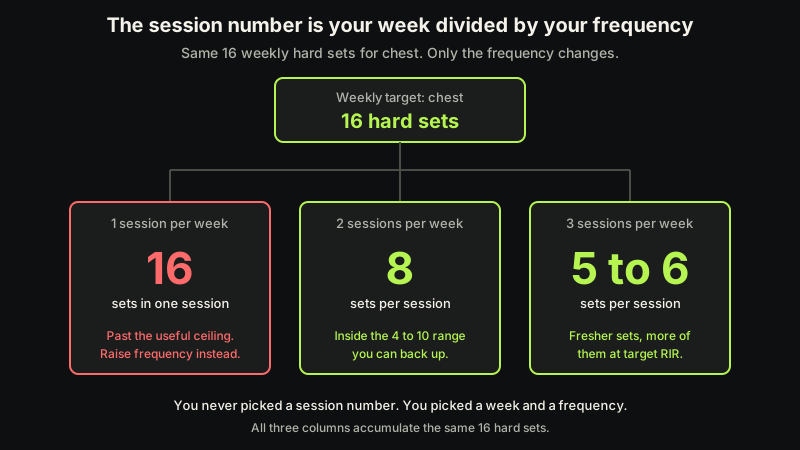
Nothing changed except how you sliced it. This is why the internet disagrees with itself: a full-body lifter training chest three times a week and a bro-split lifter hitting it once are both correct, and their session numbers differ by a factor of three. Neither number transfers to the other person.
It also explains the shape of a real session. A push day covering chest, shoulders, and triceps at 6, 5, and 4 sets lands at 15 sets. An upper day covering four or five muscles at 4 sets each lands in the same place from a completely different direction.
Run the same 10-to-20-weekly-sets-per-muscle plan through the common splits and the per-session totals cluster in the same place, because the split decides how the week is sliced, not how much work it holds:
| Split | Muscles a session covers | Typical hard sets per session |
|---|---|---|
| Full body, 3 days a week | Most major muscles, 2 to 4 sets each | 15 to 20 |
| Upper/lower, 4 days a week | 4 to 5 muscles, 4 to 6 sets each | 16 to 22 |
| Push/pull/legs, 6 days a week | 2 to 3 muscles, 5 to 7 sets each | 15 to 20 |
| Bro split, one muscle a day | 1 muscle, plus a little overlap | 12 to 20, but often past the per-muscle ceiling below |
The bro split is the row to watch. Twelve to twenty sets sounds normal until you notice they are almost all on one muscle in one session, which is exactly the case the ceiling further down rules out. Every other split spreads the same total across enough muscles that no single one gets overworked.
What counts as a hard set
The math above only works in one unit, and it is not "a set." It is a hard set: a set taken close enough to failure to actually drive growth, typically somewhere in the range of 0 to about 4 reps in reserve, with most working sets sitting around 1 to 3 RIR.
This matters more than it sounds. A set of 12 curls you stopped at 6 RIR because your phone buzzed is not a hard set. It cost you time and fatigue and contributed close to nothing. If you count it in your weekly total, your spreadsheet says 16 and your muscle experienced 11. You then wonder why 16 sets is not working and add more, which is exactly the wrong move.
If RIR is new to you, our guide to reps in reserve covers how to estimate it. The short version: RIR counts backward from failure, so 2 RIR means you believe you had about two clean reps left. Warmups do not count. Neither do the sets you drifted through. And a drop set is a single hard set, not one per load drop, no matter how many times you reach failure inside it. The same is true when a myo-rep set counts as one hard set, not one per mini-set. Pairing two moves changes nothing here either: how supersets count toward each muscle is one hard set per exercise, credited to its own muscle, not a bonus for sharing the rest.
The second constraint: sets you can still do well
The division gives you a target. Your body applies a cap, and the cap is real.
Sets late in a session are not the same as sets early in it. Fatigue accumulates, and the eighth set of chest work is measurably worse than the second: fewer reps at the same load, or the same reps at a much higher genuine effort. At some point you are adding sets that generate fatigue without adding much stimulus, which is the thing people mean by junk volume.
The problem is that junk volume is nearly invisible in a normal log. Look at a plain load-and-reps record and the sets often look fine:
| Set | Load | Reps | Looks like | Actual RIR |
|---|---|---|---|---|
| 1 | 80 kg | 10 | solid | 3 |
| 2 | 80 kg | 10 | solid | 2 |
| 3 | 80 kg | 9 | solid | 1 |
| 4 | 80 kg | 9 | solid | 0 |
| 5 | 80 kg | 8 | fine | 0, failed rep 9 |
| 6 | 80 kg | 8 | fine | 0, form broke |
Load and reps barely moved. Effort went through the floor and out the other side. Sets 5 and 6 are not extra stimulus; they are a tax on your next session and, if you keep it up across a block, on your recovery. Load and reps alone cannot tell you that, which is the core reason logging effort per set is not an optional nicety.
The reverse tell exists too, and it is the more useful one. If your last two sets are coming in at 4 or 5 RIR while the first three sat at 1, you are not fatigued, you are pacing. Those sets are padding. Cut them or add load.
One honest caveat: rest length changes this picture more than most people expect. Sets that decay fast might be a rest problem, not a volume problem, before they are anything else. How long you rest between sets is worth ruling out before you cut sets you did not need to cut.
A worked example
Take a lifter running an upper/lower split, four days a week. Chest, back, and shoulders each get trained twice a week on the two upper days.
Weekly targets: chest 16, back 18, shoulders 12, biceps 10, triceps 10.
Divide by 2 sessions:
| Muscle | Weekly target | Per upper session |
|---|---|---|
| Chest | 16 | 8 |
| Back | 18 | 9 |
| Shoulders | 12 | 6 |
| Biceps | 10 | 5 |
| Triceps | 10 | 5 |
| Session total | 33 |
Thirty-three hard sets. That is a long session, probably over two hours with honest rest, and the last third of it will be noticeably worse than the first. This is the point where the arithmetic tells you something useful: the plan is not wrong at the weekly level, it is wrong at the frequency level. Four days is not enough to spend that much volume well. The fix is not to grind out 33 sets. It is to raise frequency, which is really a question of which split you run: a third upper day, or a push/pull/legs structure. Or lower the weekly targets to what four days can actually hold.
That is the calculation working as designed. It surfaces an over-stuffed session before you spend six weeks failing to complete it.
The other half of the session number is how those sets spread across movements. Eight chest sets can be two exercises at four sets, or three at three, two, three. That choice has its own logic, which we cover in how many exercises per muscle group.
When your session number is too high
Four tells, roughly in order of how early they show up:
- Effort drifts across the session. Your first sets hit the target RIR and your last sets sit well above or below it. The set count outran your capacity.
- The last exercise never progresses. Everything at the top of the session creeps up over a block, and whatever you do last has looked the same for a month.
- Sessions get longer, not better. Two hours in the gym producing the same weekly progress as ninety minutes did.
- Fatigue outlasts the session. You come into the next workout for that muscle still not recovered, so those sets are worse too, and the problem compounds.
None of these require a formula to interpret. They require a record honest enough to show them, which mostly means logging what the set actually cost you rather than what you planned for it to cost.
If you are seeing several of these at once and cutting sets has not fixed it, the issue may be accumulated fatigue across the whole block rather than one session's set count. That is what a deload week is for.
Sets per exercise vs sets per workout
Much of the confusion in the search results comes from two different questions wearing the same clothes. "Three to five sets" is an answer about sets per exercise. "Twelve to eighteen" is an answer about sets per workout. Both get published under the same headline, and a reader trying to reconcile them concludes the experts disagree.
They mostly do not. Three to five sets per exercise across four or five exercises lands you at 12 to 20 sets per session, which is the same place. The per-exercise convention is just a rule of thumb for how to chop up a per-muscle allocation once you have one, and it is a weak rule at that: a set of leg press and a set of lateral raises are not interchangeable units of anything.
Work in sets per muscle per week. It is the only unit where the volume research, your weekly recovery, and your actual results all speak the same language.
Is 20 sets per workout too much?
Twenty sets is fine for a session covering three or four muscles and far too much for a session covering one. That is the whole answer, and it is why the question keeps failing to get a satisfying reply.
Twenty sets spread across chest, back, and shoulders is roughly 6 or 7 sets each, which is an ordinary upper day. Twenty sets of chest in one session is not ordinary. Well past the first several hard sets in a single session for one muscle, the returns flatten, and a systematic review of resistance training volumes supports the general shape of that curve: more volume helps up to a point, and the point arrives earlier within a single session than the weekly totals might suggest. You would get more out of splitting those 20 sets across two or three days.
So the ceiling is per muscle per session, not per workout. A useful working range for one muscle in one session is about 4 to 10 hard sets. Below 4 you are often not doing enough to matter that day; above 10 you are usually paying for sets you cannot back up. If your division in the section above hands you 16 sets of chest in one session, that is the arithmetic telling you your frequency is wrong, not that you should attempt 16. This is the arithmetic that decides whether training a muscle once a week actually works, and it is the part of the bro split debate that the frequency argument keeps missing.
The most famous program to ignore that ceiling is German volume training, which puts ten sets on a single movement in a single session. The one study that tested it against half the sets found the smaller number grew more.
Where to start if you have no numbers yet
If you are not currently tracking a weekly total, do not start by picking a session set count. Start here:
- Pick a weekly target per muscle. Somewhere in 10 to 20 hard sets for most intermediates. Start at the low end. It is easier to add volume than to un-dig a hole.
- Pick your frequency. How many times a week can you realistically train each muscle, given the days you actually show up?
- Divide. That is your per-session number, per muscle.
- Run it for two weeks and check the RIR. If your last sets per muscle are drifting away from target, the number is too high for now. If everything is landing at target and progressing, it is honest.
- Adjust the weekly number, not the session number. The session is a consequence. Change the cause.
Step 4 is where most people stop, because it is the step that needs data they do not have. Reconstructing from memory does not work; by the next morning every set feels like it was a 2.
Common questions about sets per workout
Is it better to do 3 or 4 sets per exercise? It depends on what the fourth set costs you, and that is a thing you can only know by logging it. If sets one through three land at your target RIR and the fourth would still come in around 1 to 2 RIR, the extra set is real volume worth keeping. If the fourth drops to 0 RIR with a failed rep, or drifts up to 4 RIR because you are pacing, it is not adding stimulus. Do not pick 3 or 4 in advance. Let the fourth set earn its place on effort.
Is 2 sets per exercise enough to build muscle? It can be, but the unit that decides is sets per muscle per week, not sets per exercise. Two hard sets of an exercise you train twice a week is four weekly sets for that muscle, which sits below the 10 to 20 most intermediates need. Two sets can be plenty for a muscle you also hit across several other movements, and far too little for one that gets a single exercise. Count the week, not the exercise.
Is 3 sets to failure enough? For most lifters, yes. Three sets taken to genuine failure or within a rep or two of it deliver most of the growth a single movement has to offer in one session; the jump from one set to two or three is large, and the jump from three to six is small. What matters more than the number is that those three were actually hard. Three sets at 4 RIR are not three hard sets, and counting them as such is how people convince themselves their volume is working when it is not.
How many sets and reps should you do per workout? Set them separately, because they answer different questions. Sets come from your weekly per-muscle volume divided by frequency, as laid out above. Reps come from the load you can move for a hard set, which for hypertrophy is a wide band; the best rep range for muscle growth covers where that band sits and why it is wider than most charts admit. A workable default is 3 to 4 hard sets of 6 to 15 reps per exercise, but the set count still falls out of the weekly math, not the rep scheme.
Seeing the number instead of guessing it
All of this rests on knowing two things you cannot get from a plan: what your hard sets per muscle actually totaled this week, and what each set actually cost you.
That is the whole reason RIRLift logs load, reps, and RIR per set on your wrist, in the moment, and then totals your weekly hard sets by muscle. The session count stops being a number you argue about on the internet and becomes something you can read: chest got 15 this week across two sessions, the late sets held at 2 RIR, the plan is working. Or: chest got 15 on paper, the last four sets were 0 RIR with a failed rep, and the real number was 11. See how the workflow runs a session if you want the mechanics.
The number of sets per workout was never the interesting question. Whether the sets you did were the sets you meant to do is.