
Blog
Best workout split for muscle growth: pick the container
Published July 19, 2026 · 11 min read
Search for the best workout split for muscle growth and you get a ranking. A five-day full body sits at the top of one list, a six-day push/pull/legs tops another, and an upper/lower wins a third. Each is delivered with the confidence of a settled question, and each contradicts the one before it.
Read closely and the disagreement collapses. Google's own AI summary of the query, sitting above every one of those articles, says the quiet part out loud: the key driver for hypertrophy is weekly volume of about 10 to 20 sets per muscle, not the specific split you choose. The people ranking splits and the summary sitting above them do not actually agree on what the question is.
That is the whole problem. A split is not a training stimulus. It is a schedule: a way of dividing the muscles you want to train across the days you can train them. Muscle growth is downstream of what that schedule lets you accumulate, not the name on the schedule. Get the container right for your week and almost any popular split works. Get your weekly volume wrong and the best-ranked split on the internet will not save it.
What is the best workout split for muscle growth?
The best workout split for muscle growth is the one you will actually adhere to that lets you train each muscle about twice a week and hit your weekly hard-set target for it. For most people juggling a real schedule, that means an upper/lower or a push/pull/legs structure across three to five days. There is no single split that grows more muscle at a matched weekly volume; the split's job is to make that volume reachable and repeatable, not to add stimulus on its own.
Everything below is why that is the answer, and how to make whichever split you pick actually deliver.
The split is a container, not the stimulus
Three things drive muscle growth from training: enough weekly volume per muscle, sets taken close enough to failure to count, and enough frequency to spread that volume so you can do it well. A split does not create any of the three. It just decides how they get arranged across the week.
The evidence keeps landing on the same point. When researchers match weekly volume and compare a split routine against a full-body routine, the difference in muscle growth is small to none. The dose that matters is the weekly one. Volume is the lever with the clearest dose-response relationship in the literature, summarized in Schoenfeld and Krieger's meta-analysis, and mainstream guidance settles around 10 to 20 weekly hard sets per muscle for most intermediate lifters. Our training volume for hypertrophy guide covers how to find your own number inside that range.
Notice what is missing from that list of drivers: the word "split." The split is the container the volume goes in. A good container makes the volume easy to reach and easy to repeat. A bad one leaves muscles trained once every seven days in a single punishing session, or crams so many muscles into one day that the last ones get your leftovers.
The major splits, and what each is really deciding
Every popular split is a different answer to one question: how many muscles do I train per day, and therefore how often does each muscle come around? That single choice sets your frequency, and frequency is what actually varies between them.
Which muscles end up sharing a day is a second decision the split's name does not make for you, and each pairing has a cost of its own once you look at which muscle trains fresh and which one trains second.
| Split | Typical days/week | Frequency per muscle | Sets per muscle per session | Fits |
|---|---|---|---|---|
| Full body | 3 | About 3x | Low (2 to 4) | Fewer training days, beginners, high frequency |
| Upper/lower | 4 | About 2x | Moderate (4 to 6) | Most intermediates, balanced recovery |
| Push/pull/legs | 6 (or 3) | About 2x at 6 days | Moderate (4 to 6) | More training days, higher weekly volume |
| Bro split (one muscle/day) | 5 | About 1x | High (8 to 12+) | Advanced lifters who prefer one big session per muscle |
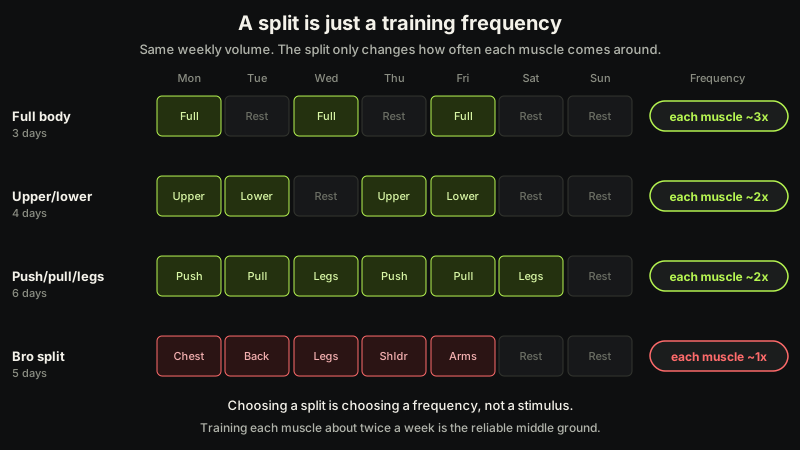
Read down the frequency column and the real difference appears. Full body trains each muscle often with a few sets each time. A bro split trains each muscle once with a large dose in one session. Upper/lower and push/pull/legs sit in the sweet spot most people mean when they say "twice a week," though a PPL only reaches that twice-weekly dose at six days. None of them adds stimulus the others lack; they distribute the same weekly work differently.
Frequency is the real variable a split sets
Since a split's main output is frequency, that is where the small, real advantages live. At a matched weekly volume, spreading your sets across two sessions instead of one tends to be at least as effective for growth, and often a little better, mostly because you can do those sets at a higher quality when a muscle is fresh.
The mechanism is simple. Sixteen hard sets of back in a single session means the last several sets happen deep into accumulated fatigue, at a worse effort than the first. Eight sets twice a week means every set happens closer to fresh. Same weekly volume, better average set. That is the entire case for training a muscle roughly twice a week, and it is why the once-a-week bro split is the one structure with a mild evidence disadvantage at matched volume, not because it is a bad split but because it forces all of a muscle's volume into one fatigued sitting. That case is worth reading in full, because the usual argument against the bro split blames the wrong variable: frequency itself is close to neutral once volume is equated, and the cost is really the per-session ceiling.
The same logic explains why the named splits are worth judging on their arrangement rather than their branding. The Arnold split reaches every muscle twice across six days, which sounds ideal until you notice it does it by putting chest and back in one session, so one of them is always trained on the tired half.
This is also why "which split is best" and "how often should I train each muscle" are secretly the same question. Pick a frequency you can recover from and repeat, then choose the split that produces it.
The same logic applies to the named programs built on top of these containers. A four-day powerbuilding split is still an upper/lower schedule underneath; what it changes is the rep range on two of the four days, and therefore how much fatigue those days hand to the other two.
How to make any split hit your weekly volume
Once you accept that the split is a container, the real work is filling it correctly. That is arithmetic, not opinion.
Start with your weekly hard-set target per muscle. Divide it by how many times that split trains the muscle each week. The result is how many sets that muscle needs per session.
Weekly hard sets per muscle ÷ sessions per week for that muscle = sets per session.
A chest target of 16 weekly sets on an upper/lower split (chest twice a week) is 8 sets per upper day, which is where the upper day starts running out of room once you do the same sum for back, delts and arms. The same target on a full-body split three times a week is 5 to 6 sets each day, which is what a full body session actually costs to fill once you count every other muscle that session also has to serve. On a bro split, all 16 land in one chest day, which is exactly the sitting most likely to decay into junk volume. The split you picked already told you which of these you are signing up for. Working the division backward is how you check whether the container actually holds your target, and it is covered in depth in how many sets per workout.
Then fill each session's sets across movements. Eight chest sets can be two exercises at four sets or three exercises at smaller doses, a choice with its own logic in how many exercises per muscle group. The split sets the total; exercise selection spends it.
Match the split to the days you actually show up
The most useful way to choose is to start from the days you can reliably train, not from a ranking. The split is downstream of your calendar.
| Days per week | Sensible default | Why |
|---|---|---|
| 3 | Full body | Trains everything about 3x with small, manageable doses |
| 4 | Upper/lower | Hits each muscle 2x with balanced recovery, the reliable intermediate choice |
| 5 | Upper/lower plus a push or pull, or a hybrid | Adds volume where you need it without a sixth day |
| 6 | Push/pull/legs | Spreads a high weekly volume across short, focused sessions, each muscle 2x |
Notice that adherence is doing the heavy lifting here. A perfect six-day plan you abandon after two weeks grows less muscle than an ordinary four-day plan you run for six months. The split that lets you show up and hit your weekly volume, week after week, is the best split for you, and it may not be the one topping anyone's list.
Why "best split" questions never resolve
The reason the internet cannot agree on a winner is that the two variables that decide it are individual and unmeasurable from the outside: how well you adhere to a schedule, and how much volume you recover from. A five-day full body is genuinely excellent for a lifter who recovers well and trains five days without fail. It is a poor recommendation for someone who trains four days in a good week. If four days is your realistic ceiling, which four-day structure you run matters more than which of these articles you read. Neither article is lying; they are answering for different people and presenting it as universal.
This is where a split intersects a training block. Volume and effort are not meant to stay flat forever; they climb across a block and then reset, which is the job of a mesocycle and its deload. The split is the weekly frame that structure runs inside. A good split does not just hit your volume this week, it lets you add a little over the coming weeks without the sessions becoming unmanageable.
The RIR tell that your split is mis-set
You can tell whether your container is sized right without any formula, if you log effort honestly. Track your reps in reserve across a session. Hard sets, the ones that count, sit around 1 to 3 RIR; our guide to reps in reserve covers estimating it.
If the last sets of a muscle in a session drift to 4 or 5 RIR while the first sat at 1, you are pacing, not training, and the session is holding more sets than that muscle can spend well. If instead the last sets collapse to 0 RIR with failed reps while load and reps barely move, those sets are a fatigue tax, not stimulus. Either tell means the split has stuffed too much into one sitting for that muscle, and the fix is usually more frequency (a split that trains it twice instead of once) rather than grinding out the padding.
That read is only possible if the record shows what each set actually cost, not what you planned for it to cost. Load and reps alone cannot show it.
Let weekly volume per muscle be the scoreboard
If the split is just a container, then the number that tells you whether it is working is not the split's name. It is your weekly hard sets per muscle, hit at the right effort, repeated week after week.
That is the number RIRLift is built to show. You build your split once on iPhone, whichever one fits your week, then run each session from your wrist, logging load, reps, and RIR per set as you train. RIRLift totals your weekly hard sets by muscle against a target, so you can see whether the container you chose is actually delivering: back got 18 this week across two sessions at 2 RIR, chest came up short, legs are past their target and the late sets are decaying. See how the workflow runs a session for the mechanics.
Pick the split you will adhere to. Make it hit each muscle about twice a week. Then stop ranking splits and start reading the only scoreboard that settles the argument: the volume you actually accumulated, and what it cost you to get it.