
Blog
4 day workout split: how to spend four sessions well
Published August 21, 2026 · 11 min read
Four days is the number most intermediate lifters land on. It fits a working week, it clears the low frequency that holds back a two or three day plan, and it stops short of the recovery bill a six day split runs up. Ask what to do with those four days and the internet answers in one voice: upper/lower, here is a template, go.
The template is usually fine. The advice is still incomplete, because "4 day workout split" is not a routine. It is a budget of four sessions, and there is more than one sensible way to spend it. Two lifters can both train four days a week and end up training every muscle a different number of times, with completely different weekly volume landing on their weak points.
The decision that actually matters is not "should I train four days." You have already made that call. It is how to divide those four days so each muscle gets enough weekly volume in doses each session can absorb. That is a question about frequency and arithmetic, and it is the part the templates skip.
What is a 4 day workout split?
A 4 day workout split is a training routine that divides your week into four gym sessions, each assigned a focus, so your weekly training volume is spread across four days instead of crammed into fewer. The word "split" refers to how you split the body across those sessions, and that is exactly the choice a generic template makes for you without saying so.
Think of the four days as a container, not a stimulus. What grows a muscle is the weekly volume of hard sets it receives, delivered close enough to failure to count. The split does not create that stimulus. It decides how the stimulus is packaged: how many times a week each muscle is hit, and how many sets land in a single session before quality drops. Get the packaging right and four days is plenty. Get it wrong and you can train four days a week for a block and watch half your body stall.
That is why the honest version of this article is a comparison, not a template. Here are the real ways to run four days, and what each one buys and costs.
The four ways to actually run four days
Almost every four-day routine is a variation on one of these four structures. They differ on one axis above all: how often each muscle gets trained.
| Structure | Typical layout | Frequency per muscle | Per-session crowding | Best for |
|---|---|---|---|---|
| Upper / lower | U / L / U / L | 2x | High on upper days | Balanced hypertrophy, the default |
| PHUL (power + hypertrophy) | Power U / Power L / Hyper U / Hyper L | 2x | High on upper days | Strength and size on the same four days |
| 4-day body-part | Chest+tri / Back+bi / Legs / Delts+arms | 1x (mostly) | Low, one focus per day | High per-session volume, fewer recovery clashes |
| PPL hybrid | Push / Pull / Legs / Upper (or rotating) | 1x to 2x, uneven | Moderate | More arm and delt frequency without a sixth day |
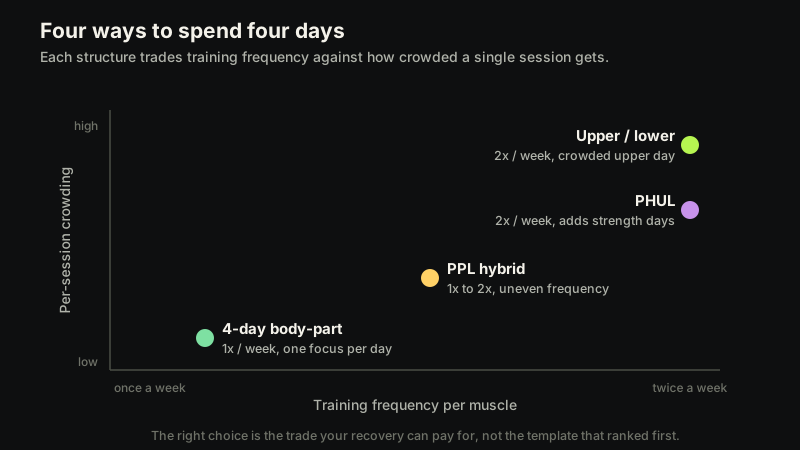
The two structures at the top, upper/lower and PHUL, hit every muscle twice a week. That twice-weekly frequency is what four-day plans are usually sold on, and it is a genuine advantage over a once-a-week structure. It comes with a cost, though. Cramming everything above the waist into two upper days makes those days long and crowded, and the muscles at the back of the session queue pay for it.
The 4-day body-part split takes the opposite trade. Each muscle gets one focused, uncrowded session, which lets you pour a lot of volume into it without the session dragging past ninety minutes. The price is frequency: most muscles are trained once a week, and the research on frequency (more below) says once is workable but rarely optimal when you could get two doses in for the same weekly volume.
The PPL hybrid sits in the middle. A pure push/pull/legs rotation wants six days to give every muscle two sessions; truncate it to four and the frequency goes uneven, with whatever you schedule twice getting the extra dose. It is a reasonable way to buy more arm and delt frequency than a body-part split without committing to a sixth day. Add a fifth day and the same idea extends into what PPLUL and ULPPL actually mean, a full five-way split that gives every muscle two sessions.
If you want a strength goal riding alongside size, PHUL is the usual pick because it assigns two of the four days to heavy low-rep work while keeping two for hypertrophy. Just decide in advance how hard each day is supposed to be, or the heavy and light days blur into four medium ones.
Is four days a week enough to build muscle?
Yes. Four well-structured days is enough to drive hypertrophy for almost everyone who is not a competitive bodybuilder, and the reason is that muscle growth tracks weekly volume more than it tracks how many days you show up.
The frequency argument that four-day plans lean on has weakened as the evidence has matured. Schoenfeld, Grgic and Krieger's 2019 meta-analysis applied volume-equated inclusion criteria across dozens of studies and found no significant hypertrophy difference between higher and lower weekly frequencies once total weekly sets were held constant. A more recent Sports Medicine dose-response meta-regression points the same way: weekly volume drives the response, and frequency is largely the delivery mechanism for that volume.
So four days does not need to beat five or six on frequency to work. It needs to deliver enough weekly hard sets per muscle, and four days has room for that. The catch is the per-session ceiling. A per-session set-volume meta-regression modelled the returns on sets performed for one muscle inside a single workout and found clear diminishing returns, with the point of undetectable added benefit landing around 11 fractional sets per session. That paper is a preprint rather than a peer-reviewed publication and the data at very high per-session volumes is thin, so treat the number as a rough landmark, not a law.
Even as a rough landmark it explains the whole four-day design problem. Twice-weekly frequency lets you split, say, 16 weekly sets for a muscle into two doses of 8, both of which land inside the productive range. A once-a-week body-part structure has to deliver all 16 in one session, and the back half of those sets falls past the point where the curve has flattened.
Put concrete numbers on it. Suppose your back needs 14 to 16 hard sets a week. On upper/lower that is 7 or 8 rows and pulldowns per upper day, an amount a fresh back can handle well twice over. On a once-a-week back day, all 16 sets stack into one session, and sets 12 through 16 arrive with your grip cooked and your lats already fatigued, buying far less than the first 8 did. Same weekly total on paper, different stimulus in practice. That is the trade every four-day structure is negotiating, and it is why how many sets you can fit into one workout matters as much as how many you program for the week.
Where four-day splits break down
The failure mode is almost never "four days is not enough." It is that the weekly volume you planned is not the weekly volume a muscle actually receives, because of where its sets fall in the session.
On the twice-a-week structures, the crowded day is the problem. An upper day serves chest, back, shoulders, biceps and triceps. Give each a respectable dose and you are looking at eighteen or more working sets, a session pushing ninety minutes, and a queue where the small muscles are structurally last. By the time you reach the curls, systemic fatigue is deciding when the set ends, not your biceps. The set can read an honest 2 reps in reserve and still deliver less than it would have fresh, because it is 2 RIR relative to a much more tired version of you on a lighter weight. The upper/lower split's tail is exactly this problem, and it is fixable by rotating what goes first rather than by changing the split.
On the once-a-week body-part structure, the problem is the opposite. There is no crowding, but there is also no second dose. Miss a session, or cut it short because a machine was taken, and that muscle gets nothing for the week instead of half its volume. A once-a-week muscle has no margin.
Either way, the number that tells you whether four days is working is weekly hard sets per muscle, counted from what you actually did, not what the plan said. A routine on paper and a routine after two skipped exercises and a rushed Friday are different routines.
How to choose your four-day structure
Pick the structure by your constraints, not by which template ranked first.
Choose upper/lower if you want the safe default. It delivers twice-weekly frequency at per-session doses each session can absorb, it survives the research well, and its one weakness (the crowded upper day) has a known fix. If you want that structure written out with a target effort attached to every slot, a four-day plan built around the progression trigger is exactly that. For most intermediate lifters chasing size, this is the right first answer, and it is why the choice of split matters less than lifters expect once weekly volume is matched.
Choose PHUL if you want strength on the same four days. If a heavy bench and squat number matters to you as much as size, the power/hypertrophy structure keeps both goals on one four-day schedule. Do not run it if you are only chasing hypertrophy; the heavy days spend recovery you could put into more productive volume.
Choose a body-part split if your recovery is the bottleneck. Older lifters, people with high life stress, or anyone who finds twice-a-week training leaves a muscle still sore for the second session may progress better with one hard, uncrowded session per muscle and more days between hits. You give up a dose of frequency to buy recovery, which is a fair trade when recovery is what is actually limiting you.
Choose a PPL hybrid if arms and delts are lagging. Rotating push/pull/legs plus an extra upper day buys those smaller muscles more frequency than a pure body-part split without a sixth training day.
Whichever you pick, the honest test is not how the plan looks. It is whether your logged weekly hard sets per muscle land where you intended, and whether the sets that are supposed to count are being trained while your effort estimate is still trustworthy.
Make four days count
A four-day split is a good container. Four sessions is enough room to train every muscle hard without living in the gym, and the structures above are all defensible ways to fill it. What decides whether yours works is not the label on the split. It is two numbers the template never shows you: how much hard weekly volume each muscle actually received, and where in the session those sets happened. Neither is printed on the plan, so log them in a free gym tracking app that totals weekly hard sets by muscle for you.
Both are countable. RIRLift totals your hard sets per muscle across the week automatically, so the gap between the volume you assumed your delts were getting and the volume they actually got shows up as a number instead of a hunch. Logging load, reps and RIR for every set on the wrist as the session runs is what makes the crowded-day tail visible, because a set drifting to a lighter weight at a pinned 2 RIR is the signature of a set that has stopped paying its way, and that only shows up in the sequence, not the total. You can see how a session runs from your wrist without pulling a phone out between sets, which matters most on the long upper days a four-day split hands you. For setting the weekly targets your structure has to hit in the first place, the training volume guide covers where the numbers should land.
Run whichever four-day structure fits your recovery and your goals. Then check that the four days you spent bought the weekly volume you meant to buy, on the muscles that needed it.