
Blog
PPLUL split: what the five letters cost you per muscle
Published September 6, 2026 · 12 min read
Two lifters both tell you they run PPLUL. One trains legs on Wednesday and again on Saturday, three days apart. The other trains them back to back on Thursday and Friday. Same five letters, same five sessions, and two schedules that recover completely differently.
That is the thing about split shorthand. PPLUL, ULPPL, PPL, U/L: the letters name which sessions you run, and gym culture treats the naming as if it settles the program. It does not. The letters tell you the grouping. The order you run them in, and the number of sessions each muscle ends up getting, is where two routines wearing the same abbreviation quietly become different training doses.
This post decodes the notation, then does the part the routine pages skip: it works out what per-muscle frequency the five letters actually buy you, and why swapping PPLUL for ULPPL changes the week even though the sessions are identical.
What is a PPLUL split?
A PPLUL split is a five-session training week made of a Push day, a Pull day, a Leg day, an Upper day and a Lower day, usually run as five training days with two rest days. It mashes together the two most common splits in the gym: push pull legs (three sessions grouped by movement pattern) and the upper/lower split (two sessions grouped by body region).
To read it, you have to decode the two splits it is built from.
- PPL stands for push, pull, legs. Push is the pressing muscles (chest, front and side delts, triceps). Pull is the pulling muscles (back, rear delts, biceps). Legs is the lower body (quads, hamstrings, glutes, calves).
- U/L stands for upper/lower. Upper is everything above the waist in one session. Lower is everything below it.
String them together and PPLUL is push, pull, legs, then upper, then lower. The first three sessions hit each region once with dedicated attention. The last two come back around and hit the upper and lower body a second time. The point of the format is frequency: it gives most muscles two sessions a week inside five gym days, where a classic six-day PPL needs six days to reach the same twice-weekly frequency.
That twice-a-week frequency is not a stylistic preference. It is the variable that most reliably separates a split that grows muscle from one that maintains it, which is why the PPL and U/L formats keep getting bolted together into five-day hybrids in the first place.
If you plan the week on your phone and then run each session from your wrist, the split stops being an abbreviation you have to decode every morning. Building the five sessions once on iPhone and logging each set on the watch is what turns PPLUL from a diagram into a program you can actually audit as the block goes on.
How to read any split shorthand
Once you can expand PPL and U/L, the rest of the alphabet soup falls out. Here is the notation you will actually run into, decoded.
| Shorthand | Expands to | Sessions | Times most muscles trained per week |
|---|---|---|---|
| U/L | Upper, Lower | 4 (each run twice) | 2x |
| PPL | Push, Pull, Legs | 3 (once) or 6 (twice) | 1x or 2x |
| PPLUL | Push, Pull, Legs, Upper, Lower | 5 | 2x |
| ULPPL | Upper, Lower, Push, Pull, Legs | 5 | 2x |
| FB | Full body | 2 to 4 | matches training days |
| Arnold | Chest/back, shoulders/arms, legs (x2) | 6 | 2x |
The rule for reading any of them: the letters tell you the grouping, and the number of times each block appears tells you the frequency. A muscle's weekly frequency is just how many of the listed sessions train it. On PPLUL, chest is trained on the Push day and again on the Upper day, so its frequency is two. Legs are trained on the Leg day and the Lower day, so their frequency is two as well. Count the sessions a muscle appears in and you have read the split correctly, no matter how the letters are arranged.
What the five letters give you per muscle
Frequency is only half the story. The number that actually drives hypertrophy is weekly hard sets per muscle, and the split decides how those sets get distributed across the week.
Say you are aiming for something like 12 to 16 hard sets a week for a major muscle, which sits inside the common weekly volume landmarks. The reason to defend that count rather than any single session is that the response scales with the weekly total: Schoenfeld, Ogborn and Krieger's dose-response meta-analysis found roughly a 0.37% gain in muscle size for each additional weekly set. PPLUL's job is to split that weekly total across two sessions so neither one has to carry all of it.
Here is what the two sessions per muscle look like on a standard PPLUL.
| Muscle | First session | Second session | Frequency | Typical split of a 14-set week |
|---|---|---|---|---|
| Chest | Push | Upper | 2x | 8 + 6 |
| Back | Pull | Upper | 2x | 8 + 6 |
| Shoulders | Push | Upper | 2x | 6 + 4 |
| Biceps / triceps | Pull / Push | Upper | 2x | 6 + 4 |
| Quads / hamstrings | Legs | Lower | 2x | 8 + 6 |
Two sessions per muscle is the whole appeal. Splitting fourteen sets into an eight and a six means neither session ends with you grinding out set twelve on a muscle that quit at set nine. The per-session set ceiling, the point where extra sets in one sitting buy fatigue instead of stimulus, is the thing PPLUL is designed to stay under. That is what it buys you over a three-day PPL, where every muscle's whole week has to fit into one session.
Notice one asymmetry the format bakes in. The dedicated Push, Pull and Leg days are cleaner: chest on the push day shares the session only with delts and triceps. On the Upper day, chest shares the room with back, both delts and both arms, so the sets it gets there are fewer and later. The upper day is the crowded one, the same crowding problem a four-day upper/lower runs into, and on PPLUL it is where a muscle's second, smaller dose lands.
PPLUL vs ULPPL: the order is not cosmetic
This is the part that gets waved away as personal preference and is not. PPLUL and ULPPL contain the identical five sessions. What changes is the order, and the order changes two things that matter: how many days pass between a muscle's two sessions, and whether its heavy work or its volume work leads the week.
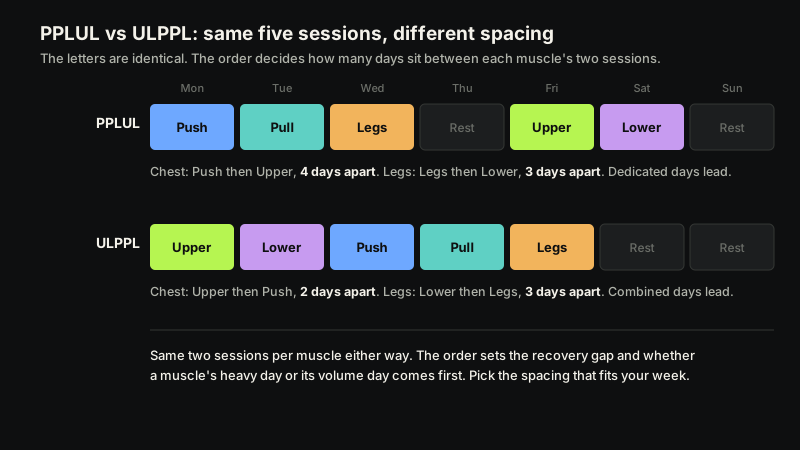
Run PPLUL as push, pull, legs, rest, upper, lower, rest, and legs land on day three and again on day six, three days apart, with a rest day wedged between. Chest gets its dedicated push day first, fresh, and its upper-day work later in the week. The dedicated single-region sessions lead; the combined upper and lower sessions clean up.
Run ULPPL as upper, lower, push, pull, legs, and the picture flips. The upper day leads the week, so chest, back and shoulders get their first hit inside a crowded full-upper session, then come back for a focused push or pull day two to three days later. The combined sessions now lead and the dedicated ones follow.
The practical consequences:
- Spacing. The gap between a muscle's two sessions is not equal in the two orders. Whichever version you run, check that no muscle gets both of its sessions crammed into back-to-back days with five days of nothing after, which is the second lifter from the opening. Even spacing recovers better than lopsided spacing at the same weekly volume.
- Which session is the heavy one. People tend to lift heaviest when fresh, so the leading session for each muscle is usually where the low-rep, high-load work belongs and the trailing session is where the higher-rep volume goes. PPLUL puts the dedicated day first, ULPPL puts the combined day first. Neither is better in the abstract; pick the one that puts your priority work on the day you arrive freshest.
ulppl split is one of the faster-growing search terms in this niche, and the reason is exactly this: lifters run PPLUL, feel the spacing is off for them, and go looking for the reordered version. The reorder is a real lever, not a rebrand.
Does a PPLUL split actually build muscle?
Yes, and the mechanism is less exciting than the format's fans make it sound. It works because of what it lets you fit, not because five is a magic number of sessions.
Schoenfeld, Ogborn and Krieger's 2016 meta-analysis in Sports Medicine found that training a muscle twice a week produced more hypertrophy than training it once, and recommended hitting major muscle groups at least twice weekly. PPLUL delivers exactly that twice-weekly frequency inside five days, which is its whole reason to exist.
But when the same researchers held total volume constant, their 2019 review in the Journal of Sports Sciences concluded that frequency does not meaningfully change hypertrophy once weekly volume is equated. Frequency was not doing the work directly. It was letting the higher-frequency groups accumulate more quality volume without any single session overflowing.
So the honest read is that PPLUL is a good split when it helps you hit a weekly volume target you could not hit cleanly in fewer sessions. It is not a good split because it has more letters than U/L. If you could fit the same weekly sets into a four-day upper/lower without the sessions falling apart, the research says the muscle would not know the difference. This is the same conclusion the best-split question keeps arriving at: the split is a container, and what you pour into it is the training.
Who a five-day split is for
PPLUL and ULPPL suit an intermediate or advanced lifter who can reliably train five days a week and wants twice-weekly frequency without committing to six gym days. That is a genuine sweet spot.
It is the wrong tool in two cases. If you can only train three or four days, do not run a five-day split at four-fifths capacity; a full body split on three days hits every muscle three times, and a four-day upper/lower hits everything twice, both without a session you skip every week. And if you are a beginner, the binding constraint is not weekly volume, it is repetition of the movement patterns, so a higher-frequency full body layout gives you more practice on the big lifts than a five-way split does.
The measurement trap in a five-day split
Here is the failure mode that belongs to five-day splits specifically, and it is not on any of the routine pages.
Five sessions do not divide evenly into seven days. Run PPLUL as a strict five-on two-off week and it lines up, but the moment life pushes a session and you run it as a rolling five-day cycle instead, a muscle stops getting trained on the same days each calendar week. Its two sessions drift, and some Monday-to-Sunday windows catch both while others catch one and a half.
That matters because weekly hard sets per muscle is the right scoreboard for hypertrophy, and a drifting cycle makes the weekly frame lie to you. A chest total that reads 14, 14, 8, 14 across four weeks can describe a perfectly consistent rolling program, not a week you slacked in. React to the 8 by piling on sets and you are correcting a calendar artifact, not a real volume dip.
The fix is to judge volume over the block, not the calendar week. Your RIR read per set tells you whether each session's effort held; the weekly muscle totals tell you whether the volume landed. RIRLift totals hard sets by muscle and shows them against a target, so on a five-day split you watch the two-week or block average and let a single week's number wobble in peace. The alternation becomes visible instead of mysterious, which is the difference between adjusting your program and chasing noise.
Running a PPLUL split honestly
Four rules, in the order they get broken.
- Count the frequency before you trust the letters. Expand the shorthand, then count how many sessions train each muscle. If the answer is not two for the muscles you care about, the split is not delivering what its name implies.
- Pick the order for your spacing, not the acronym's popularity. PPLUL and ULPPL are the same five sessions. Run whichever one spaces each muscle's two sessions evenly and puts your heaviest work on the day you arrive freshest.
- Cap the session, not the week. If a weekly target needs more sets than two sessions can hold cleanly, lower the target or add a day. Do not stack the overflow onto the end of the crowded upper day.
- Judge volume over the block. A five-day cycle drifts against the calendar. Read the two-week or block-level average, not any single week's total.
The two questions that settle it
Stop asking whether PPLUL is better than ULPPL, or whether either beats a six-day PPL. They are the same five sessions arranged for different recovery, and the arrangement is a preference you tune, not a ranking you look up.
Ask the two questions the letters leave open instead. How many days a week will you actually train, and does the order you run put each muscle's two sessions far enough apart to recover? Answer those honestly and the five letters take care of the rest. Get them wrong and no amount of reordering the acronym will fix a week that never added up.