
Blog
Training frequency for hypertrophy: how often to train a muscle
Published August 18, 2026 · 11 min read
Ask how often you should train a muscle to grow it, and every answer comes back the same: two to three times a week. The search results agree, the AI summary at the top agrees, and the meta-analyses they are quoting agree. It is one of the few settled numbers in hypertrophy training.
Which makes it a strange thing to keep arguing about. If the number is settled, why do lifters running the same training frequency for hypertrophy get such different results, and why does the advice feel useless the moment you try to apply it to your actual week?
Because "train each muscle two to three times a week" is an answer to a question most people are not really asking. The number is correct and almost beside the point. What matters is what frequency is for, and whether the frequency you think you are running is the one your training log actually shows. Both of those are things you can pin down, and neither is the number itself.
What is training frequency for hypertrophy?
Training frequency for hypertrophy is how many separate sessions each muscle group receives per week, not how many days you train. A lifter who trains six days a week on a body-part split hits each muscle once. A lifter who trains three days a week full body hits each muscle three times. The days-per-week number tells you almost nothing about the frequency that matters, which is always counted per muscle.
That distinction is the first place the advice goes wrong. Frequency is also not the same thing as volume, and the two get blurred constantly. Volume is how many hard sets a muscle gets across the week. Frequency is how those sets are distributed across sessions. You can hold one constant and change the other, and once you see them as separate dials, most of the confusion clears up. If you have not set your weekly volume target yet, that is the prior decision, and the training volume guide covers how much weekly volume each muscle actually needs. Frequency is the question of how to deliver it.
What the research actually says
The evidence that started the "twice a week" consensus is a 2016 meta-analysis. It found higher frequency favourable for hypertrophy, and the fitness internet has repeated the headline ever since.
The catch was in the methods. In most of the studies it pooled, the higher-frequency groups also performed more total weekly sets, so the comparison could not separate frequency from volume. The groups that trained more often were also, quietly, training more.
Schoenfeld, Grgic and Krieger revisited the question in 2019 with volume-equated inclusion criteria. Across 25 studies, once weekly set volume was held constant between the groups, there was no significant difference in hypertrophy between higher and lower frequencies. Their plain-language conclusion was that for a given weekly training volume, you can choose your frequency based on preference. The earlier 2016 result, in other words, was mostly volume wearing a frequency costume.
More recent work points the same way. A Sports Medicine dose-response meta-regression on weekly sets and frequency found that weekly volume drives the hypertrophy dose-response, and frequency functions largely as a way of delivering that volume rather than a separate stimulus of its own.
So the honest version of the settled number is narrower than the headline. It is not "training a muscle twice a week grows more muscle than training it once." It is "training a muscle twice a week lets most people accumulate more quality weekly volume than training it once, and the extra volume is what grows the muscle."
Frequency is a delivery mechanism, not a stimulus
That reframe is the whole article, so it is worth stating flatly. Frequency does not build muscle. It decides how your weekly volume gets packaged into sessions, and the packaging matters only because a single session can hold a limited amount of productive work.
Weekly volume and per-session volume have different dose-response curves. Weekly volume keeps paying off across a wide range. Per-session volume for one muscle flattens out much sooner: past a point, the extra sets you pile into the same workout stop adding a detectable stimulus and start adding fatigue without stimulus. A meta-regression on per-session set volume estimated that flattening point at roughly 11 hard sets per muscle per session, with the usual caveats: it is a preprint rather than a peer-reviewed paper, and the data thin out at very high per-session volumes, so treat the number as a rough landmark, not a hard cutoff.
Put those two curves together and frequency stops being mysterious. If a muscle can only absorb around a dozen productive sets in one session, and you want to give it eighteen or twenty across the week, you need more than one session to fit them in without wasting the tail end. That is the entire reason two to three times a week wins. Not the frequency, the fit.
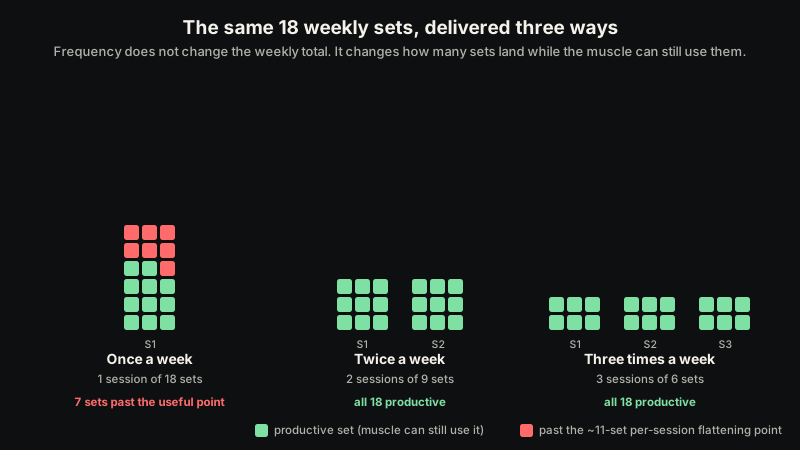
Here is the same weekly volume, packaged three ways.
| 1x per week | 2x per week | 3x per week | |
|---|---|---|---|
| Weekly hard sets | 18 | 18 | 18 |
| Sets per session | 18 | 9 | 6 |
| Sets in the productive region | ~11 | ~9 and ~9 | all 18 |
| Sets past the flattening point | ~7 | ~0 | 0 |
| RIR read on the last set | Unreliable | Clean | Clean |
| Sessions receiving stimulus | 1 | 2 | 3 |
The weekly number is identical in every column. The number of sets that plausibly did something is not, and that gap is the real difference frequency makes.
How much frequency, and when more stops helping
Because frequency is a delivery mechanism, the useful range follows directly from your weekly volume. The more weekly sets a muscle needs, the more sessions it takes to deliver them under the per-session ceiling.
- Low weekly volume (roughly 6 to 10 sets): once a week can genuinely be enough. The whole week's work fits inside one session without straining the per-session limit. This is the narrow case where a muscle trained once per week holds up fine.
- Moderate weekly volume (roughly 10 to 18 sets): twice a week is the sweet spot for most lifters. It splits the volume into two sessions that each stay in the productive region, and it keeps your effort estimate honest on the last set of each.
- High weekly volume (roughly 18 to 25+ sets): three or more times a week starts to matter, because there is no way to fit that much productive work for one muscle into two sessions without the back half of each turning into padding.
Notice what is driving the recommendation. It is never "more frequency is better." It is "spread the volume you already decided on across enough sessions that each session stays productive." Once your weekly volume is delivered inside the per-session ceiling, adding more frequency on top buys you very little. Training a muscle five times a week to deliver 12 weekly sets is not more effective than twice a week; it is just more sessions to organise for the same dose.
High frequency, low volume training
There is one frequency pattern that gets discussed on its own terms, and it is worth naming because it is the exception that proves the rule. High frequency low volume training means hitting a muscle often, sometimes four to six times a week, with only a couple of hard sets each time.
It works for the same reason everything else in this article works. A muscle getting three sets per session is nowhere near the per-session ceiling, so almost every set lands in the productive region and your RIR read stays clean because you are never deep into a fatigued, degrading session. Spread far enough, even a fairly high weekly volume can be delivered with every single set fresh.
The costs are practical, not physiological. More sessions means more warm-up ramps, more setup, more logistics, and a schedule that only works if you can get to a bar most days. It suits lifters who train at home, who like short frequent sessions, or who are working around a joint that tolerates volume better when it is spaced out. For most people on a conventional three-to-five-day schedule it is not worth the overhead, but it is a legitimate way to deliver volume, and it makes the delivery-mechanism framing concrete: the same weekly sets, sliced thin enough that none of them are ever junk.
Picking your frequency from your actual week
All of this collapses into a simple procedure. Set your weekly volume per muscle first. Then choose the frequency that delivers it without overstuffing a session, and let the number of training days you can realistically commit to constrain the answer.
| Days you train | Common structure | Frequency per muscle |
|---|---|---|
| 3 | Full body | 3x |
| 4 | Upper / lower | 2x |
| 5 | Upper / lower / full, or a rolling split | 2x to 3x |
| 6 | Push / pull / legs x2 | 2x |
| 5 to 6 | Body-part (bro) split | 1x |
The split you pick is mostly a frequency decision in disguise. A four-day upper/lower divides your weekly sets into two exposures per muscle. A push/pull/legs only reaches twice-weekly frequency at six days a week; run it three days and every muscle drops to once. The container you choose sets the frequency, and the frequency sets how your volume is delivered.
One more input belongs in the decision: recovery. Frequency assumes a muscle is ready to train again by the time its next session comes around, and that window is not fixed. It follows the size of the last dose, so a brutal session pushes the next exposure further out. The recovery window follows the dose, not the muscle size, which is why very high per-session volumes and high frequency pull against each other. You cannot train a muscle three times a week if each session leaves it wrecked for four days.
How to know the frequency you are actually running
Here is the part no meta-analysis can answer for you, and the part that actually decides whether any of this worked. The frequency in your plan and the frequency in your week are often different numbers.
Plans assume you finish. In practice sessions get cut short, a machine you needed is taken, the last exercise silently disappears, and a missed Thursday pushes a muscle from twice a week to once. A "twice a week" program that you complete two-thirds of the time is running closer to once a week for the muscles that live in the sessions you skip. You will not feel this happening, because how many sets a session actually holds and how many sessions a muscle actually got are both invisible unless you count them.
So count them. The only reliable read on your training frequency is the one you take from what you logged, not what you planned: how many separate sessions each muscle actually received this week, and whether the sets in each session stayed in the productive region or drifted into a fatigued, unreliable tail. Both are things you record set by set and read back afterward.
That is the job RIRLift is built for. It totals your hard sets per muscle across the week automatically, so you can see at a glance whether your split is delivering the frequency and volume you assumed, and the per-set load, reps and RIR history shows you where in a long session your numbers start sliding. You can see how a session runs from your wrist and log each set as you go, which is what turns "I think I train back twice a week" into a number you can actually check.
The number was never the hard part
Two to three times a week is correct. It is also the least useful true thing you can say about frequency, because it hides the mechanism that makes it correct: frequency is how you fit a week of productive volume into sessions that each stay productive. Get the weekly volume right, deliver it across enough sessions that no set is wasted, and pick the whole thing off a schedule you will actually keep.
Then check that the frequency you designed is the frequency you ran. That last step is the one lifters skip, and it is the only one that tells you whether the settled number ever reached your muscles. Your weekly volume target is where this starts; frequency is only how you deliver it, and your log is the one place you can confirm you did.