
Blog
How many exercises per muscle group?
Published July 11, 2026 · 9 min read
Search "how many exercises per muscle group" and you get the same answer everywhere: two to four. It is not wrong, but it is the right answer for the wrong reason. The number of exercises you run for a muscle is not the thing that grows it. It is a byproduct of how many hard sets you give that muscle each week and how you spread them across your training days.
Get the weekly sets right and the exercise count sorts itself out. Chase a magic number of exercises instead, and you can easily end up doing too little on the muscles that matter to you or piling on junk volume that only adds fatigue. This post reframes the question around the number that actually drives growth, then shows how to pick your exercises from there.
How many exercises per muscle group? The short answer
For most intermediate lifters, 2 to 5 different exercises per muscle group per week covers it. Within a single session, 1 to 3 exercises for a given muscle is plenty. That is the practical range, and it matches what the better results in the search agree on.
But treat that as an output, not a target. The exercise count falls out of two decisions you make first: your weekly hard-set target for the muscle, and how many times a week you train it. Set those, and the number of exercises is just how you fill the sets in.
Why the exercise count is the wrong thing to count
The currency of muscle growth is not exercises. It is hard sets per muscle per week, taken close enough to failure to matter. Most evidence-based guidance lands on roughly 10 to 20 hard sets per muscle per week for a growing intermediate lifter, with beginners needing less and some advanced lifters tolerating more. Our guide to weekly training volume walks through where those landmarks come from and how to find your own number.
Once you fix the weekly sets, the exercise count is downstream. Fourteen chest sets a week can be three exercises or five. What matters is that the sets are there, that they are hard, and that they are distributed sensibly. Counting exercises instead of sets is how people accidentally do six chest movements for two sets each (lots of variety, not enough stimulus per movement) or one movement for ten straight sets (plenty of stimulus, no variety and a lot of local fatigue).
Here is how a weekly set target translates into exercises, assuming you train each muscle twice a week:
| Weekly hard sets | Sets per session (2x/week) | Exercises per week | Example split |
|---|---|---|---|
| 8 to 10 | 4 to 5 | 2 to 3 | One compound, one isolation, repeated |
| 12 to 16 | 6 to 8 | 3 to 4 | Two compounds, one or two isolations |
| 18 to 20 | 9 to 10 | 4 to 5 | Two compounds, two or three isolations, angles varied |
The exercise count grows with volume, not on its own. That is the whole point.
How to pick your exercises per muscle group
Work in this order and the number picks itself.
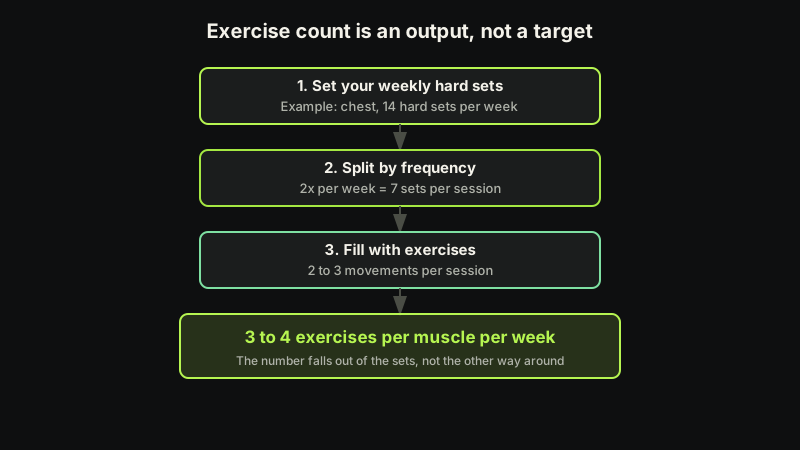
- Choose the weekly hard sets for the muscle, based on how much it needs and how well you recover. Start near the middle of the range (say 12 to 14 for a muscle you want to grow) and adjust.
- Choose your frequency. Training a muscle twice a week beats once for most people, because it splits the volume into fresher, higher-quality sessions. Spreading sets is also how you keep effort high without your last sets falling apart.
- Divide sets across sessions, then fill with exercises. If chest gets 14 sets across two days, that is 7 per session. That division is the whole answer to how many sets per workout you should be doing. Two exercises at 3 to 4 sets each covers a session cleanly. Across the week that is three to four chest exercises total, comfortably inside the 2 to 5 range.
Is seven exercises in one workout too much? For a single muscle, usually yes. For a whole session that trains two or three muscle groups, five to eight total exercises is normal. The problem is not the session length, it is stacking too many movements onto one muscle at the cost of set quality. That is the same trap in chaining exercises into a giant set: the back-half movements run on an exhausted muscle and add fatigue faster than stimulus.
A reasonable default for a muscle you are prioritizing: one or two compound movements that let you add load over time, plus one or two isolation movements that hit an angle or head the compounds miss. Whether those slots get filled with barbells or machines matters less than most lifters assume, since machines and free weights build muscle about equally well; pick whichever loads the target muscle best in your gym. That split between compound and isolation exercises is really a decision about where your weekly volume lands, because a compound credits several muscles per set while an isolation credits one. Those compounds usually sit in a lower rep range and the isolations in a higher one, which is what the best rep range for muscle growth comes down to. That is where progressive overload lives, on the movements you can actually load week to week.
What counts as a hard set, so the number means something
All of this assumes your sets are actually hard. A set taken to a comfortable stopping point is not the same stimulus as one taken close to failure, and counting the easy ones inflates your volume on paper without growing anything.
A hard set is one taken near enough to failure to drive growth, usually 1 to 3 reps in reserve for most working sets. That is the unit you are counting. Effort matters more than the exact rep scheme: reviews of loading find you can build muscle across a broad range of roughly 5 to 30 reps as long as the set is taken close to failure (Schoenfeld et al., 2021), and analyses like Stronger by Science on the hypertrophy rep range reach the same conclusion. In other words, whether a set counts depends on how hard it was, not which exercise or rep target it used.
If you are new to gauging effort, reps in reserve is the scale to learn first, and it is worth being honest about it. Most lifters stop further from failure than they think. We covered the tradeoff of pushing harder in how hard each set should be.
So the full picture is not "how many exercises," it is "how many hard sets, taken close enough to failure, spread across the week." Exercises are just the containers.
When more exercises help, and when they are just junk volume
Variety earns its place for two reasons. Different exercises bias different regions of a muscle, and a couple of movements can cover a muscle more completely than one. Variety also spreads mechanical stress across joints and tissues, which can keep a high-volume muscle healthier over a block.
Past that, adding exercises stops paying off. When you tack on a fifth or sixth movement for a muscle that is already getting its sets, you are usually adding junk volume: sets that cost recovery without adding stimulus. The tells are familiar, and they are worth learning to read: spotting junk volume in your own log comes down to your later sets being noticeably weaker, the muscle not recovering between sessions, and your logbook not moving. When that happens, the fix is rarely another exercise. It is fewer, harder, better-tracked sets. And when that stall shows up across your whole program rather than one muscle, it is usually accumulated fatigue talking, which is when backing off to clear fatigue with a lighter week beats any exercise change.
A simple ceiling: if you cannot say what a given exercise adds that the others do not, it is probably volume for its own sake. Cut it and put the effort into the movements that are already working.
How to know you actually hit your volume
The catch with all of this is that weekly hard sets are easy to plan and hard to track in your head. You will remember the workout you just did. You will not remember whether back landed at eleven sets or eighteen across the week, which is exactly the number that decides whether the plan worked.
This is the problem RIRLift is built to solve. You set an exercise's target sets, rep range, and RIR on iPhone, then log the load, reps, and actual RIR for every set on Apple Watch as you train. Because effort is captured live, a hard set is a hard set, not a guess reconstructed later. RIRLift then totals your weekly hard sets by muscle so you can see, at a glance, whether each muscle hit its target or drifted under. If chest keeps coming in at nine sets when you planned fourteen, the number tells you before a wasted block does. You can see how a session runs from your wrist, or how the weekly review turns your logs into volume by muscle.
That is the honest version of "how many exercises per muscle group." Pick your weekly sets, spread them across a couple of sessions, fill them with two to five exercises that each earn their place, keep the sets hard, and then check that the volume actually landed where you planned it.
FAQ
How many exercises per muscle group per day vs per week?
Per day, 1 to 3 exercises for a single muscle is usually enough. Per week, 2 to 5 is a good range for most lifters. The weekly number is what matters for growth, because it reflects total hard sets. The per-day number is just how you split them.
Can one exercise per muscle be enough?
Yes, if it delivers the sets. A single well-chosen compound run for the right number of hard sets can grow a muscle. Most people add a second or third movement for variety and to cover angles one exercise misses, not because one is inherently too few.
Should I count exercises or sets?
Count hard sets per muscle per week. Exercises are just how you deliver those sets. Two exercises at high volume can beat five exercises at low volume. Track the sets, keep them close to failure, and let the exercise count be whatever hits your target.