
Blog
Compound vs isolation exercises for muscle growth
Published July 24, 2026 · updated September 5, 2026 · 14 min read
Ask which is better for muscle, compound or isolation exercises, and most answers land in the same place: compounds are multi-joint and efficient, isolations are single-joint and detailed, do both. That is not wrong. It is also not useful, because it skips the question a lifter with a plan actually has. You are not choosing between building muscle and not building muscle. You are deciding how to spread a fixed weekly stimulus across the muscles you want to grow.
That reframe changes everything about how you pick exercises. A compound movement pays out stimulus to several muscles at once. An isolation movement concentrates it on one. Once you see exercise selection as a volume-distribution decision rather than a "which is stronger" contest, the compound versus isolation debate mostly dissolves. This is a look at what each type does, what the research says when the argument is settled honestly, and how to build a mix that matches your per-muscle targets instead of a slogan.
What are compound and isolation exercises?
A compound exercise moves more than one joint and loads several muscle groups at once. A squat bends the hips, knees, and ankles and drives the quads, glutes, adductors, and spinal erectors together. A barbell row moves the shoulder and elbow and loads the lats, mid-back, rear delts, and biceps. Bench press, deadlift, pull-up, overhead press, and lunge are all compounds.
An isolation exercise moves a single joint and targets one muscle as directly as the movement allows. A biceps curl bends only the elbow. A leg extension straightens only the knee. Lateral raises, leg curls, triceps pushdowns, and cable flyes are isolations. The distinction is mechanical, not moral. One joint or several joints, one muscle emphasized or several muscles sharing the load.
The practical consequence is what matters. A compound distributes effort, so no single muscle usually reaches the same local extreme the systemic effort does. An isolation focuses effort, so the target muscle takes the full brunt. That distribution is exactly what a per-muscle log is built to reveal, which is why RIRLift totals your weekly volume by muscle instead of just listing the movements you did. Hold onto the idea, because it is the thread that runs through everything below.
Do compound or isolation exercises build more muscle?
Both build muscle. When you equate the training so both sides do similar work, the "which is superior" question stops having a clean winner. A review of single-joint versus multi-joint exercises found no meaningful difference in upper-limb size or strength between the two, and no extra growth from bolting isolation work onto an already solid compound program (Gentil and colleagues, 2017). If your multi-joint work already trains a muscle hard through a full range, the muscle does not know or care that the movement crossed one joint or three.
It gets more interesting when the compound does not train the target muscle hard. In a direct comparison, a biceps curl grew the elbow flexors more than twice as much as a dumbbell row over eight weeks, 11 percent versus 5 percent (Barbalho and colleagues, 2019). The row is an excellent back builder, but the biceps are a helper there, sharing load with much larger muscles. For the biceps specifically, the isolation delivered more stimulus. Isolation is not a lesser tool. It is a targeting tool. That same helper-muscle problem is what pre-exhausting a muscle before its compound tries to solve, though the evidence for it is weaker than the logic sounds.
The lower body tells the same story from the other direction. Comparing leg press with leg extension, the leg press matched the extension for overall quadriceps growth and additionally grew the glutes and adductors, while the leg extension was better for the rectus femoris, a quad head the leg press tends to under-load (Kassiano and colleagues, 2025). The compound covered more muscles. The isolation reached a spot the compound missed. Neither replaced the other.
So the honest answer to "which builds more muscle" is: whichever one delivers more effective stimulus to the muscle you are asking about. That is a per-muscle question, not a category verdict.
The real difference is how each spreads stimulus
Picture the same hard set delivered two ways. A barbell row spends that set across your lats, mid-back, rear delts, and biceps. A curl spends the whole set on your biceps. Same effort, same slot in your session, completely different distribution across muscles.
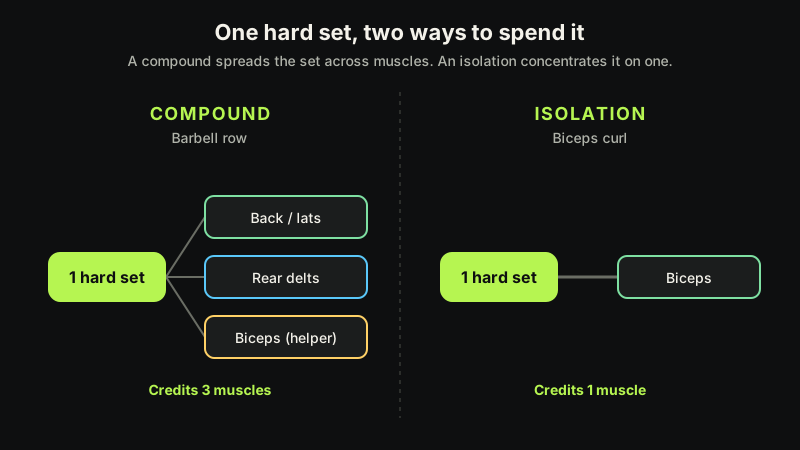
This is why exercise type is really a volume-accounting decision. When you count weekly training volume as hard sets per muscle, every compound quietly credits several muscles at once and every isolation credits one. A push day of bench, incline press, and dips can bury your chest in volume while your side delts and triceps ride along as helpers, never getting a concentrated set of their own. On paper you did nine sets. For the side delts, you did close to zero that count.
That distribution is the lever most lifters ignore. It is also the thing a good log makes visible. If your rear delts or your hamstrings lag no matter how many big lifts you grind, the fix is rarely more compounds. It is usually one well-placed isolation that pays the full set to the muscle the compounds keep shortchanging.
Why compounds and isolations read differently for RIR
Here is the part almost no article on this topic mentions, and it is the one that matters most if you autoregulate. Compound and isolation exercises give you very different information about how hard the set actually was.
On a heavy compound, the set often ends for reasons that have little to do with the muscle you care about. The bar stalls because your grip failed, your lower back rounded, your balance drifted, or your whole system ran out of drive. You hit technical failure before the prime mover hit muscular failure. That makes your effort estimate noisy. Learning to estimate reps in reserve honestly is harder on a squat or a deadlift precisely because so many things can end the set first.
An isolation set is cleaner. On a leg extension or a curl, one muscle is doing the work and it is the muscle that gives out. The rep slows, the range shrinks, and the failure you feel is the failure that counts. Your RIR read is more trustworthy, which is exactly why isolations are useful for calibrating effort and for pushing genuinely close to failure without the systemic risk of grinding a maximal compound. It is also the setting where the mind-muscle connection actually earns its keep, because the target muscle is working alone and a deliberate internal focus has room to bias the effort toward it. When you decide how hard each set should be, the movement type is part of the answer: leave a slightly bigger buffer on the compounds where the read is fuzzy and the fatigue cost is high, and let the isolations run closer to the edge. The equipment does the same thing to your effort estimate, which is why machines and free weights read so differently for RIR even when they train the same muscle.
How compounds change your weekly volume math
Because compounds credit several muscles, stacking too many overlapping ones is a quiet way to manufacture fatigue without adding useful stimulus. Three heavy horizontal presses in a session hammer the chest, front delts, and triceps in nearly the same pattern each time. The fourth pressing movement mostly adds systemic fatigue and elbow wear, not new growth. That is one route into junk volume: sets that raise the fatigue bill without moving the muscle-building needle.
Isolations let you add volume surgically. If your weekly set target says the side delts need six hard sets and your presses only credit them as a helper, three sets of lateral raises close the gap cleanly, with almost no systemic cost. You bought exactly the volume you needed for exactly the muscle that needed it, and you did not have to add another back-taxing compound to get it.
This is where selection and volume meet. Deciding how many exercises per muscle group to run is downstream of this distribution question. Compounds are how you cover several muscles per movement and keep the session efficient. Isolations are how you top up the specific muscles your compounds under-serve. The exercise count follows the per-muscle gaps, not the other way around.
Do compounds and isolations need different rep ranges?
They tend to sit in different rep ranges for practical reasons, not because the muscle counts reps differently. Compounds load the most muscle and the most stable positions, so they carry heavy weight well and are often trained in lower ranges, roughly 5 to 10 reps. Isolations put a small muscle in a long lever with less margin for a grinder, so they usually feel better and safer in the 10 to 20 range. But the best rep range for muscle growth is wide, and proximity to failure drives the stimulus more than the exact number. A hard set of curls at 15 reps and a hard set of rows at 8 both build the biceps if both are taken close enough to failure.
The table below sums up how the two types trade off across the things you actually program around.
| Factor | Compound exercises | Isolation exercises |
|---|---|---|
| Joints and muscles | Multiple joints, several muscles share the load | One joint, one muscle emphasized |
| Load carried | High, systemically demanding | Lower, locally demanding |
| Volume accounting | Credits several muscles per hard set | Credits one muscle per hard set |
| RIR readability | Noisier (grip, technique, balance can end the set) | Cleaner (target muscle fails, clearer read) |
| Typical rep range | Roughly 5 to 10 | Roughly 10 to 20 |
| Best used for | The base of the session, covering many muscles efficiently | Filling gaps and hitting muscles the compounds miss |
| Examples | Squat, deadlift, bench, row, pull-up, overhead press | Curl, leg extension, lateral raise, leg curl, pushdown |
How to actually pick your mix
Start from the muscles you want to grow and their weekly hard-set targets, not from a compound-versus-isolation preference. Then build in this order.
- Anchor with compounds. Pick one or two big movements per muscle group as the base. They deliver the most stimulus per unit of time and cover several muscles at once, which keeps the session tight.
- Read the distribution. Look at which muscles your compounds credit as prime movers and which only ride along as helpers. Chest, back, quads, and glutes usually get plenty from compounds. Side delts, rear delts, biceps, triceps, hamstrings, and calves are the usual under-served list.
- Fill the gaps with isolations. Add targeted single-joint work only where a muscle is short of its weekly target after the compounds are counted. This is where isolations earn their place, and where the cleaner RIR read lets you push close to failure safely.
- Stop when the targets are met. More overlapping compounds past that point buy fatigue, not growth. The goal is enough hard sets on each muscle, not the most movements on the whiteboard.
Once the list is settled, the sequence you write it in becomes its own decision. Which exercise you put first does not change how much stimulus the session holds, but it does decide which muscle receives the best of it.
Beginners can grow on almost all compounds because everything is a novel stimulus and the big lifts credit most muscles at least a little. As you advance, the lagging muscles get specific, and isolations become the precise instrument that fixes them. The mix shifts over a training career from mostly compound toward compound-plus-targeted-isolation, driven by what your log tells you is falling behind.
Compound vs isolation FAQ
Can I mix compound and isolation exercises?
Yes, and most effective programs do exactly that. The two are not rivals to choose between; they are two ways to spend a hard set. Anchor the session with compounds to cover several muscles efficiently, then add isolations to top up the specific muscles your compounds only train as helpers. The mix is a distribution decision, not a loyalty test.
What happens if you only do compound exercises?
You can build a lot of muscle on compounds alone, especially as a beginner, because the big lifts credit most muscles at least a little. The gap shows up over time in the muscles that ride along as helpers rather than prime movers: side delts, rear delts, biceps, hamstrings, and calves often stay short of their weekly hard-set target no matter how many presses and pulls you grind. Those are the muscles a well-placed isolation exists to reach.
What are the big compound exercises?
The movements most programs build around are the squat, deadlift, bench press, overhead press, barbell row, and pull-up. The "big three" usually means the squat, bench press, and deadlift, the three barbell lifts that load the most muscle under the heaviest weight. Each one crosses multiple joints and pays stimulus out to several muscle groups in a single set, which is why they sit at the base of the session.
What is the difference between accessory and isolation exercises?
Isolation describes the mechanics of the movement: a single joint, one muscle emphasized. Accessory describes the role of the movement in your program: any lift that supports your main lifts rather than being one. An accessory can be an isolation, like a triceps pushdown to support the bench press, or it can be a smaller compound, like a dumbbell row to support the deadlift. So every isolation is usually an accessory, but not every accessory is an isolation.
Should you do compound or isolation exercises first?
As a rule, put compounds first, while you are fresh. They demand the most from your whole system and carry the most injury risk when technique breaks down under fatigue, so they deserve your best energy. Isolations work well at the end of the session, where the target muscle can be fatigued in relative safety and a cleaner effort read lets you push close to failure. The exception is deliberate pre-fatigue of a lagging muscle, which is a specific tactic rather than the default order.
Which muscles need isolation exercises most?
The muscles that stay helpers in your main lifts. Side and rear delts, biceps, hamstrings, and calves rarely get a concentrated hard set from pressing, pulling, and squatting, so they are the usual candidates for targeted single-joint work. Research points the same way: a biceps curl grew the elbow flexors more than twice as much as a row, and a leg extension reached the rectus femoris that the leg press under-loads. If a muscle lags no matter how many compounds you run, the fix is almost always one isolation aimed straight at it, not another big lift.
Log the distribution, not just the movement
None of this works from memory. The whole approach depends on being able to see, week to week, which muscles are actually getting their hard sets and which are quietly running short. That is the entire reason the weekly volume view groups your work by muscle rather than just listing the exercises you did. A compound row shows up as sets credited to your back and your biceps. A curl shows up as sets on your biceps alone. The muscle map makes the distribution obvious, so the gaps that isolations are supposed to fill stop hiding behind an impressive-looking exercise list.
The rest follows the same logic. You set a target RIR per exercise, then log actual load, reps, and RIR for every set while a session runs from your wrist, phone in your bag. Because the log knows which muscles each movement loads, the weekly picture is honest whether the set came from a heavy compound or a targeted isolation. Exercise selection stops being a debate about which type is superior and becomes what it always should have been: a question of where your volume is landing, and which movement puts the next hard set exactly where you need it.
Compound and isolation exercises are not rivals. They are two ways to spend a hard set, one broad and one focused, and a muscle grows from either when the effort is real and the volume adds up. Build the base with compounds, patch the gaps with isolations, and let your per-muscle log, not a slogan, decide the mix.