
Blog
Pre-exhaustion training: does it build more muscle?
Published August 23, 2026 · 10 min read
You rack the leg extension after a hard set, and before your quads have stopped burning you are already lowering into a squat. The theory feels airtight: pre-tire the target muscle on its own, then hit it again on the big lift while it is already deep in the tank, and it has nowhere to hide. The quads will be the thing that fails on the squat instead of your lungs or your lower back, and surely that means more growth.
That is pre-exhaustion, and it is one of the oldest ideas in bodybuilding. It is also one of the most misread, because the logic that sells it and the evidence that tests it point in different directions. The technique is not useless. It just does not do the specific thing most people run it for, and if you log it the way it is usually described, it quietly corrupts the numbers you use to make every other training decision.
What is pre-exhaustion?
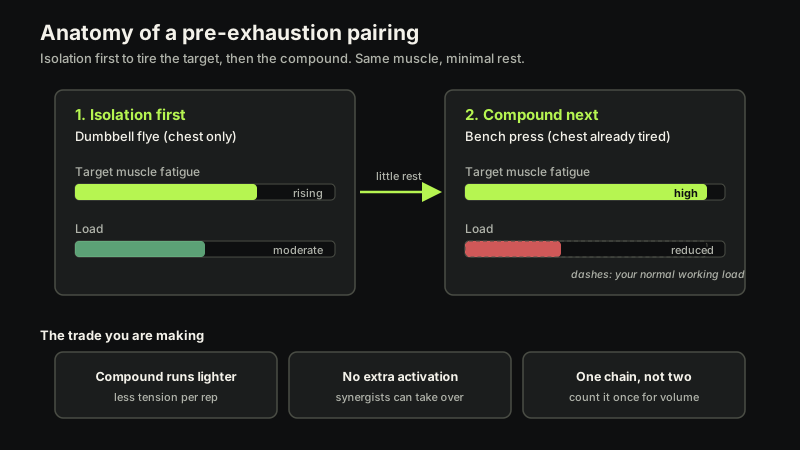
Pre-exhaustion is a training method where you perform a single-joint isolation exercise for a muscle immediately before a multi-joint compound exercise that also trains it, with little or no rest between the two. The isolation move fatigues the target muscle first, so it enters the compound lift already tired.
The classic pairings all follow the same shape: leg extensions before squats or leg presses for the quads, dumbbell flyes before the bench press for the chest, straight-arm pulldowns before lat pulldowns or rows for the lats. In every case you are pairing an isolation exercise before a compound that hits the same muscle. Structurally this makes pre-exhaustion a specific kind of same-muscle superset, which matters later when you go to count it.
The stated goal is to fix a perceived problem with compounds. On a bench press your triceps and front delts assist the chest, and on a row your biceps assist the lats. The worry is that these smaller assisting muscles fatigue and give out before the big target muscle has been worked hard enough, so the target never reaches true failure. Pre-exhausting the target first is meant to flip that order, tiring the main muscle so it becomes the limiting factor on the compound.
Does pre-exhaustion build more muscle?
This is the claim the whole technique rests on, and it is the one the evidence does not support.
A 2022 narrative review of pre-exhaustion training pulled together the controlled studies on the method and reached a consistent verdict: when total volume and effort are equated, pre-exhaustion does not produce more muscle growth than training the same exercises in the normal order. A plain-language write-up of the same evidence in Men's Health landed in the same place: regular set order matches or beats pre-exhaustion for hypertrophy. The suffering is real. The extra growth is not.
The reason is mechanical, and it is the opposite of the selling point. Because the target muscle is already fatigued, you cannot load the compound anywhere near as heavily as you normally would. That reduced load means less mechanical tension on every rep of the big lift, which is one of the main things you are there to produce. Worse, the acute studies show that pre-fatigue does not reliably make the target muscle work harder on the compound. Often the assisting muscles simply pick up more of the load to compensate, so the exercise you were trying to focus becomes less focused, not more. You paid a heavy strength tax and did not buy the recruitment you wanted.
This is the same lesson that keeps showing up across intensity techniques. Growth is driven mostly by hard reps taken close to failure, and the honest driver is how close to failure a set is, not how clever the set structure looks on paper. A method that lowers your working load while adding fatigue is spending on the wrong side of that trade.
What pre-exhaustion actually buys
None of this makes pre-exhaustion a mistake. It makes it a specialty tool with two legitimate uses, neither of which is "more muscle per session."
The first is bringing up a genuinely lagging muscle whose stronger partner keeps stealing the compound. If your chest never seems to get the work on a bench press because your triceps and delts take over, pre-exhausting the chest with a flye can force it to be the part that is already close to failure when the press begins. You are not adding stimulus overall; you are redistributing it toward the muscle you care about, at the cost of the movements it shares the lift with. Used deliberately and rarely, that redistribution can be worth it for a stubborn body part.
The second is joint-friendly loading. Because the target is pre-fatigued, you reach a hard, close-to-failure effort on the compound with much less weight on the bar or in your hands. For a lifter managing cranky shoulders or knees, getting a quality stimulus at a lighter load is a real benefit, even though the lighter load is a drawback for everyone else.
| Regular exercise order | Pre-exhaustion | |
|---|---|---|
| Muscle growth (volume equated) | Baseline | No advantage |
| Load on the compound | Full working weight | Reduced (target already tired) |
| Target muscle focus on the compound | Normal | Not reliably higher; synergists can take over |
| Fatigue per pairing | Lower | Higher |
| Best use | Your everyday working sets | A lagging muscle, or joint-friendly loading |
| Counts toward weekly volume as | Each set counted normally | The chain counts as sets for the target, not double |
How pre-exhaustion distorts your RIR read and your set count
Here is the part the ranking articles skip, and it is the part that actually reaches into the rest of your training.
Start with effort. Most of your working sets are best left with a small buffer, which is the whole case for leaving a rep or two in reserve rather than grinding every set to failure. Reps in reserve only works as a guide if you can read it, and pre-exhaustion makes that read harder. When you walk into a squat with quads that are already smoked from leg extensions, the set ends early because the target muscle quits, not because the whole movement reached a normal limit. The RIR you would log for that squat is not comparable to the RIR of a fresh squat at a real working weight. The number means something different, so treating it the same way in your history will mislead you.
Then there is volume. Because a pre-exhaustion pairing is a same-muscle chain, it is tempting to count the isolation and the compound as two full hard sets for the muscle. That inflates your total the same way counting each drop of a drop set separately does. The isolation set and the pre-fatigued compound set are not two independent maximal efforts; the second one runs on an already-tired muscle at a reduced load. If your log says you did more effective work than you did, every decision downstream of that number inherits the error. This is the stimulus-to-fatigue ratio problem again: a pre-exhaustion pairing adds a lot of fatigue for a stimulus that is no larger than doing the two moves normally, so it should not pad your tally. When you track your weekly volume by muscle, count the pairing honestly as the work it really did for that muscle, not as a free doubling.
How to program pre-exhaustion
Treated as a targeted tool rather than a default, pre-exhaustion has a place. A few rules keep it useful.
- Use it to bring up a lagging muscle, not as a general growth hack. If a body part is progressing fine in normal order, there is no reason to pay the strength tax.
- Pair a single-joint isolation with a compound for the same muscle. Flye then press, extension then squat or leg press, straight-arm pulldown then row. Keep the rest between them short so the pre-fatigue carries over.
- Expect to drop the load on the compound. The lighter weight is the mechanism, not a failure. Do not chase your normal working weight on the second exercise.
- Keep it to a movement or two, occasionally. Like any technique that stacks fatigue, it belongs in accumulation work when you have recovery to spend, not in a deload or the back half of a hard block.
- Do not run it on maximal free-weight lifts you need a spotter for. Reaching failure on a pre-fatigued barbell squat or bench is a safety problem, not a hypertrophy win. Machines and cables are the safer home for it.
A worked example on the chest looks like this:
| Step | Exercise | Load | Reps | Rest before next step |
|---|---|---|---|---|
| Pre-exhaust | Dumbbell flye | Moderate | To ~1 to 2 RIR | ~0 to 15 seconds |
| Compound | Bench press | Reduced from your normal working weight | To ~1 to 2 RIR | Normal rest, then repeat the pair |
Two exercises, one continuous pairing, the chest reaching a hard effort on both. On your log, that is chest volume counted for what it did, with the compound's RIR understood as a pre-fatigued read, not a fresh one.
How to log pre-exhaustion in RIRLift
A technique this easy to mis-record only helps if your log survives it, and the common mistake is entering the pairing as two clean, independent sets at face value. Do that for a few weeks and your history will say your chest volume climbed and your bench RIR held steady, when really you added fatigue and trained the press lighter. You will not be able to tell the productive weeks from the padded ones.
The fix is to record the pairing as what it is. In RIRLift you build the isolation and the compound as a superset on the exercises themselves, so the pair is stored as one deliberate chain instead of a stack of pretend straight sets, and it counts toward your weekly volume by muscle honestly rather than doubling it. You still log real load, reps, and reps in reserve on each part, so the intensity is visible, but the structure makes clear that the compound ran on a pre-fatigued muscle at a reduced load. Months later you can see that pattern instead of reading a phantom PR.
The mechanics matter too, because a pre-exhaustion pairing is a race against rest: the pre-fatigue only carries if you move to the compound quickly. That is hard to do while you unlock a phone and thumb through a set list. RIRLift runs the pairing from your wrist, so logging the isolation and jumping to the compound is a tap or a turn of the Digital Crown, and the rest timer knows the difference between the near-zero gap inside the pairing and a real rest between rounds. The record stays honest and you never break the technique to keep it.
The honest verdict on pre-exhaustion
Pre-exhaustion is a scalpel aimed at a specific problem, not a lever for extra muscle. When volume and effort are matched it grows the target about as well as training the same movements in the usual order, while forcing you to lift lighter on the compound and pay more in fatigue. That trade is worth it in two narrow cases: a lagging muscle whose stronger partner keeps hijacking the compound, and loading a joint-friendly stimulus at lighter weight. For everything else, ordinary set order is the better default.
If you do use it, use it on purpose, put it where recovery allows, and above all record it as one honest chain of work rather than two inflated sets. The technique feels like it must be doing something extra for the same reason a drop set does, and the fix is the same one: judge it by what your log says it did over a block, not by how much it burned on the day.