
Blog
What is a superset? Types, benefits, and how to log one
Published July 26, 2026 · updated September 4, 2026 · 15 min read
You have an hour, a leg day and an arm day both due, and a gym that is filling up fast. So you start pairing things. Curls straight into pushdowns. Leg press into leg curls. Two exercises back to back, one rest instead of two, and suddenly the session that needed 70 minutes fits into 45. It feels like a smarter way to train, and in one specific way it is. In a few other ways it quietly changes numbers you are trying to keep honest.
That pairing is a superset, and it is one of the most misread tools in the gym. It is sold as a growth hack, treated as a fat-burner, and logged as if each half were a full separate set. The useful version of a superset is narrower and more boring than any of that, and it lives in the gap between how the technique feels and what it actually does to your volume and your effort readings.
What is a superset?
A superset is two exercises performed back to back with little or no rest between them, with your rest taken after the pair instead of after each exercise. You do a set of exercise A, go straight into a set of exercise B, then rest, then repeat the pair. The load, reps, and effort on each exercise are the same as they would be on their own. The only thing you have changed is where the rest goes.
That last point is what separates a superset from the two techniques people confuse it with. It is not a drop set, where you keep one exercise going and strip the load to push a single muscle past failure. And it is not a circuit, where three or more exercises run in a continuous loop, usually for conditioning rather than hypertrophy. A superset is just two movements sharing one rest period. Chain three or more exercises for one muscle with no rest and you have crossed into giant-set territory, which stacks a lot more fatigue for a smaller honest return.
The pairing is the whole design decision, and it is where supersets go right or wrong.
The types of superset
Not every pairing does the same thing. The exercises you choose decide whether the superset saves you time for free or quietly costs you reps.
| Type | Example pairing | What it does | Effect on your reps |
|---|---|---|---|
| Antagonist (opposing) | Biceps curl + triceps pushdown | One muscle rests while the other works | Little to none |
| Non-competing (staggered) | Leg curl + calf raise, or squat + a core movement | Two unrelated muscles share a rest | Little to none |
| Agonist / same muscle | Bench press + dumbbell fly | Piles fatigue onto one muscle | Real rep loss on the second exercise |
| Compound set | Two exercises for the same muscle, back to back | A same-muscle superset by another name | Real rep loss on the second exercise |
Antagonist and non-competing pairings are the ones worth building a session around. Because the second exercise trains a muscle that was resting during the first, it arrives fresh, so you keep close to the reps you would have hit on your own. Same-muscle pairings (often called pre-exhaust or post-exhaust, or a compound set) are a different animal: the second exercise lands on an already-fatigued muscle, so the reps drop and the fatigue spikes. That is not automatically bad, but it is a trade, not a free lunch.
Do supersets build more muscle?
This is the claim the technique lives or dies on, and the honest answer is no. Supersets build a comparable amount of muscle to straight sets, not more. What they reliably buy is time.
A 2025 review of superset versus traditional training in the sports-science literature found that supersets reduce how long a session takes without compromising training volume, muscle activation, or long-term hypertrophy. Men's Health summarized the same evidence in one line: a time-efficient alternative to traditional sets that does not reduce volume, activation, or growth. And a Legion Athletics review of 18 studies reached the same verdict from the other direction: supersets will not make you build muscle faster, but used well they let you finish your workouts faster.
The mechanism is not exotic. Muscle growth is driven mostly by hard sets taken reasonably close to failure. A superset does not add any of those; it just removes the idle rest between two of them by parking one muscle while you train another. You end up doing the same productive sets in less clock time. The growth follows the sets, so the growth is the same.
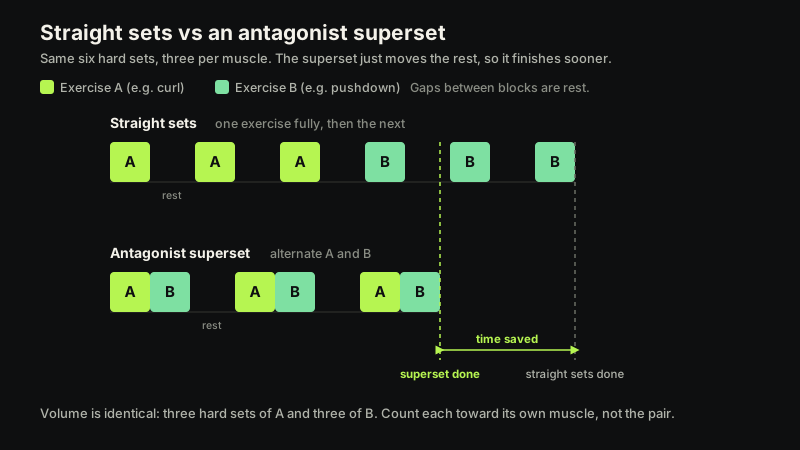
This is why the "supersets spike testosterone and growth hormone" line does not survive contact with the evidence. The acute hormone bump from short rest is real and transient, and it does not translate into meaningful extra muscle. If a pairing helps you, it helps because you fit the same quality work into less time, not because of a hormonal event.
What a superset actually costs
The time saving is real, but nothing about compressing rest is entirely free, and supersets charge in two currencies.
The first is systemic fatigue. The 2025 review that found equal growth also found that supersets induce higher internal loads, more severe muscle damage, and higher perceived exertion than the same work done as straight sets. You are doing the same number of hard sets, but you are doing them with less recovery between efforts, so the session hits you harder. That is fine in the right dose and a problem if every exercise in a long session is paired.
The second cost only shows up on same-muscle pairings: lost reps. When the second exercise trains a muscle that is still fatigued from the first, you cannot produce the same output, so the reps fall. Sometimes that is the point, as a way to reach failure on a small muscle quickly. But if you did not intend it, you have just turned a would-be hard set into a diminished one, and your log will not tell you unless you were watching the actual numbers. This is the stimulus-to-fatigue ratio problem in a new shape: the pairing can add fatigue without adding stimulus if you pick the wrong two exercises.
That is the real reason antagonist and non-competing pairings are the default recommendation. They collect the time saving while protecting the reps. Same-muscle supersets can be useful, but they are a deliberate intensity choice, not a way to move faster for free.
How a superset counts toward your weekly volume
Here is the part almost no ranking article covers, and it is the part that quietly corrupts a training log.
When you pair a curl with a pushdown and do three rounds, how many hard sets did you just do? The answer for an antagonist pairing is clean: three hard sets for biceps and three hard sets for triceps, counted separately, because each exercise trained its own muscle with its own near-failure effort. The shared rest changed nothing about what each muscle received. So a superset does not deflate your volume, and it does not inflate it either. Each exercise counts once, toward its own muscle, exactly as it would have on its own.
Same-muscle pairings need more care. If you superset dumbbell bench with flies, that is not two full hard chest sets. The fly landed on a pre-fatigued chest at a lighter effective output, so the honest count is closer to one and a bit for chest, not two. Recording it as two clean chest sets tells your weekly total you did more effective work than you did.
| Straight sets | Antagonist superset | Same-muscle superset | |
|---|---|---|---|
| Muscle growth per set | Baseline | Comparable | Comparable, but on fewer real reps |
| Time to complete | Longer | Shorter | Shorter |
| Fatigue per round | Lower | Higher | Highest |
| Reps on the second exercise | Full | Close to full | Reduced |
| Counts toward weekly volume as | One set each | One set for each muscle | One solid set plus a partial |
This matters because weekly hard sets per muscle is the number your whole plan turns on. If supersets let you fit more sessions or more sets into the week, that is a genuine win, and the extra sets count normally. What you cannot do is let the pairing blur the tally, because every progression call you make downstream inherits the error. Get the count right and a superset is a volume-efficient tool. Get it wrong and your log says twenty sets while your muscle got fourteen.
Supersets and your RIR read
The second number a superset distorts is effort, and this one is easy to miss because it feels like the opposite of a problem.
Because a superset raises your perceived exertion and leaves residual fatigue in the tank, the second exercise feels closer to failure than it truly is. You finish a paired set gassed, heart rate up, and your gut says that was a 1 reps-in-reserve set. On an antagonist pairing it may well have been a clean 3, and the extra difficulty came from systemic fatigue, not from the target muscle running out of reps. On a same-muscle pairing the reverse trap appears: the second exercise really is closer to failure than the load suggests, so a weight that looks light on paper is doing more than the number implies.
Either way, the pairing decouples how a set feels from how much the muscle actually had left. The fix is not to guess harder. It is to log the real reps and the real RIR on each exercise, set by set, and let the pattern correct you over a block. A planned 2 RIR that keeps coming in at 0 on the second half of a superset is telling you the pairing is stealing more than time. A planned 2 that comes in at 2 tells you the pairing is doing its job. You only see that if the effort is recorded in the moment rather than reconstructed from a memory of feeling wrecked.
How to program supersets
Used with intent, a superset is a clean way to buy time in a crowded session. Used everywhere, it is a fatigue machine that muddies your numbers. A few rules keep it on the right side of that line.
- Default to antagonist or non-competing pairings. Biceps with triceps, back with chest, quads with hamstrings, or any movement paired with an unrelated one. These protect your reps while saving the rest.
- Keep supersets off your heaviest compounds. Pairing squats or heavy deadlifts with anything compromises form when fatigue is high and the risk is real. Save supersets for accessories, arms, and machine or cable work where failure is safe.
- Take a little rest inside the pair if you need it. A short 30 to 60 second gap between the two exercises still saves time versus full rest and protects performance. A superset does not have to mean zero rest.
- Use same-muscle pairings deliberately, not by accident. A pre-exhaust or compound set is a valid intensity tool on the last movement for a muscle. It is a poor way to run your main volume, because the rep loss and fatigue stack up fast.
- Do not pair everything. The systemic fatigue is cumulative. A couple of supersets in a session buys real time; a whole session of them just makes the later work worse.
A worked antagonist example looks like this:
| Round | Exercise A | Exercise B | Rest after pair |
|---|---|---|---|
| 1 | Biceps curl, ~2 RIR | Triceps pushdown, ~2 RIR | ~90 seconds |
| 2 | Biceps curl, ~2 RIR | Triceps pushdown, ~1 RIR | ~90 seconds |
| 3 | Biceps curl, ~1 RIR | Triceps pushdown, ~1 RIR | Done |
Three hard sets for biceps and three for triceps, in a little over half the time two straight-set exercises would take, with the reps and RIR on each movement kept intact.
How to log a superset honestly
A superset only helps if your record survives it, and the common failure is logging the pair as a single blurred effort or letting the shared rest confuse your set count. The record has to keep each exercise separate, credited to its own muscle, with its own honest effort.
This is where a logbook built for how lifters actually train earns its place. In RIRLift you log each exercise in the pair as its own set, with its own load, reps, and RIR, and each one counts toward its own muscle in your weekly total. Nothing about pairing them changes the bookkeeping, so an antagonist superset shows up as what it is: a full slate of hard sets for two muscles, done faster. The rest timer starts after the pair, not after each exercise, so the tool matches the way you are actually training instead of fighting it.
The pace matters too, because a superset is partly a race against your own rest. Digging your phone out between two paired exercises defeats the point and breaks the flow that made the pairing worth doing. Running the session from your wrist keeps your hands on the weights and the numbers going in where your attention already is, which is the difference between a superset that saves time and one that just feels rushed. If short rest is the lever you are pulling, it helps to know how compressing rest between sets costs reps, so you spend that time saving where it does not quietly shrink your working sets.
Everything you log this way feeds the number that decides whether a superset earned its spot in your program: your effective weekly volume by muscle, counted once per exercise, not doubled by the pairing. Fit the same quality sets into less time and keep progressing, and the superset is doing exactly what the evidence says it can. Watch your logged reps and RIR slide on the second half of every pair, and it is stealing from your sets, which also tells you the pairing has pushed you past what a single session can productively hold.
The honest verdict on supersets
A superset is a time tool, not a growth hack. Pair opposing or unrelated muscles and you fit the same productive work into less time for almost no cost. Pair the same muscle and you trade reps for a sharper intensity hit, which is fine when you mean it and a leak in your plan when you do not. Either way, the muscle grows from the hard sets, not from the pairing, so do not expect extra size from the extra burn.
Count each exercise toward its own muscle, log the real reps and RIR on both halves, and judge the technique by what your log says it did across a block rather than how gassed it left you on the day. Do that, and supersets become one of the cleanest ways to get a full session done when the clock is against you.
Superset FAQ
What is the difference between a superset and a regular set?
A regular (straight) set is one exercise followed by a rest. A superset is two exercises done back to back, with the rest taken after the pair instead of after each one. The load, reps, and effort on each exercise stay the same; the only thing that changes is where the rest sits, which is why a superset mostly buys time rather than extra growth.
How many sets are in a superset?
One superset is a single round of the two paired exercises: one set of exercise A straight into one set of exercise B. Most people repeat that pair three or four times, so a typical superset block is three to four rounds. Each exercise still counts as its own set toward its own muscle, so three rounds of a biceps and triceps pairing is three hard sets for biceps and three for triceps, not three combined.
What is an example of a superset?
The cleanest example is an antagonist pairing: a biceps curl straight into a triceps pushdown, rest, then repeat for three or four rounds. One muscle recovers while the other works, so both keep close to their normal reps. Chest with back, or quads with hamstrings, work the same way.
Is a superset the same as a circuit?
No. A superset is two exercises sharing one rest period. A circuit chains three or more exercises in a continuous loop, usually for conditioning rather than hypertrophy. Chaining three or more movements for a single muscle with no rest is a giant set instead, which stacks far more fatigue for a smaller honest return.
What is the 3-3-3 rule at the gym?
The 3-3-3 rule is a beginner workout structure, not a superset method. The common strength version is three sets of three exercises across three muscle groups; a cardio version splits a session into three ten minute blocks. It organizes a whole workout, whereas a superset is only how you pair and rest two exercises inside one.
Are supersets good for fat loss?
Only in the ordinary sense that a shorter, denser session keeps your heart rate up and lets you train more in less time. There is no special fat-burning effect, and the brief calorie and hormone bump from short rest does not meaningfully change body composition on its own. Fat loss still comes down to your overall training and diet, not the pairing.