
Blog
Straight sets: what they are and how to make them work
Published August 14, 2026 · 11 min read
You load the bar, do a set of eight, rest a couple of minutes, and do another set of eight with the same weight. Then a third. Three sets of eight, one exercise, nothing clever. After scrolling past drop sets, giant sets, rest-pause, and pyramids, plain straight sets can start to feel like the thing you do because you have not learned the good techniques yet.
That has it backwards. Straight sets are not the beginner option you graduate out of. They are the baseline every fancier set style gets measured against, the format most hypertrophy research is actually built on, and the cleanest tool for the one thing that reliably grows muscle: adding a little work over time at a controlled effort. The intensity techniques are variations on this theme, and most of them trade away some of what makes a straight set so easy to progress. This is what a straight set is, whether it builds muscle, and how to stop yours from stalling at the same three sets of eight forever.
What is a straight set?
A straight set is the standard way to perform an exercise: you do a set, rest, and repeat the same exercise for your planned number of sets, using the same weight and aiming for the same rep target each time. Three sets of ten on the leg press with 200 pounds, resting two minutes between each, is a straight-set scheme. The load stays put, the rep goal stays put, and you rest fully between efforts before moving to the next exercise.
That is the whole definition, and its plainness is the point. Because nothing changes between sets except accumulated fatigue, a straight set gives you a clean read on two things that matter: how much load and reps you managed, and how hard the set was. Every other set structure distorts one of those on purpose.
| Set structure | What changes across the sets | Rest between efforts |
|---|---|---|
| Straight sets | Nothing (same load, same rep target) | Full rest |
| Ascending pyramid | Load goes up, reps come down | Full rest |
| Reverse pyramid | Heaviest set first, load drops after | Full rest |
| Drop set | Load stripped mid-set, no rest | None until the drops are done |
| Superset | Two exercises back to back | None between the pair |
The defining feature of a straight set is that it isolates one variable at a time. You hold load and reps constant within the session, which means the only honest way to make the exercise harder next time is to add a rep or add weight. That is not a limitation. That is exactly the property that makes straight sets the easiest scheme in the gym to progress deliberately.
Straight sets vs supersets, pyramids, and drop sets
Most of the popular intensity techniques are straight sets with one constraint added or removed. Understanding what each one trades helps explain why straight sets remain the default rather than the fallback.
A pyramid set ramps load up (or down, in reverse pyramid) across your sets. The appeal is that it feels like it covers more bases, but the early light sets of an ascending pyramid are really warm-ups, and the scheme quietly hides how many genuinely hard sets you did. A superset pairs two exercises with no rest between them; it saves time, and for antagonist pairings it does so cheaply, but stacking two movements on the same muscle costs you load on the second one. A drop set strips weight mid-set to push a single set past its first failure point, buying extra near-failure reps at the cost of a lot of fatigue.
Every one of those is useful in the right spot. What they share is that they blur the clean load-reps-effort read that a straight set gives you for free. On a straight set you can look at the numbers afterward and know precisely what happened. On a drop set or a same-muscle superset, the fatigue from the previous effort contaminates the next one, so the reps you got and the effort you felt no longer mean what they would on a fresh set. That blurring is the recurring theme: fancier structures buy time efficiency or a burst of extra fatigue, and they pay for it in bookkeeping clarity.
Do straight sets build muscle?
Yes, and about as well as anything else per hard set. This is the claim the whole "you need advanced techniques" narrative runs into, because when researchers actually pit fancy set structures against plain straight sets with volume equated, the fancy ones rarely win for hypertrophy.
A 2017 study in the European Journal of Applied Physiology by Angleri and colleagues trained well-trained men for 12 weeks using traditional constant-load sets, crescent pyramid sets, or drop sets, with volume matched across groups. All three produced similar muscle growth and strength gains. The drop-set and pyramid systems did not deliver more size than plain straight sets. The most useful evidence on supersets tells the same story: a 2025 systematic review and meta-analysis in Sports Medicine by Zhang and colleagues found that supersets matched traditional straight-set training for muscle growth in significantly less time, and that same-muscle supersets actually produced less volume load at a higher perceived effort. The intensity techniques win on efficiency, not on stimulus per hard set.
The reason is that hypertrophy is driven mostly by taking a reasonable number of hard sets close enough to failure, then doing a bit more over time. A straight set delivers that as directly as it can be delivered. There is nothing a drop set or a pyramid adds to the underlying stimulus that a plain hard set taken to a similar proximity to failure does not already provide. Where the fancier schemes earn their keep is compressing that work into less time or squeezing a last dose of stimulus onto a muscle when you are out of session budget. If your constraint is time, they help. If your constraint is stimulus, straight sets already have it covered.
Why straight sets actually work
The mechanism that makes straight sets grow muscle is not the sets themselves. It is what you can do with them week to week. Straight sets are the cleanest possible vehicle for progressive overload: because the format holds everything constant within a session, the only way to make it harder next time is to do measurably more, and "measurably more" is the entire game.
Here is the trap that makes straight sets look boring. Someone does three sets of ten with the same 100 pounds every week for six months and concludes straight sets stopped working. Straight sets did not stop working. Progression stopped, because nothing about the sessions got harder. The load was the same, the reps were the same, and without a rising demand there is no reason for the muscle to adapt. The straight set is just the container. Progressive overload is what has to happen inside it.
This is where a target reps-in-reserve figure does the heavy lifting. If you run your straight sets at a planned 2 RIR and you hit ten reps at 2 RIR this week, then next week you either add a rep or add a little load and check whether the effort held. When a set you logged at a planned 2 RIR actually comes in at 4 RIR, that is your signal the weight got easy and it is time to add load. When a string of sets keeps landing at 0 RIR and the reps are falling, that is your signal to back off. The straight-set format is what makes those reads legible, because the numbers are not contaminated by a drop or a superset partner. Effort is data, and a clean straight set is the easiest place to collect it.
When straight sets are the right call
For most lifters, most of the time, straight sets should be the default and the intensity techniques the exception. They are the right call when:
- You want to progress an exercise deliberately. Anything you plan to add load or reps to over a block belongs in straight sets, because the clean read is what lets you make that call honestly.
- You are training a heavy compound. Squats, deadlifts, presses, and rows are where technique matters and fatigue is expensive, so you want full rest and a clean effort read, not a drop set turning a barbell into a safety problem.
- You have the time to rest properly. If you can afford two to three minutes between sets, straight sets give you the best stimulus per unit of fatigue. The efficiency techniques mostly exist to solve a time problem you may not have.
Reach for something fancier when the constraint changes. When the clock is the bottleneck, a superset or a giant set compresses the work. When you want one last dose of near-failure stimulus on an isolation movement late in a session, a drop set or a rest-pause finisher delivers it. But treat those as targeted tools, not upgrades. The base of a good hypertrophy program is straight sets you can actually progress.
Why straight sets stall, and how to fix it
A straight set stalls for one of two reasons, and they need opposite fixes. Either you stopped adding load and reps, or you are trying to add them faster than you can recover. Telling those apart is a bookkeeping problem, which is exactly what straight sets are good for.
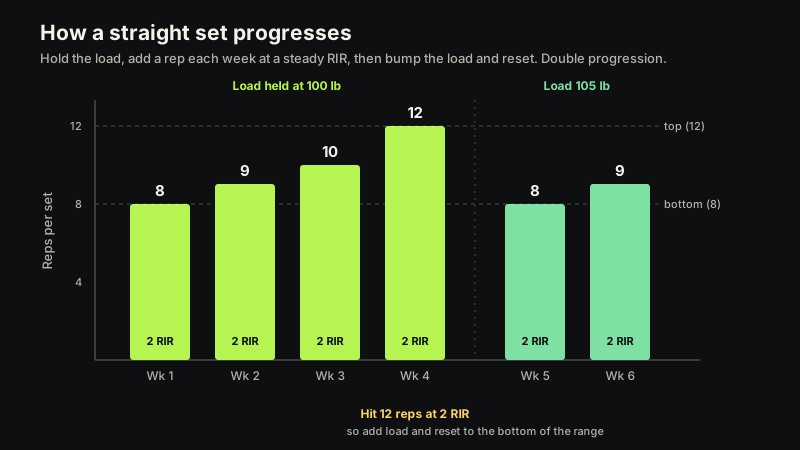
The fix for the first case is a rule that forces progression: double progression. You pick a rep range instead of a single number, say eight to twelve. You keep the load fixed and add reps each week until you hit the top of the range at your target RIR across all your sets, and only then do you add weight and drop back to the bottom of the range. It turns "add weight when it feels easy," which cannot be audited, into a concrete trigger you can read off your log. The straight-set format is what makes double progression possible, because it holds the load steady so the reps can climb.
The fix for the second case is to look at the effort trend. If your reps are falling and your logged RIR keeps drifting toward zero across sessions, you are not under-progressing, you are accumulating fatigue faster than you clear it, and the answer is a lighter week or a step back rather than more load. Each straight set is one hard set toward your weekly volume, and when the effort read on those sets turns sour, that is the signal to manage recovery, not to grind harder. You can only see either pattern if the sets were clean enough to trust, which is the recurring argument for keeping most of your work straight.
How to run and log straight sets in RIRLift
A straight set only helps your progression if the record survives it, and the record is where a plain scheme actually shines. You set a target load, rep range, and RIR per exercise on iPhone, then log the actual load, reps, and RIR for each set on your Apple Watch as you go. Because a straight set has full rest built in, the RIRLift workflow fits it naturally: load, reps, and RIR come pre-filled from last time, so you confirm a set in a tap or dial any value with the Digital Crown, and the rest timer starts itself while you sit down.
Over a block, that clean per-set record is what turns straight sets from a boring default into a progression engine. Your log shows whether the reps are climbing at a held RIR (progress), flat at a rising RIR (the weight got easy, add load), or falling at a sinking RIR (back off), and it totals each set into your weekly hard sets by muscle so you can see the volume you are actually accumulating. There is no drop or superset partner muddying the numbers. The straight set gives you the honest reading, and RIRLift keeps it.
The honest verdict on straight sets
Straight sets are not the format you use until you learn the real techniques. They are the real technique. They are the control condition in the research, the format that isolates load and effort so you can progress on purpose, and the base that every good hypertrophy program is built on. The intensity techniques are worth knowing, but they are variations that buy time efficiency or a burst of extra fatigue, and they charge for it in the clarity of your log.
Run most of your work as straight sets, give each one a target RIR and a rep range so it has somewhere to progress, and reach for the fancier stuff only when the clock or a lagging muscle genuinely calls for it. Judge the whole thing by what your log says across a training block, and a well-progressed straight set will out-build a flashier scheme you cannot read almost every time.