
Blog
Double progression: how to run it and where it breaks
Published July 15, 2026 · 14 min read
Almost everyone who lifts can recite the double progression method: pick a rep range, add reps until you reach the top of it, then add weight and start again. It is the most reliable way to progress a lift without needing a heavier bar every single session, and it is a sensible default for most hypertrophy work.
Then you actually run it, and the tidy version falls apart. Your three sets come in at 10, 9, 9, and the rule does not say what to do. You finally hit the top of the range, but only because you ground out the last rep with your face turning purple. You add the weight, your reps collapse below the bottom of the range, and you spend three weeks clawing back to where you were. None of that is in the instructions.
This post covers the parts that are usually left out: what to do when your sets desync, how to tell an earned rep from a bought one, how wide your rep range should be, and what to do when the progression stalls. The thread running through all of it is that double progression has a hidden third variable nobody writes in the table, and once you log it, most of these problems answer themselves.
What is double progression?
Double progression is a progression method where you increase two variables in sequence rather than at once: first reps, then load. You pick a rep range for an exercise, keep the weight fixed, and add reps session to session until you reach the top of the range on your working sets. Then you increase the load, your reps drop back toward the bottom of the range, and the climb repeats.
The "double" is the two variables. It sits inside the broader principle of progressive overload, which just means gradually increasing the demand on a muscle over time. Double progression is one way to apply that principle, chosen because it gives you room to progress on most sessions instead of demanding a heavier weight every time you train.
Double progression vs linear progression
The usual comparison is against linear progression, sometimes called single progression, where you add weight on a fixed schedule and hold reps constant. Linear progression works beautifully right up until it does not, which for most lifters is a few months in. Spotting that moment is its own skill, because the numbers on the bar keep climbing for weeks after the method has stopped measuring anything; we cover when session-to-session progression stops working separately.
| Linear progression | Double progression | |
|---|---|---|
| What changes | Load, on a schedule | Reps first, then load |
| Reps | Fixed (for example, 3 x 5) | A range (for example, 3 x 6 to 10) |
| When you add weight | Every session or every week | Only once you fill the rep range |
| Progress looks like | A straight line, then a wall | A staircase |
| Best for | Beginners on main lifts | Most lifters, most exercises |
| Fails when | Your body stops adapting weekly | Rarely, but it can stall at the top |
The practical difference is where the honesty lives. Linear progression asks you to add weight because a week has passed. Double progression asks you to add weight because you earned it by filling the range first. That earned increase is the whole point, and it is also the part that quietly breaks, which we will get to.
How to run double progression
Here is the method in five steps:
- Pick a rep range for the exercise, for example 6 to 10 reps.
- Pick a load you can keep inside that range for all your planned working sets, at your target effort.
- Each session, try to add reps while holding your technique and your target proximity to failure.
- Once every working set reaches the top of the range at your target effort, increase the load.
- Your reps drop back near the bottom of the range. Climb again.
Watch it play out on an incline dumbbell press, 3 sets in a 6 to 10 range, with a target of 2 reps in reserve:
| Session | Sets x reps | Load | RIR on last set | What it means |
|---|---|---|---|---|
| 1 | 8, 7, 7 | 30 kg | 2 | Mid-range. Chase reps, hold the load. |
| 2 | 9, 8, 8 | 30 kg | 2 | Reps climbing at the same effort. Working. |
| 3 | 10, 9, 9 | 30 kg | 1 | Top on one set only, and effort crept up. Not yet. |
| 4 | 10, 10, 10 | 30 kg | 2 | Every set at the top, effort held. Add load. |
| 5 | 7, 7, 6 | 32.5 kg | 2 | Reps reset near the bottom. Climb again. |
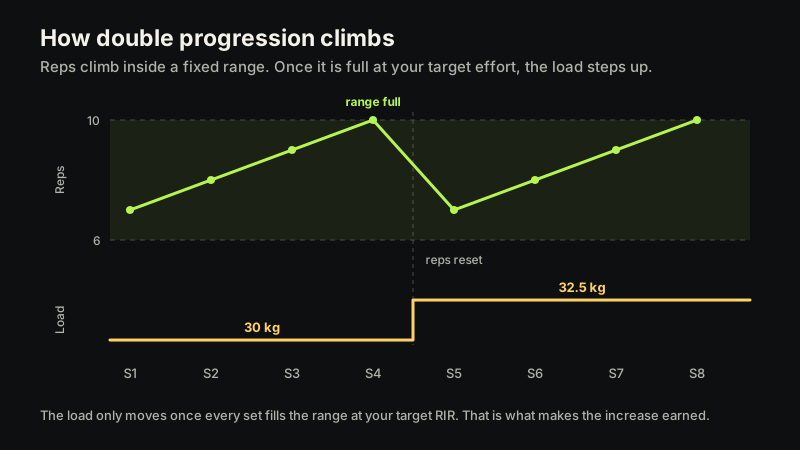
The exact numbers do not matter. The shape does: reps climb, load steps, reps reset, repeat. Each load increase is backed by reps you already proved you could hit.
Now look at that RIR column, because it is the one almost nobody writes down, and it is doing more work than any other column in the table.
The rep only counts if your RIR held
Session 3 is the interesting one. Reps went up, from 9, 8, 8 to 10, 9, 9. Progress, surely? Look at the effort: it moved from 2 RIR to 1 RIR. That extra rep did not come from the muscle getting stronger. It came from digging one rep deeper into the reserve. You did not get better; you tried harder.
This is the blind spot in every double-progression table on the internet. Load and reps tell you what you did. They do not tell you how hard it was, and without that, "I hit the top of the range" is an ambiguous claim. Ten reps at 2 RIR and ten reps at 0 RIR are not the same achievement. Only one of them means the weight actually got easier. It is also the difference that lets you tell real muscle gain from simply trying harder: strength rising at a held effort is the tissue improving, while a rep bought with more effort is not.
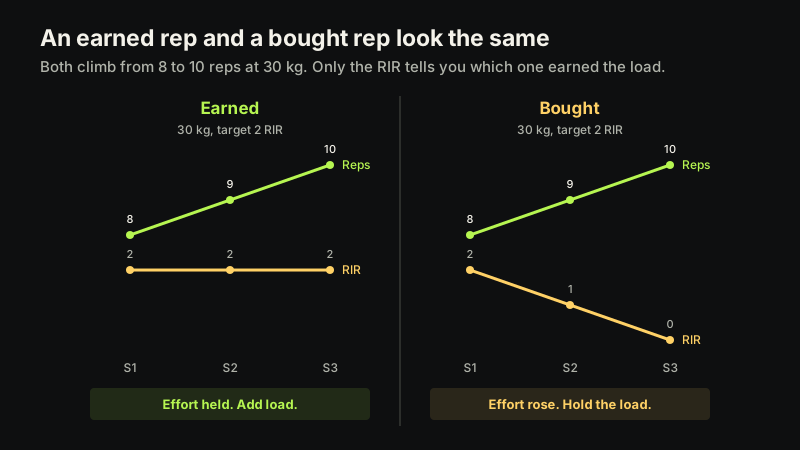
Reps in reserve closes the gap. RIR counts backward from technical failure: 2 RIR means you stopped believing you had about two clean reps left. Add it to your rep range and the rule sharpens into something you can act on:
Add load when every working set reaches the top of the rep range at your target RIR, not just when the reps appear.
The alternative, which is what most people are doing without noticing, is a slow slide into training every set to failure. Each session you buy one more rep with a bit more effort, the reps creep up, the log looks like progress, and your actual load has not moved in a month. Meanwhile the fatigue cost is real. Failure training is not required for growth in the first place: a systematic review and meta-analysis found "no evidence to support that resistance training performed to momentary muscular failure is superior to non-failure resistance training for muscle hypertrophy" (Refalo et al., 2023). Paying a real fatigue cost for a fake progression is the worst trade in the gym, and it is worth understanding why a small buffer usually wins.
RIR is an estimate, and an imperfect one. It is also learnable: the research that formalized the RIR-based effort scale found that more experienced lifters judge their proximity to failure more accurately than novices (Zourdos et al., 2016). You get better at it by logging it honestly, in the moment, and then finding out whether you were right.
What to do when your sets desync
This is the question the instructions never answer, and the one lifters actually ask. Your sets read 10, 9, 9. The first one filled the range. The others did not. Do you add weight?
First, understand why it happens: it is fatigue, and it is normal. Within a session, your later sets have less left in them than your first. Sets desyncing is the method working, not breaking. You do not need to fix it.
You have three defensible options.
The all-sets rule (recommended default). Every working set must hit the top of the range at your target RIR before the load moves. It is the strictest and the most conservative, it keeps your effort honest, and it means every load increase is thoroughly earned. The cost is slower load progression. For most lifters chasing hypertrophy, this is the right trade.
The top-set rule. The first set hits the top, so the load goes up, and the back sets are allowed to lag lower in the range. Load climbs faster. The risk is that your later sets drift below the bottom of your range and quietly turn into a different exercise at a different effort.
Per-set tracks. Each set progresses on its own, so set one might be at 32.5 kg while sets two and three sit at 30 kg. This is the most precise and the most bookkeeping. It works well if you are the kind of person who enjoys that, and it collapses immediately if you are not tracking each set separately.
Pick one and stay with it. The failure mode is not choosing the wrong rule; it is switching rules based on how you feel that day, which turns your progression into a story you tell yourself.
How wide should your rep range be?
The width of your range decides how big a load jump you can absorb. That matters more than most people expect, because the jump is not a fixed number of kilos; it is a percentage of the weight on the bar.
| Exercise | Working load | Smallest jump | Jump as % | Range that fits |
|---|---|---|---|---|
| Barbell squat | 100 kg | 2.5 kg | 2.5% | Narrow (5 to 8) works |
| Incline dumbbell press | 30 kg | 2.5 kg | 8% | Medium (6 to 10) |
| Lateral raise | 8 kg | 2 kg | 25% | Wide (12 to 20), or micro-plates |
On a heavy compound, a 2.5 kg jump is a rounding error and a narrow range is fine. On a lateral raise, the smallest dumbbell increment in most gyms is a 25% increase, which will drop your reps off a cliff. A wider range gives you more rungs to climb before you are forced into that jump, and micro-loading plates give you smaller rungs.
The good news is that range width is flexible. Muscle grows across roughly 5 to 30 reps when sets are taken close enough to failure (Schoenfeld et al., 2021), so you are not sacrificing growth by picking a wider range on your small isolation work. Choose the range that lets you actually progress on that specific exercise, and see picking a rep range by exercise for the fuller picture.
When double progression stalls
Double progression is durable, but it is not infinite. Two stalls are common, and they have different fixes.
You are stuck at the top of the range. You have been at 10, 10, 9 for three weeks and the last rep will not come. Before you rewrite your program, check the effort trend in your log. If those sets used to be 2 RIR and are now 0 RIR, that is not a strength plateau, that is accumulated fatigue, and adding more effort will not solve it. Look at the signs you need a deload instead. Telling those two cases apart is the whole of how to break a lifting plateau: flat reps with rising effort is fatigue, flat reps at pinned effort is a stalled stimulus. If the effort has genuinely held steady and the rep still will not move, take the load increase anyway and accept a few sessions below the top of the range.
You added load and the reps collapsed. You went from 10, 10, 10 at 30 kg to 6, 5, 5 at 32.5 kg, well below your range. The jump was too big for that exercise. Micro-load with smaller plates, widen the range slightly, or add a set at the old weight and take the jump next block.
Either way, remember that progression runs inside a training block, not forever in a straight line. Reps and load climbing indefinitely is not how training works. If you understand how to plan a training block, a stall near the end of one reads as information rather than failure. The same effort gate scales up from a single exercise to a whole training week, which is what a training plan has to state for every slot if you want to audit it rather than trust it.
Running double progression in RIRLift
The method needs three numbers from last time, per set: what you lifted, how many reps you got, and how hard it was. Miss any of them and you are guessing. Most people are working from the first two and reconstructing the third from memory, which is exactly how the slow slide into failure training happens.
RIRLift is built around that per-set record. You set a rep range and an RIR target per exercise on iPhone, then run the session from your wrist. Each set shows your previous load, reps, and RIR inline, so the question "did every set hit the top of the range at my target effort?" has an answer in front of you while you are deciding, not a week later. You log actual RIR in the moment with the Digital Crown, so what lands in your history is what the set felt like rather than what you remember it felt like. If you want to see the whole loop, here is how a session runs from your wrist.
That is the entire pitch for logging effort. Double progression is a good method. It just quietly stops being one the moment you cannot tell an earned rep from a bought one.
FAQ
What is double progression?
Double progression is a method where you progress two variables in sequence: reps first, then load. You pick a rep range, keep the weight fixed while you add reps session to session, and once you reach the top of the range on your working sets you increase the load and let the reps reset toward the bottom of the range.
What is the difference between double progression and linear progression?
Linear progression adds weight on a schedule while holding reps fixed, so you might add 2.5 kg every week to a set of 5. Double progression adds reps inside a range first and only increases the load once the range is full. Linear progression is simple and works for beginners on main lifts. Double progression keeps working long after weekly load increases stop being realistic.
When should you add weight in double progression?
When every working set reaches the top of your rep range at your target effort. The effort half matters: if you reached the top of the range only by grinding closer to failure than you planned, the load did not get easier and the increase is not earned yet. Hold the weight until the reps come at your target RIR.
How much weight should you add?
The smallest increment that keeps you inside your rep range afterward, usually 2.5 kg on a compound lift. If a jump drops your reps below the bottom of your range for several sessions, it was too big for that exercise. Micro-loading plates or a wider rep range both help on smaller movements, where the smallest available dumbbell can be a 20% increase.
Does double progression work for beginners?
Yes, though newer lifters can often add weight faster than the method allows, so plain linear progression is usually the better first tool on main lifts. Double progression becomes the more useful default once weekly load increases stop being realistic, which for most people is a few months in, and it stays useful indefinitely after that.