
Blog
How to break a lifting plateau and start progressing again
Published August 13, 2026 · 15 min read
You have loaded the same weight for the same reps three weeks running. The bar has not moved, the reps have not moved, and the advice you keep reading is a pile of levers: add variety, switch your split, eat more protein, sleep more, try drop sets. Any of them might be the answer. None of them tells you which one is your answer, so you end up changing five things at once and learning nothing.
A lifting plateau is not a mystery, and it does not need a scattergun of fixes. It is a specific thing: no progression across sessions when the effort is matched. And it hides two completely different problems under one word. Sometimes the set stopped getting easier because fatigue has quietly piled up and is masking gains you have already made. Sometimes the stimulus genuinely stalled and your body has no reason to adapt further. The fix for the first is to back off. The fix for the second is to push. Get the diagnosis backwards and you dig the hole deeper.
The good news is that the diagnosis is sitting in your training log, if you keep one worth reading. This post covers what a lifting plateau actually is, why lifters plateau, how to read which of the two problems you have from your logged reps and reps in reserve, and exactly what to change for each. The through-line is that a plateau is a data problem before it is a training problem, and logging each set honestly is what turns a vague stall into an obvious decision.
What is a lifting plateau?
A lifting plateau is a sustained stall in progression: across several sessions, at the same exercise, you stop adding reps or load while training at the same effort. The two qualifiers matter. It has to be a trend, not a single flat session, and the effort has to be matched, because a "plateau" where your reps held but the set got easier is not a plateau at all. It is progress you failed to measure.
That second point is where most plateau panic comes from. If you only log load and reps, a week where you hit the same 8 reps at the same weight looks identical whether the set was a grind at 0 reps in reserve or a comfortable 3 reps in reserve. In the first case you really are stuck. In the second case you got stronger, the set moved from hard to easy, and you simply forgot to add weight. Load and reps alone cannot tell those two weeks apart. Effort can.
So before you try to break a plateau, confirm you actually have one. A real plateau shows up as a flat trend in your log across two to four weeks, at matched or rising effort, on a lift you have been training consistently. A missed rep after a bad night of sleep, a single heavy day, or two weeks of inconsistent logging is noise, not a plateau, and the worst thing you can do to noise is overhaul your whole program in response to it.
Why lifters plateau: the two failure modes
Almost every genuine plateau is one of two things, and they call for opposite responses.
Accumulated fatigue. You have been training hard and progressing for weeks, and the fatigue from all that work has built up faster than you have shed it. Your true strength may still be climbing, but it is buried under fatigue, so the weights feel heavier than your adaptation says they should. Reps stall, effort creeps up, and everything feels like a grind. This is the plateau that looks like weakness but is really tiredness, and pushing harder makes it worse.
A stalled stimulus. Your program stopped giving your body a reason to adapt. The load and reps have been the same for long enough that the sessions are no longer a meaningful challenge, or your weekly hard sets for that muscle are too low to drive growth, or your sets are ending further from failure than you think. Here the tank is not empty, the signal is just too weak, and the fix is to give the muscle more of a reason to change.
The reason lifters flail against plateaus is that these two feel similar in the moment (the weight will not move) but the load-and-reps record cannot separate them. What separates them is proximity to failure. Fatigue and a stalled stimulus push your reps in reserve in opposite directions, and if you log reps in reserve for every set, the direction it moved is the diagnosis.
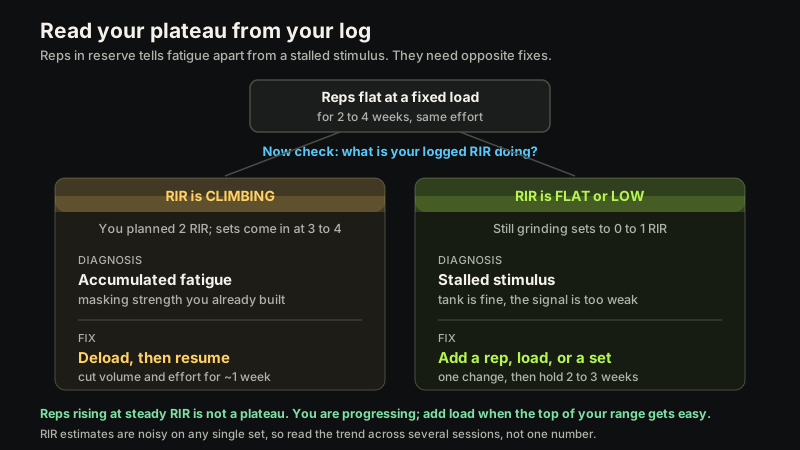
Read your plateau from your log
Here is the whole diagnosis in one table. Look at two trends over the last two to four weeks for the stuck lift: your reps at a fixed load, and your logged reps in reserve on those sets. Where they land tells you which plateau you have and which fix applies.
| Reps at a fixed load | Logged RIR trend | What it means | What to do |
|---|---|---|---|
| Flat | Rising (planned 2, coming in 3 to 4) | Accumulated fatigue is masking your strength | Deload, then resume and expect the loads to move |
| Flat | Flat or low (still grinding at 0 to 1) | Genuine stalled stimulus | Add a rep, add load, add a hard set, or vary the exercise |
| Flat | Falling toward 0 over weeks | Stimulus fading as fatigue rises | Small deload, then add stimulus on return |
| Rising | Steady | Not a plateau, you are progressing | Add load when the top of your rep range gets comfortable |
The table works because reps in reserve is the one field that tracks how hard the set actually was, independent of the number on the bar. When your reps are flat but your logged RIR is climbing, the set is getting subjectively harder at the same output, which is the fingerprint of fatigue. When your reps are flat and your RIR is still pinned at 0 to 1, you are already emptying the tank and the weight still will not move, which means the stimulus, not your freshness, is the limit. RIR estimates are noisy on any single set, so read the trend across several sessions rather than reacting to one number.
How to break a lifting plateau
Once you know which failure mode you are in, the fix is specific instead of a guess.
If it is fatigue: deload, then resume
If your reps are flat and your effort has been creeping up, you do not need to train harder. You need to let fatigue fall so the strength you already built can show up. That is what a deload week is for: a planned, roughly seven-day cut in volume and effort, keeping the loads reasonably heavy but slashing the number of hard sets and stopping every set well short of failure. Expert consensus frames deloading as a core fatigue-management tool across a long training career (Bell et al., 2023), and a week of reduced volume is far too short to cost you muscle: in a controlled study, a mid-program deload did not reduce muscle size compared with training straight through (Coleman et al., 2024). You will usually come back and find the weight that felt immovable now moves, because you were never weak, just buried.
Note the trap: if this was your problem, adding sets or chasing failure to "push through" is exactly wrong. It piles more fatigue onto a system that is already saturated, and the plateau hardens into a stall you cannot grind out of.
If it is a stalled stimulus: give the muscle a reason to change
If your reps are flat while your RIR is still low and grinding, the tank is not the problem, the signal is. You have a few levers, roughly in order of how little you should disturb before reaching for the next one.
- Progress reps before load. The cleanest fix is double progression: work a rep range, add a rep at the same weight session over session, and only add load once you hit the top of the range across all your sets, which is exactly what a progression plan has to write down for each slot. It keeps you progressing when a full weight jump is too big to complete. Progression can come from load or from reps, and both drive growth when effort is high; you do not have to add plates to overload a muscle. If a lift has been stuck at one end of the load spectrum, shifting between heavy low-rep and lighter high-rep work can renew progress without overhauling the rest of your program.
- Micro-load the bar. If you have been trying to jump 5 or 10 pounds and stalling, the jump is too big. Fractional plates of 1 to 2.5 pounds let you add load in a dose you can actually complete, which turns a wall into a ramp.
- Add a hard set or two. If your weekly hard sets for that muscle are on the low side, more volume is a direct lever on growth, within sensible limits (Schoenfeld et al., 2017). Add a set or two per week to the lagging muscle and hold it there for a block before judging. Watch that the new sets are real hard sets and not junk volume tacked on at the end of a session.
- Check your honest effort. The most common hidden cause of a stalled stimulus is training further from failure than you believe. A set you called 1 RIR that was really 4 is not driving much adaptation. Logging RIR live, in the moment, is what keeps that estimate honest instead of a flattering guess reconstructed after the fact.
- Vary the exercise as a last resort. Swapping a stuck movement for a close variation (incline dumbbell press for flat barbell, hack squat for back squat) can restart progression by loading the muscle slightly differently. It is a real lever, but it is also the one that costs you the ability to track progress on the original lift, so reach for load, reps, and volume first.
You rarely need more than one of these at a time. Change one variable, hold it for two to three weeks, and let the log tell you whether it worked. If you do not have a logbook yet, a free workout tracker is enough to see the trend. Changing five things at once is why the last plateau taught you nothing.
Bench press and squat plateaus are the same problem
A stuck bench press or a stuck squat feels lift-specific, and the searches for each are their own little industry, but the diagnosis does not change. A bench press plateau where your reps are flat and your logged RIR is climbing is a fatigue problem, and the fix is a deload, not a new bench program. A squat plateau where you are still grinding to 0 RIR and the bar will not move is a stimulus problem, and the fix is micro-loading, an added set, or reps-before-load progression.
The one honest lift-specific note: heavier, lower-rep compounds like these need a bigger safety buffer, because RIR estimates get noisier as reps get lower and the cost of misjudging a near-maximal single is real. Keep a rep or two more in reserve on your heavy barbell work than you would on a machine, where nothing fails before the target muscle, and read the trend across sessions rather than trusting any single grind. The lift changes the loads and the buffer. It does not change how you read the plateau.
Break your plateau with an honest log
Everything above depends on one thing: a record clean enough to show the two trends that matter. If your training lives in memory or a messy notes app, a plateau is a fog. You know the weight will not move, but you cannot see whether your effort has been climbing or holding, so you cannot tell fatigue from a stalled stimulus, and you are back to guessing.
RIRLift is built to make that read obvious. Because you log the actual load, reps, and reps in reserve for every set on your wrist, your history shows exactly the two lines from the diagnosis table: your reps at a given weight, and your logged RIR on those sets. Previous numbers sit inline as you train, so a set that should be a comfortable 2 RIR and instead grinds to a stop is obvious in the moment, not a vague memory later. The app also totals your weekly hard sets by muscle, which is how you check whether a stalled muscle is simply under-volumed, and it tracks your estimated one-rep max over time, so you can see whether real strength is trending up under the fatigue or genuinely flat. If you want that number for a single set right now, the one-rep max calculator takes your reps in reserve into account.
Acting on the diagnosis is just as concrete. If the read says fatigue, you dial the routine down for a deload week: fewer sets, a higher RIR target, the same or slightly lighter loads, all logged the same way from the wrist so the week stays in your history. If the read says stalled stimulus, you set a target RIR per exercise, run double progression against your rep range, or add a hard set, and the log tells you two to three weeks later whether the plateau broke. If you want to see how a session runs from your wrist, it is the same workflow whether you are pushing through progression or backing off to recover. A plateau you can read is a plateau you can break. The tool's only job is to keep the record honest enough to read.
A lifting plateau is not a wall you throw random fixes at until one sticks. It is a flat trend with a cause, and the cause is legible in your log the moment you record effort alongside load and reps. Confirm it is a real trend, read your reps against your RIR to tell fatigue from a stalled stimulus, apply the one fix that matches, and hold it long enough to see the numbers move. Then get back to progressing.
FAQ
How long does a lifting plateau last?
A genuine plateau lasts as long as its cause goes unaddressed. A fatigue-driven plateau often resolves within a week or two of a deload, because you were not actually weak, just tired. A stimulus-driven plateau lasts until you change something real (add reps, load, or a hard set), then measure it over the following two to three weeks. If you have "plateaued" for only a session or two, that is usually noise rather than a plateau, and the fix is to keep training consistently and keep logging.
Why am I not getting stronger even though I train hard?
The two usual reasons are opposite. Either accumulated fatigue is masking strength you have already built, in which case training harder makes it worse and a deload fixes it, or your stimulus has stalled and the sessions are no longer challenging enough, in which case you need more load, reps, or volume. Logging reps in reserve tells them apart: rising RIR at flat reps points to fatigue, low RIR at flat reps points to a stalled stimulus.
What causes a weightlifting plateau?
Most plateaus come from one of two things: accumulated fatigue from a long run of hard, progressive training, or a stimulus that stopped challenging the muscle (load and reps held too long, weekly volume too low, or sets ending further from failure than you think). Less common causes include under-eating, poor sleep, and inconsistent training. The training causes are the ones your log can diagnose directly.
Should I deload or push harder to break a plateau?
It depends entirely on which plateau you have, which is why the diagnosis matters. If your logged effort has been climbing at the same weights, you are fatigued and should deload. If you are still grinding sets to 0 to 1 RIR and the weight will not move, you are under-stimulated and should add load, reps, or a set. Doing the opposite of what your log says is how a short plateau becomes a long one.
Does changing my workout program break a plateau?
Sometimes, but it is usually the wrong first move. A full program change alters many variables at once, so even if you start progressing again you learn nothing about what was actually wrong, and you lose your progress history on the lifts you swapped out. Change the smallest thing that could plausibly fix your specific plateau (a deload, a rep added, a set added, a micro-load), hold it for two to three weeks, and only overhaul the program if the targeted fixes fail.