
Blog
High reps vs low reps: which actually builds muscle?
Published September 3, 2026 · 11 min read
High reps vs low reps is the oldest argument in the gym, and it usually gets framed as a fork in the road: go heavy for a few reps, or go light for many, and pick a side. The framing is wrong, which is why the argument never ends. Load and reps are two dials on the same machine, and once you know what each dial actually changes, low weight high reps vs high weight low reps stops being a coin flip and becomes a choice you make per exercise, on purpose.
Here is the short version. Low reps with heavy weight build strength best. High reps with light weight build muscular endurance best. For building muscle, the size you came for, both ends work about equally well, and the thing that decides whether either one grows anything is how close to failure you take the set. This post walks through why that is true, what each style is genuinely good at, and how to stop guessing and start choosing. If you want the full menu of rep ranges rather than the heavy-versus-light decision, the best rep range for muscle growth lays out the whole band; this page is about the two ends of it and how to pick between them.
What is the difference between high reps and low reps?
Low reps means roughly 1 to 5 repetitions per set with a heavy load (about 85% of your one-rep max or more). High reps means roughly 15 or more repetitions with a lighter load (under about 60% of your max). The moderate middle, around 6 to 12 reps, is where most people train most of the time. The two extremes are not different exercises; they are the same movement loaded so that failure arrives sooner or later.
That is the whole mechanical difference. A heavy triple and a light set of 20 both end when you cannot do another clean rep. What changes between them is how the fatigue is distributed: the heavy set is short and neurologically demanding, the light set is long and metabolically punishing. The muscle at the end of each, if you actually reached the end, has been asked to do a similar job.
Heavy weight low reps vs light weight high reps: what each one trains
Different loads are good at different things. The mistake is assuming "good at strength" and "good at size" are the same axis. They are not.
| Style | Reps | Load (%1RM) | Best at | The catch | | --- | --- | --- | --- | | Heavy, low reps | 1 to 5 | 85%+ | Maximal strength, neural drive, practising heavy technique | Builds muscle too, but needs more sets to match the volume of lighter work; hard on joints and focus | | Moderate | 6 to 12 | 70 to 85% | Muscle growth per minute of effort | The efficient default, not a magic zone | | Light, high reps | 15 to 30 | under 65% | Muscular endurance, joint-friendly volume | Only grows muscle if taken very close to failure; the early reps are nearly free |
Read down the "best at" column and the debate resolves itself. If your goal is a bigger one-rep max, the heavy end wins because strength is partly a skill of producing force, and you practise that skill with heavy loads. If your goal is size, both ends can get you there, and you choose based on the exercise and your joints rather than on which one is secretly anabolic. The endurance column is the one most lifters do not actually want, which is worth knowing before you spend a training block chasing sets of 25 for a goal they do not serve.
Do high reps build muscle? The benefits of high reps with low weight
Yes, high reps with low weight build muscle, and this is the finding that surprises people who grew up on the heavy-or-nothing school. When you match the total work, light loads taken to failure grow muscle about as well as heavy loads. In a well-controlled comparison of well-trained men, low-load and high-load training produced similar muscle growth, while the heavy group came out ahead on strength (Schoenfeld et al., 2015). A later systematic review and meta-analysis of the same question reached the same conclusion across many studies: hypertrophy is similar between low and high loads, strength favours the heavy end (Schoenfeld et al., 2017).
So the benefits of high reps with low weight are real: they build muscle, they are gentle on your joints, and they let you accumulate volume on movements where heavy loading is awkward or risky. A lateral raise, a cable fly, or a leg extension is far better trained for 15 to 20 than for 4, because loading it like a deadlift turns a clean isolation into an ugly whole-body heave.
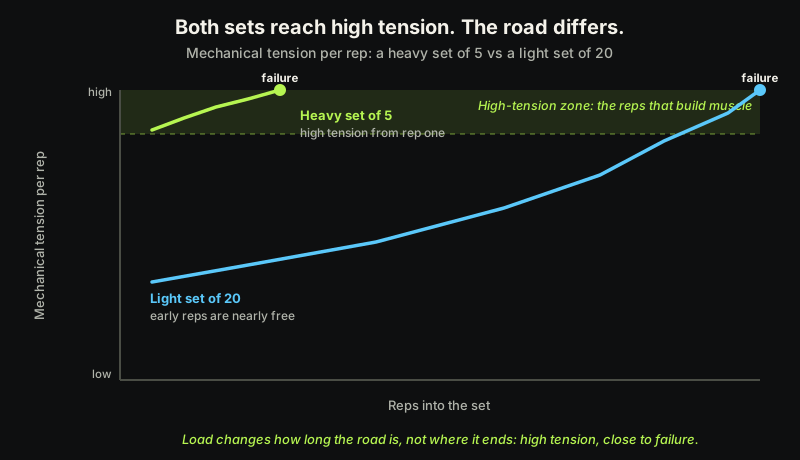
There is a catch, and it is the entire point of this post. Light sets only work if you take them close to failure. When training was equated for effort, only the loads taken to muscular failure produced full growth; a light set stopped well short did far less (Lasevicius et al., 2018). The first ten reps of a set of twenty are close to a warm-up. The growth lives in the last handful, the ones that burn and slow down, and if you rack the weight the moment it gets uncomfortable you skipped the part that mattered. Heavy sets are more forgiving here, because a heavy triple is hard from the first rep. Light sets demand honesty about how many reps you had left.
Do low reps build muscle, or just strength?
Low reps build both, but they are the specialist tool for strength. Training in the 1 to 5 range teaches your nervous system to recruit more muscle fibres at once and to fire them harder, which is a large part of what "getting stronger" means beyond the muscle itself. That neural piece is why a powerlifter can be markedly stronger than a bodybuilder who carries more muscle.
For pure size, low reps are effective but less efficient. Because each heavy set contains so few reps, you need more sets to reach the same growth-driving volume that a moderate set banks quickly, and those heavy sets cost more recovery and more joint stress. That is the practical case against training everything heavy: not that it fails to build muscle, but that it buys the same muscle at a higher price. If your aim is to separate the two goals rather than blend them, hypertrophy vs strength training covers how load, rest, and progression differ once you commit to one.
More reps or more weight? The question dissolves into effort
Here is where the whole high reps vs low reps debate collapses into one variable. If a heavy set of 5 and a light set of 20 grow muscle about equally, then the number of reps is not the thing doing the work. Proximity to failure is. A set of any length taken to within a rep or two of failure is a real stimulus; the same set stopped five reps early is a fraction of one, no matter what the load says.
This is why counting reps and load alone is half a measurement. Two lifters can both "do 12 reps" and get completely different results because one stopped at a grinding twelve and the other stopped at a comfortable one. What separates them is not visible on the bar. It is reps in reserve, the number of clean reps you had left when you stopped. RIR is the same effort scale whether you are grinding a heavy set of 6 or burning through 20 on a cable, which is exactly why it travels across the whole load spectrum when load by itself does not. For most working sets, finishing at about 1 to 3 RIR is the sweet spot; chasing zero on everything usually costs more fatigue than the extra stimulus is worth, a tradeoff we unpack in when to leave reps in reserve.
Underneath RIR sits the actual driver: mechanical tension, the force a muscle fibre produces under load. Heavy sets generate high tension from the first rep. Light sets only reach it in the final reps, as fatigue forces your body to recruit the big fibres it saved. That is the same mechanism read two ways, and it is why "more reps or more weight" is a false choice. Both routes end at high tension close to failure; they just take different roads to get there. It is also why chasing a slow tempo is the wrong lever: time under tension is a byproduct of effort, not a substitute for it.
How to choose: by exercise and goal, not by ideology
You do not pick one side. You match the load to the movement and to what you are training for, and most of the choice makes itself.
- Heavy compounds go lower. Squats, deadlifts, presses, and weighted pulls are where you can load safely and see progress on the bar. Train most of them around 5 to 8 reps. This is also where progressive overload is clearest, because adding a rep or a small plate is unambiguous.
- Most machine and accessory work sits in the middle. Machine presses, rows, and hack squats do well at 8 to 15: enough load to drive tension, enough reps to bank volume without grinding your joints.
- Isolations and joint-sensitive lifts go higher. Lateral raises, curls, leg extensions, and cable work belong at 12 to 20 or more, taken genuinely close to failure so the light load still counts.
Whichever end you pick, the set only counts toward growth if it was hard, and a hard set is the unit you tally when you track weekly training volume. Ten light sets stopped at 5 RIR are not ten hard sets; they are warm-ups you paid recovery for. That distinction, not the rep number, is what decides whether a training block works. If your progress has flatlined, changing the load and rep style on a stale lift is one of the more reliable levers, which is why it shows up in how to break a lifting plateau.
High reps vs low reps: frequently asked questions
Can I build muscle with high reps? Yes. Light loads taken close to failure build muscle comparably to heavy loads when the work is matched (Schoenfeld et al., 2017). The requirement is effort: a high-rep set has to reach roughly 0 to 2 RIR to earn its keep, because the early reps are nearly free.
Is 3 sets of 20 reps too much? Not inherently. Three sets of 20 is a reasonable high-rep prescription for an isolation lift if each set finishes close to failure. It becomes too much only when the reps are so submaximal that they add fatigue without stimulus, which is wasted, junk volume that costs recovery and returns nothing.
Is 4 sets of 12 reps too much? For a single exercise, four hard sets of 12 is a normal, productive amount. Whether it is too much depends on the rest of your week: what matters is your total hard sets per muscle across the week, not the count on any one lift.
Should I lift heavy or light to lose fat? Neither reps nor load drive fat loss; a calorie deficit does. Train in whatever range preserves the most muscle while you diet, which for most people is the same moderate-to-heavy work they were already doing.
How RIRLift keeps high-rep and low-rep sets honest
The reason the high reps vs low reps question is so easy to get wrong is that the one variable that decides it, how close to failure you trained, is the one nothing on the bar records. RIRLift is built around logging exactly that. Every set gets an RIR value alongside its load and reps, so a heavy set of 5 at 1 RIR and a light set of 20 at 1 RIR read as what they are: two equally hard sets that both count, regardless of how different they look.
That makes the comparison across loads legible over time. You can see whether your light isolation work is actually reaching failure or quietly drifting to 4 RIR, and whether your heavy compounds are progressing on the bar the way strength work should. RIRLift does not prescribe your program or pick your loads for you; it records effort accurately enough that you can. You can see how the workflow runs a session from your wrist, RIR and all. Pick the load that fits the lift, take the set close enough to failure to matter, and let the log tell you whether it did.