
Blog
Hypertrophy vs strength training: what actually differs
Published July 23, 2026 · 12 min read
Search "hypertrophy vs strength training" and you get the same table every time: 6 to 12 reps for size, 1 to 5 for strength, short rest for one, long rest for the other. It is not wrong, exactly. It is just the smallest, least useful version of the answer, and it hides the thing that actually decides whether a muscle grows.
Here is the more honest framing. Hypertrophy training and strength training share most of their DNA. Both are resistance training, both add load over time, and both grow some muscle and build some strength. The differences that matter are narrower than the chart implies and live in a few specific levers: how heavy you go, how close to failure you train, how long you rest, and what you are trying to progress. Get those straight and you can train for size, for strength, or for both on purpose instead of by accident. This post walks through what genuinely separates the two goals, where they overlap, and how to log and progress each one so your results come from data instead of a hunch.
What is the difference between hypertrophy and strength training?
Hypertrophy training aims to increase muscle size. Strength training aims to increase the force you can produce, usually on a specific lift. They are different targets, so they reward slightly different methods, but they are not opposites. Getting stronger builds some muscle, and building muscle raises your strength ceiling. The gap is one of emphasis, not category.
The mechanisms explain the emphasis. Muscle growth is driven mostly by mechanical tension applied across enough hard sets, accumulated over weeks. Maximal strength is that plus a large neural component: your nervous system learning to recruit more motor units and coordinate a heavy lift efficiently. That neural piece is why a powerlifter can be far stronger than a bodybuilder who carries more muscle. One trained the skill of a maximal effort; the other trained the size of the tissue.
| Factor | Hypertrophy training | Strength training |
|---|---|---|
| Primary goal | Muscle size | Force on a lift |
| Main adaptation | Mechanical tension, muscle cross-section | Neural drive plus muscle |
| Typical load | ~60 to 85% of 1RM | ~85% and up of 1RM |
| Typical reps | 5 to 30, most work in 6 to 15 | 1 to 5 |
| Proximity to failure | 1 to 3 reps in reserve on most sets | 1 to 4 in reserve, further out on heavy singles |
| Rest between sets | ~1 to 3 minutes | ~3 to 5 minutes |
| Total volume (hard sets) | Higher | Lower, at higher intensity |
| Exercise selection | Compounds plus isolation and machines | Mostly heavy compounds |
Read the table as tendencies, not walls. The rows overlap on purpose, because in practice the two goals share far more than they divide.
The rep range gap is real, but smaller than the chart says
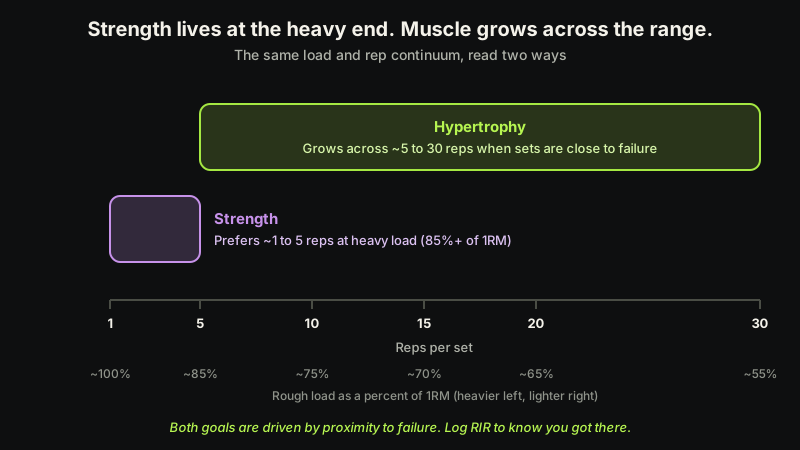
The most repeated claim in every "hypertrophy vs strength" article is that muscle grows in the 8 to 12 zone. Muscle actually grows across a wide band, roughly 5 to 30 reps, as long as the set is taken close enough to failure. Heavy sets of 6 and burning sets of 20 build similar size per hard set when effort is matched, which is the whole high reps vs low reps question in one sentence. That is also why the idea that high reps and low reps build different kinds of muscle does not hold: both grow the same muscle, and you cannot pick a growth pathway by rep count.
The evidence here is fairly settled. A widely cited re-examination of the repetition continuum concluded that similar hypertrophy occurs across a broad spectrum of loads when sets are taken near failure, and that the classic 8 to 12 zone is best read as a time-efficient default rather than a uniquely anabolic range (Schoenfeld et al., 2021). Practical summaries land in the same place: Stronger by Science on the hypertrophy rep range concludes that anywhere from about 5 to 30 reps produces similar growth per set taken near failure. We went deeper on this in the best rep range for muscle growth, and the short version is that the range is a container, not the driver.
Strength is the pickier goal. To lift a heavy weight you have to practice lifting heavy weights, so maximal strength really does prefer the low-rep, high-load end (roughly 1 to 5 reps at 85% and up). You can build a bigger muscle with 15s; you build a bigger max with 3s. This is the one place the old table earns its keep.
So the accurate summary is asymmetric. Muscle grows across almost the whole rep range; strength lives mostly at the heavy end. That single asymmetry, rather than two separate "zones," is what you are actually navigating.
Proximity to failure is the lever both goals share
If muscle grows across a wide rep range, the number on the bar is not doing the work. Effort is. A set of 10 stopped four reps early is a fraction of the stimulus of the same set taken to within a rep or two of failure. This is true for the size goal and, in a different way, for the strength goal too, because a heavy triple that was actually a comfortable five-rep effort did not train much force production.
This is where reps in reserve becomes the common language between the two goals. RIR counts backward from failure, so a set logged at 2 RIR means you believe you had about two clean reps left. It reads the same whether you are grinding a heavy 4-rep squat or burning out a 20-rep leg extension, which is exactly why it travels across loads and rep ranges better than percentages of 1RM. If you need to move between the two, estimating your max from a submaximal set converts an RIR-tagged set into a percentage you can program from. The same effort scale is often written as an RPE score; RIR is just the version that counts reps instead of rating perceived exertion.
The practical targets differ slightly by goal:
- For size, most working sets should finish around 1 to 3 RIR. Close enough to failure to count, far enough to keep the fatigue cost sane so you can do more hard sets across the week.
- For strength, your top heavy sets often sit a touch further from failure (2 to 4 RIR on a heavy single or double), because grinding a true max every session wrecks recovery and technique. The stimulus you want is a fast, well-coordinated heavy rep, not a slow near-miss.
Either way, the honest read on a set is effort, not just load and reps. Two lifters can both "do 5 reps at 225" and get different results because one had two reps left and the other had none.
Where strength and hypertrophy genuinely diverge
Strip away the myths and four real differences remain.
- Load and intensity. Strength needs heavy. Practicing near-maximal loads is how you train the neural side and the specific skill of the lift. Hypertrophy is load-flexible; moderate weights taken close to failure work as well as heavy ones and are kinder to your joints and recovery.
- Rest between sets. Heavy strength sets need long rest, often 3 to 5 minutes, so force output recovers and the next set is not compromised by fatigue. Hypertrophy tolerates shorter rest (1 to 3 minutes) because a little residual fatigue does not blunt growth much. Even here the difference is smaller than people think, which we covered in how long to rest between sets.
- Volume and how it is spent. Hypertrophy responds to accumulating hard sets, so the weekly total of training volume matters a lot. Strength cares more about intensity than raw set count, so strength blocks often run fewer, heavier sets and guard recovery.
- How you progress. For size, you add reps and load inside a range over time. For strength, you chase the load on a small number of key lifts. Both are progressive overload; they just point the progress at different numbers.
Notice what is missing from that list: rep range as a hard wall. It appears indirectly (strength prefers heavy, low-rep work), but it is a consequence of the load and skill demands, not an independent rule.
Can you train for both at the same time?
Yes, and most lifters should. Strength and size are not mutually exclusive, and there is a whole style built on doing both, often called powerbuilding: heavy low-rep work on a few main lifts, then moderate, higher-rep hypertrophy work for everything else. It is a sensible default for anyone who is not a competitive powerlifter or a stage bodybuilder. The PHUL workout is the most popular packaged version of that idea, and it is worth reading for the catch that comes with it: running both styles in one week only works if you give the two day types different effort targets.
A simple way to structure a session:
- Open with the strength stimulus. One or two compound lifts in the 3 to 6 rep range, longer rest, a rep or two in reserve. This is where you push the load over a mesocycle.
- Fill in with hypertrophy work. Accessory compounds and isolations in the 8 to 20 range, shorter rest, taken to 1 to 3 RIR. This is where you bank weekly volume.
The one real tradeoff is recovery. Heavy work and high volume both cost fatigue, so you cannot max out on both at once forever. That is what training blocks are for: emphasize strength for a few weeks, then size, and let the other quality maintain. If you run this on a schedule, our mesocycle guide walks through shifting emphasis across a block.
How to log and progress each goal
This is the part the comparison articles skip. Knowing the difference between the two goals is useless if your logbook cannot tell whether you actually trained the way you intended. Both goals live or die on honest per-set data, and they watch slightly different numbers.
For hypertrophy, watch effort and weekly volume. The unit that counts is a hard set: one taken close enough to failure to drive growth. So you need two things recorded live, in the moment, not reconstructed from memory: the actual RIR of each set, and the running total of hard sets per muscle across the week. A planned 2 RIR that came in at 4 means add load; ten sloppy sets at 5 RIR are closer to warm-ups you paid recovery for than real volume.
For strength, watch load and estimated 1RM. The signal is whether the weight on your key lifts is trending up at a given effort. An estimated 1RM (e1RM), computed from the load, reps, and RIR of your top sets, smooths out the day-to-day noise so you can see the trend even when you are not testing a true max. A 5-rep set at 225 taken to 1 RIR is stronger than a 5-rep set at 225 taken to 3 RIR, and e1RM captures that where raw load alone cannot.
RIRLift is built to make both readable from the same log. You set a target rep range and RIR per exercise on iPhone, then log the actual load, reps, and RIR for every set on Apple Watch, in a tap or a turn of the Digital Crown, while the set is fresh. It totals your hard sets by muscle for the size side and surfaces e1RM trends for the strength side, from the same taps. You can see how a session runs from your wrist, phone left in your bag.
That is the difference between guessing which goal you trained and knowing. The table at the top of every article tells you the plan; your log tells you what actually happened.
Which should you choose?
Match the goal to what you want, then let the levers above follow.
| If your goal is | Emphasize | Rep range | Rest | Watch this number |
|---|---|---|---|---|
| Look more muscular | Hypertrophy | 6 to 20 | 1 to 3 min | Weekly hard sets per muscle |
| Get stronger on the big lifts | Strength | 1 to 5 | 3 to 5 min | Estimated 1RM trend |
| Both (most lifters) | Powerbuilding | 3 to 6 heavy, then 8 to 20 | Mixed | Both, by block |
For the large majority of people in the gym, the answer is "mostly hypertrophy, with enough heavy work to keep getting stronger." You do not have to pick a tribe. You just have to know which lever you are pulling on a given set, and log it honestly enough to tell whether it worked.
FAQ
Is it better to train for strength or hypertrophy?
For most lifters, a blend is best. Muscle grows across a wide rep range, so you can build size with moderate loads while keeping some heavy, low-rep work to drive strength on your main lifts. Only competitive powerlifters or physique competitors need to specialize hard. If you are unsure, run mostly hypertrophy work and anchor a couple of compounds in the 3 to 6 rep range.
Does hypertrophy training increase strength?
Yes. A bigger muscle has a higher strength ceiling, and hypertrophy work still involves lifting challenging loads, so it builds real strength, especially in less-trained lifters. It just builds maximal strength less efficiently than dedicated heavy, low-rep practice, because it trains less of the neural, skill side of a one-rep max.
Do you need heavy weights to build muscle?
No. Sets taken close to failure build similar muscle across roughly 5 to 30 reps, so moderate loads work well and are easier on your joints. Heavy weight is required for maximal strength, not for size. What size training does require is genuine proximity to failure, usually 1 to 3 reps in reserve on your working sets.
How many reps is best for hypertrophy versus strength?
Hypertrophy grows across about 5 to 30 reps, with most work sitting in the efficient 6 to 15 band. Maximal strength prefers 1 to 5 reps at heavy loads, because it trains force production and lifting skill. Anchor compounds lower, fill volume with moderate and higher-rep accessory work, and take every set close enough to failure to count.