
Blog
Sarcoplasmic vs myofibrillar hypertrophy: the rep-range myth
Published August 13, 2026 · 10 min read
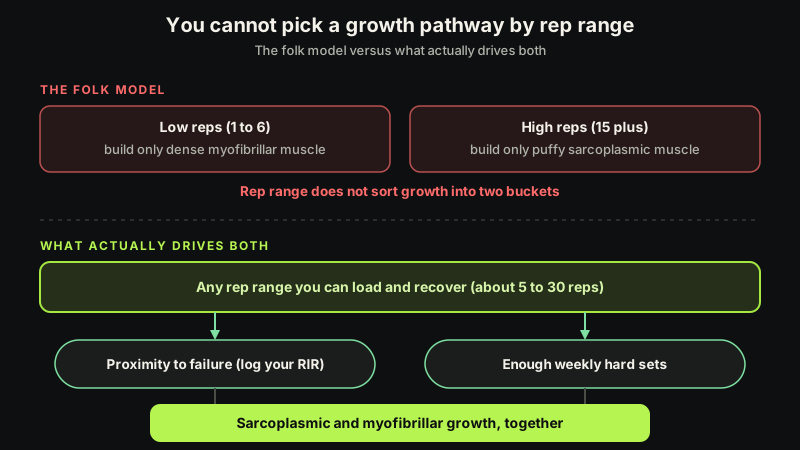
Somewhere in every lifter's education is the idea that muscle grows two different ways, and that you pick which one by choosing your rep range. That belief has a name: the sarcoplasmic vs myofibrillar hypertrophy model, the two ways a muscle fiber is said to enlarge. Go heavy for a few reps and you build dense, functional myofibrillar muscle. Pump out high reps until you are burning and you build puffy, water-filled sarcoplasmic muscle that looks big but does not do much. So you split your week into "strength days" and "pump days" and feel like you are dialing two separate growth pathways on purpose.
It is a tidy story, and it has been repeated in gyms and training articles for decades. The two types of hypertrophy are real cellular phenomena, and the scientific debate about how much each one contributes is genuine and ongoing. What does not survive contact with a training log is the prescription bolted on top: that your rep range selects which type you grow. That part is folklore. Both adaptations answer to the same two levers, and those levers happen to be the ones you can actually measure set by set. This post explains what sarcoplasmic and myofibrillar hypertrophy are, what the evidence does and does not say about training each one, and why the practical answer is both simpler and more useful than trying to pick a pathway.
What is sarcoplasmic hypertrophy?
Sarcoplasmic hypertrophy is an increase in the volume of the sarcoplasm, the fluid and non-contractile contents inside a muscle fiber. That includes water, glycogen, mitochondria, and various enzymes and structures that surround the contractile machinery but do not themselves generate force. When this compartment expands relative to the contractile proteins, the fiber gets bigger without a proportional gain in raw force output.
This is the growth people associate with the "pump" and with higher-rep, shorter-rest training. The reasoning is that metabolic-stress-heavy work drives fluid and glycogen accumulation, so the muscle swells in size more than in strength. Some of that swelling is transient (the acute pump fades in hours), and some appears to be a longer-lasting structural change. That distinction, temporary versus durable, is exactly where the science gets interesting.
What is myofibrillar hypertrophy?
Myofibrillar hypertrophy is growth of the contractile proteins themselves, the actin and myosin filaments packed into the myofibrils that shorten to produce force. Add more of this material, or pack it more densely, and the fiber gets both bigger and stronger, because the thing that grew is the thing that pulls.
This is the growth people associate with heavy, low-rep training and high mechanical tension. Because the contractile apparatus is what you are adding, the folklore frames it as the "quality" hypertrophy: denser muscle, more force per unit size, the look and function of a strong lifter rather than an inflated one. As we will see, the heavy-reps-only prescription attached to it is the weakest part of the whole model.
Sarcoplasmic vs myofibrillar hypertrophy: the real difference
Strip out the training claims and the cellular distinction is straightforward. One is growth of the stuff around the contractile machinery; the other is growth of the machinery itself. Here is the honest comparison, with the folklore column separated from the reality column so you can see where the story bends.
| Sarcoplasmic hypertrophy | Myofibrillar hypertrophy | |
|---|---|---|
| What grows | Fluid, glycogen, mitochondria, non-contractile content | Actin and myosin, the contractile proteins |
| Effect on force | Size gain with little direct strength gain | Size and strength gain together |
| Folklore trigger | High reps (15+), short rest, "the pump" | Low reps (1 to 6), heavy load |
| What the evidence suggests | A real but debated adaptation; you cannot reliably isolate it | Real and well established; still driven by tension, not rep count alone |
| Can you target it by rep range? | Not in any controlled way | Not in any controlled way |
Read the bottom row twice, because it is the whole point. The two phenomena are real. The idea that your rep selection is a dial that routes growth into one bucket or the other is what fails.
Can you actually train one over the other?
This is where an evidence-literate reader deserves the full picture, not a slogan. Two things are true at once, and cheap articles pick only one.
First, sarcoplasmic hypertrophy is not fake. A frequently cited review by Roberts and colleagues (2020) concluded that a disproportionate expansion of the sarcoplasm relative to contractile protein does appear to occur under certain training conditions. So dismissing the concept as a myth is wrong. The cellular event is plausible and partly supported.
Second, and this is the part the folklore gets backward, the rep-range prescription does not hold. You cannot lift in a way that grows only the sarcoplasm or only the myofibrils. Both compartments respond to the same overall training, and in practice they grow together. Even studies set up to separate "sarcoplasmic-style" from "myofibrillar-style" training do not deliver the neat result the gym story predicts. A small 2025 trial by Gezer and colleagues compared the two training styles and reported that the myofibrillar-style group actually showed greater muscle growth on ultrasound, the opposite of "high reps for more size." It is a single small study and should be read as one data point, not a verdict, but it points the same direction as the broader literature: rep range is not a size-versus-quality switch.
The cleaner way to think about it: heavy and light training both build muscle, and both build some strength, as long as the sets are hard. The difference in what grows at the cellular level is real but is not something you steer with your rep counter. If you want the deeper mechanism, we covered it in mechanical tension, which is the actual driver underneath both adaptations, versus the metabolic stress that the pump story leans on.
What actually drives both
If rep range is not the lever, what is? Two things, and they are the same two that drive muscle growth in general.
The first is proximity to failure. Muscle grows across a wide band of loads, roughly 5 to 30 reps, provided the set is taken close enough to failure to recruit and fatigue the high-threshold motor units (Stronger by Science on the hypertrophy rep range). A heavy set of 5 and a burning set of 20 build similar size per hard set when effort is matched. What separates a growth set from a junk set is not the number on the bar; it is how many reps you left in the tank. That is why reps in reserve is the number worth tracking. A set logged at 2 RIR means you believe you had about two clean reps left, and it reads the same whether you are grinding a heavy triple or finishing a long set of curls.
The second is weekly volume: the number of hard sets you give a muscle across the week. Total contractile and sarcoplasmic growth both accumulate from doing enough stimulating sets and recovering from them, not from routing certain sets into a "sarcoplasmic" bucket. This is why training volume for hypertrophy is the lever that actually moves size over a block, and why chasing the pump for its own sake (time under tension belongs to the same family of proxy-chasing) tends to add fatigue faster than growth.
Put together, the prescription that replaces "pick a pathway" is boring and effective: train each muscle across a rep range you can load and recover, take your working sets close to failure (a low RIR), and hit enough hard sets per week. Do that and you grow both compartments, because you were never able to separate them anyway.
Is sarcoplasmic hypertrophy "temporary"?
This is the most useful objection, and it deserves a straight answer. Part of what makes a muscle look bigger after high-rep work is an acute pump: blood and fluid shift into the muscle during the session and drain out within hours. That part is genuinely temporary, and it is why the mirror after a hard set flatters you and Monday morning does not.
But "the pump is temporary" does not mean all sarcoplasmic expansion is. Longer-term increases in stored glycogen and the structures around the myofibrils appear to be real, durable changes for trained lifters, not just a transient swell that vanishes by the next morning. The practical takeaway is the same either way, and it does not depend on winning the physiology argument: do not judge a session, or a training block, by how big you looked in the moment or how hard the pump felt. Judge it by whether the numbers you logged are trending up over the weeks. A pump is a sensation, and sensations lie. Progress is a record, and a record does not.
How to train for both without guessing the pathway
You do not need a "sarcoplasmic day" and a "myofibrillar day." You need a plan that specifies effort and volume, and a way to check that you actually hit them. Here is the whole method.
- Pick a rep range you can load and recover, and vary it by exercise. Heavier compounds (5 to 8) and higher-rep isolation work (10 to 20) both build muscle. The variety is for joint health and loadability, not for targeting a cell compartment. If you want the full argument, see the best rep range for muscle growth.
- Take working sets close to failure. Most sets should finish around 1 to 3 RIR: close enough to count, far enough to keep the fatigue cost sane so you can do more hard sets. Log the RIR you actually hit, not the one you meant to.
- Hit your weekly volume. Track hard sets per muscle across the week, not just per session. This is the number that predicts growth, and it is easy to lose count of without a record.
- Judge by the log, not the mirror. Rising load and reps at the same RIR is growth. A great pump on a day your numbers stalled is not.
None of that requires knowing which compartment grew, because you cannot steer that anyway. This is exactly the workflow RIRLift is built around: your load, reps, and RIR come pre-filled from last time so you confirm a set in a tap on your wrist, and your weekly hard sets per muscle add up automatically so the two levers that actually drive both kinds of hypertrophy stay in front of you instead of buried in a notebook.
FAQ
Is myofibrillar hypertrophy better than sarcoplasmic? For most lifters the question is moot, because you grow both together and cannot reliably train one alone. Myofibrillar growth is the part that also raises strength, so if you care about force output it is the more valuable adaptation, but you get more of it by training hard across a full rep range, not by avoiding high reps. If your goal is specifically strength, the difference between hypertrophy and strength training is the more useful frame.
Does myofibrillar hypertrophy increase size? Yes. Adding contractile protein makes the fiber both bigger and stronger. It is the growth most directly tied to getting visibly and functionally more muscular, which is why the "high reps for size" folklore has it backward.
What are the three types of hypertrophy? People usually mean sarcoplasmic hypertrophy, myofibrillar hypertrophy, and sometimes "connective tissue" or hyperplasia (an increase in fiber number) as a third. Hyperplasia is not well established in humans, so for training purposes the useful split is the two above, and even that split is not something you control with your rep range.
How do I maximize myofibrillar hypertrophy? The same way you maximize hypertrophy in general: train close to failure, accumulate enough hard sets per week, and progressively overload over a block. Heavy loading contributes, but effort and weekly volume do the heavy lifting, and those are the two things worth logging every set.