
Blog
Time under tension: does it actually build muscle?
Published July 21, 2026 · 9 min read
You can spot someone chasing time under tension from across the gym. Every rep of the lat pulldown takes five slow seconds down and five slow seconds up, the stack is half of what they could handle, and their face says they are sure this is the secret. Two racks over, someone loads a real weight, takes the set close to failure, and racks it in forty seconds. A year later one of them is noticeably bigger, and it is usually not the person who was counting.
Time under tension is one of the stickiest ideas in training because it sounds mechanistic and it feels productive. The longer the muscle works, the more it should grow, right? The evidence says the story is narrower than that, and getting it right changes how you run a set and what you bother to write down afterward.
What is time under tension?
Time under tension, often shortened to TUT, is the total time a muscle spends under load during a set. It is the sum of every rep's tempo: the lowering phase (the eccentric), the lifting phase (the concentric), and any pause at the top or bottom. Ten reps at roughly three seconds each is about thirty seconds of tension. The same ten reps grinding at six seconds each is about a minute.
You will see lifting tempo written as a string of numbers like 3-1-2-0: three seconds down, a one-second pause at the bottom, two seconds up, no pause at the top. Multiply the per-rep total by your reps and you have the set's time under tension.
Search the term and you land in a fight. One camp treats TUT as a hidden lever and tells you to slow every rep to a crawl. The other camp declares time under tension dead and irrelevant. Both are wrong in the same way: they treat a number on a clock as if it were the thing that grows muscle. It is not. It is a shadow of the thing that grows muscle.
Does time under tension matter for muscle growth?
Time under tension for hypertrophy matters only to the extent that it tracks something else: how many hard, close-to-failure reps you did against a meaningful load. When it drifts away from that, it stops predicting growth.
The cleanest evidence comes from studies that hold the work roughly equal and change only the tempo. A systematic review and meta-analysis of repetition duration by Schoenfeld and colleagues found that a wide range of rep tempos, from about half a second to eight seconds per rep, produced similar muscle growth when sets were taken to or near failure. The one clear loser was the extreme: volitionally very slow reps, longer than roughly ten seconds each, were inferior for hypertrophy, most likely because they force a much lighter load.
That is the whole finding in one sentence. Within a normal range, how fast or slow you move the weight barely changes muscle growth, as long as you are training hard. Pile on so much tempo that the load collapses, and growth suffers.
Why? Because the real drivers are mechanical tension and effort, not elapsed seconds. A muscle grows in response to hard reps against a heavy-enough load, and the last few reps before failure are the ones that count most. That is the logic behind effective reps and hard-set counting, which Stronger by Science lays out in its work on training volume: a set's value comes from its stimulating reps, not its duration. Push the same idea from the other direction and you get proximity to failure. A meta-analysis of proximity-to-failure training found that training closer to failure carries a small hypertrophy advantage, and that you do not need to hit literal failure to collect most of it. Nowhere in that picture is a stopwatch.
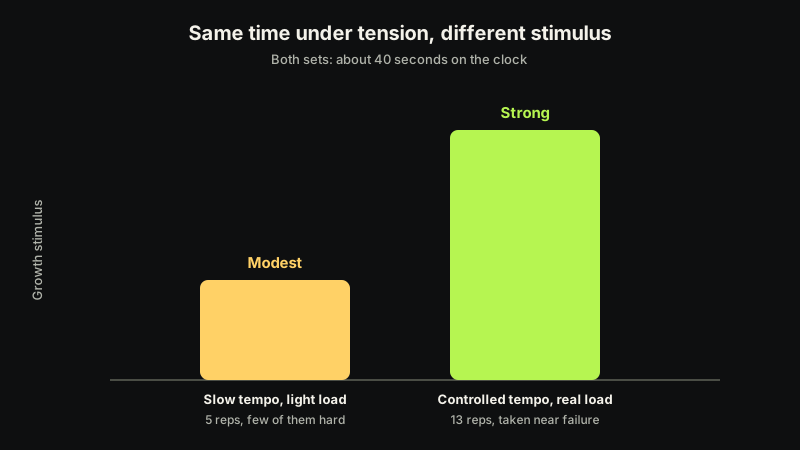
The table below shows why the seconds mislead. Both sets read the same on a clock. Only one delivered the load and the hard reps that actually drive growth.
| Slow tempo, light load | Controlled tempo, real load | |
|---|---|---|
| Tempo per rep | ~8 seconds | ~3 seconds |
| Load | Light (about half) | Challenging, near your limit |
| Reps | 5 | 13, taken close to failure |
| Time under tension | ~40 seconds | ~40 seconds |
| Hard reps near failure | A few | Many |
| Mechanical tension | Low | High |
| Growth stimulus | Modest | Strong |
Where controlling tempo actually helps
None of this means tempo is irrelevant to how you lift. It means tempo is a control cue, not a dose you crank up. Used that way it matters, and it is worth getting right.
Control the eccentric. Lowering the weight under control, rather than letting it drop, keeps tension on the target muscle through the part of the rep where a lot of the stimulus lives. A rough one to three seconds down is plenty. You are not counting toward a magic number; you are refusing to freefall.
Own the full range of motion. A controlled tempo makes it much harder to cheat range. If you are exploding up and crashing down, you are usually shortening the rep and letting momentum do the work. Slowing down just enough to feel the muscle through the whole range is where time under tension earns its keep, especially on isolation work. The one deliberate exception is training the stretched portion on purpose, which is why half reps at long muscle lengths hold up despite covering less distance.
Kill the momentum reps. The fastest way to log a rep that did nothing is to heave it with body English. A deliberate concentric, roughly a second of real intent to move the bar, keeps the working muscle on the hook instead of handing the rep to a swing. Fast on purpose is fine; sloppy and bouncing is not.
So the practical tempo for most hypertrophy work is unremarkable: control the lowering phase, move the weight up with intent, do not bounce, and use a full range. That is a tempo you can hold while still loading the exercise properly, and it is close to what most good lifters already do without a metronome.
Where chasing time under tension backfires
The failure mode is treating more seconds as more growth and reverse-engineering your training from the clock.
When you slow reps down far enough to pad the TUT number, the load has to fall, sometimes by half. Now you are doing a lighter set that feels brutal because of the metabolic burn, and mistaking that burn for a growth signal. The burn is real; it is just not the driver. You have quietly turned a set that could have built size and strength into a slow, light grind that does neither especially well. Progression stalls too, because there is not much load left to add.
The mirror-image error is just as common: dropping tempo entirely and bouncing the weight to hit a rep count. That inflates reps while stripping tension off the muscle, so your log overstates the work you actually did. This is exactly how junk volume hides in a training record. The reps are there; the effective reps are not.
Both mistakes share a root cause. They optimize a number that is easy to chase, seconds or reps, instead of the thing that is harder to chase but actually matters: hard reps close to failure at a load worth using.
Time under tension vs reps and RIR: what to actually track
Here is the practical problem with time under tension, even if you decided it mattered: you cannot reliably measure it. Try counting seconds under load while you grind through the last two reps of a heavy set. You cannot, and you should not want to, because the number would not tell you what you need to know anyway.
Two things do tell you: how many reps you got, and how close to failure you stopped. Reps capture the work. Reps in reserve captures the effort, which is the part that load and rep count alone always miss. A set of eight left at 3 reps in reserve and a set of eight taken to the edge read the same in a plain logbook and are not the same set. Only the effort estimate separates them, which is why how hard each set should be is a question you answer per set, not once per program.
Reps and RIR also travel across tempos. Whether you took three seconds or five on the eccentric, "eight reps at 1 RIR with 80 kg" is a complete, comparable record of that set. Next week you try for nine reps at the same load, or the same eight at a lower RIR, and you have progression you can see. That is the whole game, and it is why the exact rep count matters less than the effort behind it: the number is a container, the effort is the stimulus.
How to put it to work
You do not need a tempo prescription. You need a few habits and an honest log.
- Control the eccentric and use a full range. One to three seconds down, no dropping, no bouncing. That is all the tempo management most hypertrophy training needs.
- Pick a load you can take to 1 to 3 reps in reserve in your chosen rep range. Effort close to failure is the driver, and the weekly hard sets you accumulate at that effort are the dose.
- Progress load and reps, not seconds. Add a rep, then add weight once you reach the top of your range. Double progression gives you a lever the clock never will.
- Log reps and RIR for every working set. That record, not a tempo count, is what tells you whether a set counted and whether your training is moving.
Slowing your reps to a crawl is not a hypertrophy hack. It is usually just a lighter set wearing a serious face.
Log the work that actually counts
Time under tension is a proxy that fell in love with itself. It correlates with growth because it usually rides along with hard reps near failure, and the moment you chase the seconds directly, you lose the thing that made the number useful in the first place.
RIRLift is built around the variables that actually move the needle. You set a rep range and an RIR target per exercise on iPhone, then log load, reps, and reps in reserve for every set on your Apple Watch, in the moment, with last time's numbers pre-filled so confirming a set is a tap or a turn of the Digital Crown. Afterward, weekly hard sets by muscle show you the real dose you delivered. No stopwatch, no tempo column, no counting seconds mid-set. Just the effort and the volume that build muscle, captured while a session runs from your wrist.