
Blog
How long to rest between sets, based on your goal
Published July 13, 2026 · updated August 24, 2026 · 13 min read
Ask how long to rest between sets and you want a single number. The honest answer depends on what you are training for, but the ranges are simple, and one of them is probably longer than you have been told. For building muscle, most lifters cut their rest too short, chase a "pump" or a metabolic burn, and quietly leave reps on the table. Those lost reps are lost stimulus.
Here is the quick version, then the reasoning behind it. Rest is not dead time between the sets that matter. It is what protects the quality of the next set, which is the set that matters. Rest too little and your reps drop, your load drops, and the effort reading you would use to make progression decisions gets noisy. This post gives you the ranges by goal, corrects the most common mistake, and shows how to run your rest without staring at a clock or reaching for your phone.
How long should you rest between sets?
Your rest depends on the goal of the set. As a starting point:
- Strength (heavy, low reps): rest 2 to 5 minutes.
- Hypertrophy (muscle growth): rest 1.5 to 3 minutes on compounds, about 1 to 2 minutes on isolation.
- Muscular endurance (high reps, conditioning): rest 30 to 90 seconds.
| Goal | Rep range | Rest between sets | Why |
|---|---|---|---|
| Strength | 1 to 5 | 2 to 5 min | Full recovery of the nervous system and energy stores so you can lift heavy again |
| Hypertrophy, compounds | 6 to 12 | 1.5 to 3 min | Enough recovery to keep reps and load high, which is what drives the stimulus |
| Hypertrophy, isolation | 12 to 20 | 1 to 2 min | Smaller muscles recover faster; the set still needs to be near failure |
| Muscular endurance | 15+ | 30 to 90 sec | Short rest trains the muscle to work while fatigued |
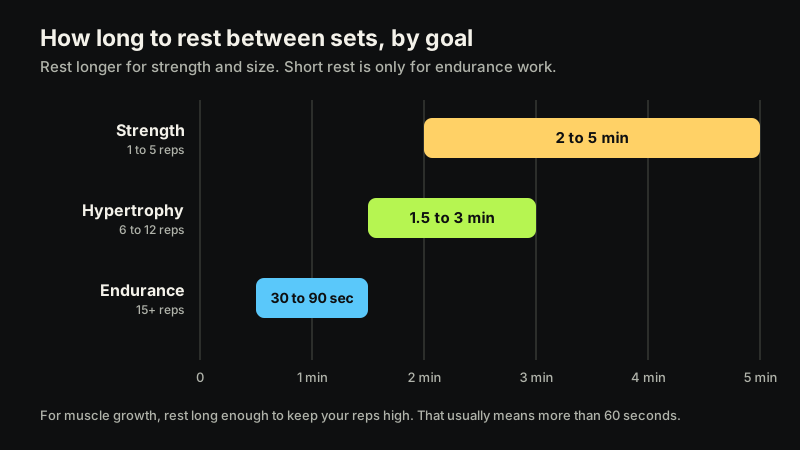
That table answers the search. The rest of this post is why the hypertrophy row is longer than the advice you usually see, and how to actually run these rest periods during a session.
Why rest length matters more than it looks
A set does not build muscle because it happened. It builds muscle because it was hard enough, close enough to failure, with enough clean reps to count. Rest is the thing that lets the next set be that.
Cut your rest short and three things happen. Your reps fall, so you accumulate less volume at a given load. Your load falls if you try to hold reps constant, so tension drops. And your effort reading gets unreliable, because a set that ends early from leftover fatigue feels maximal without actually being close to a true failure point. You end up tired but understimulated, which is the worst trade in the gym. It also quietly changes how many sets a session can actually hold, because sets that decay early stop counting toward your weekly total.
Longer rest fixes all three at once. It is not wasted time. It is the price of a productive next set.
How long to rest between sets for hypertrophy
This is where the common advice is out of date. For years the standard line was that short rest, roughly 30 to 60 seconds, builds more muscle because it drives "metabolic stress" and a bigger pump. That idea is still repeated across the top search results and in most quick summaries.
The more recent evidence points the other way. In a controlled study of resistance-trained men, resting 3 minutes between sets produced greater gains in muscle thickness and strength than resting 1 minute, most likely because the longer rest let lifters keep their reps and total volume higher across the workout (Schoenfeld et al., 2016). The older short-rest recommendation traces back to work like de Salles et al., 2009, which is still widely cited but predates the volume-focused understanding we have now.
The practical takeaway is not "rest as long as possible." It is that for muscle growth you should rest long enough to keep your reps up, which for most compound lifts lands around 1.5 to 3 minutes, and for smaller isolation work closer to 1 to 2 minutes. If your reps are falling off a cliff set to set, you are resting too little. The pump is a sensation, not the goal. Preserved reps at a real effort level are the goal, and they are also what fills out your weekly training volume, since only genuine hard sets count toward it.
Rest for strength and for endurance
The two ends of the table follow the same logic from different directions.
Strength lives at heavy loads and low reps, where the limiter is your nervous system and your phosphate energy stores, not local muscle burn. Those systems take longer to bounce back, so heavy sets of 1 to 5 want 2 to 5 minutes, sometimes more on a maximal top set. Rush a heavy triple and the next one turns into a grind at a lower weight, which trains fatigue tolerance more than force. This is also the range where progressive overload is cleanest to track, because a fully rested set lets you add a rep or a small plate and know the change was real, not a recovery artifact.
Muscular endurance is the opposite. If you are doing high-rep sets, circuits, or conditioning work, short rest of 30 to 90 seconds is the point. You are deliberately training the muscle to keep working while it is still fatigued. That is a valid goal. It is just not the fastest way to add size, so do not borrow endurance rest periods for your hypertrophy work by accident.
How hard the set was changes how long you rest
Goal-based ranges are the starting point, not the whole answer. Two more factors move your rest inside the range.
How big the movement is. A set of heavy squats or deadlifts taxes multiple large muscle groups and your whole system, so it needs more rest than a set of the same effort on a leg extension. Push compounds toward the top of their range and let isolation work sit at the bottom.
How close to failure you took it. A set finished at 3 reps in reserve clears quickly. The same exercise taken to a true 0 RIR leaves you far more fatigued and wants noticeably more rest before the next set is any good. If you train near failure often, plan for longer rest, not shorter. How close you push in the first place is its own decision, one we cover in how hard each set should be.
This is the link most rest advice misses: rest and effort are connected. The harder the set, the more rest it earns, because the rest is there to protect the quality and the honesty of what comes next.
How long should beginners rest, and what about between exercises?
Two questions the goal-based ranges leave open, and both come up constantly.
Beginners. If you are new to lifting, the rule does not change: rest long enough to keep your reps up. In practice that usually lands at the moderate end, around 1 to 2 minutes. Your loads are still light so the muscle itself recovers quickly, but your form and coordination fatigue faster than a trained lifter's, and a sloppy rep late in a set teaches the wrong pattern. You do not need to sit for five minutes between sets of goblet squats. Rest until your breathing settles and you are sure you can hit your target reps with clean technique, then start.
Rest between exercises is a different clock than rest between sets. Between sets of the same exercise, you follow the ranges above. Between two different exercises you can usually move on as soon as you feel recovered, because working a different muscle group gives the first one a head start. The exception is when you pair two moves back to back on purpose to save time, which compresses rest deliberately rather than by accident. When you do that, the effort you record afterward still has to be the real number, not one coloured by how gassed the pairing left you.
Why short rest quietly corrupts your RIR
If you log reps in reserve, and you should, undersized rest does something sneaky. It inflates your sense of effort.
Say you plan a set at 2 RIR. You rest 45 seconds, start the next set still half-gassed, and grind to a stop two reps early. It felt like a hard 0 RIR set, so you log it that way. But you did not fail because the muscle was near its true limit. You failed because you were still tired from the last set. Now your log says 0 RIR when the muscle had more in the tank, and your next-session decision, add load or hold, is built on a bad number.
Rest enough and your effort reading means what it says. A set logged at 2 RIR was actually about two reps from a clean failure, not two reps from a fatigue wall. That is the whole value of tracking reps in reserve: it only works as a progression signal if the number reflects the muscle, not your incomplete recovery. Rest is what keeps the signal clean. The same distortion shows up on purpose when you compress rest to save time, which is one reason pairing two exercises into a superset needs the real RIR logged rather than guessed from how gassed you feel.
How to time your rest without watching the clock
Knowing the numbers is easy. Actually holding them, set after set, for a whole session, is where it falls apart. Most people either guess, drift long while scrolling, or cut rest short because standing around feels unproductive. All three wreck the consistency that makes rest work.
The fix is to let something else keep time so you do not have to. A rest timer that starts on its own the moment you finish a set turns rest from a guess into a number you can trust, without adding a task. The trap is that on most apps the timer lives on your phone, so timing your rest means holding your phone, which means the feed is one thumb-swipe away and your focus is gone. That is the exact problem with logging between sets on a phone at all, which is why logging on your wrist wins.
The cleaner version keeps the timer on your wrist. You set a rest target per exercise once, then during the session the countdown runs on the watch and taps you when the next set is due. Your phone stays in your bag, your rest stays consistent, and you are not deciding "has it been long enough" 20 times a workout.
How RIRLift runs your rest
RIRLift is built around this idea. When you create a routine on iPhone, you set a rest target for each exercise, alongside its rep range and RIR target. Then during the workout, on Apple Watch, logging a set auto-starts that rest timer on your wrist. The countdown lives where your attention already is, and the phone never has to come out.
Because the timer is tied to the set you just logged, your rest stays honest without any clock-watching. And because RIRLift records the load, reps, and RIR for every set live, you can see the payoff directly: when your rest is adequate, your reps hold and your logged RIR reflects the muscle, so your progression decisions come from real numbers. RIRLift then totals your hard sets by muscle across the week, so you can check that all those well-rested, near-failure sets are actually adding up to enough stimulus. You can see how a session runs from your wrist, or how the weekly review turns each logged set into volume by muscle.
So the full answer to how long to rest between sets is two parts. Pick the range that matches your goal, longer than you might think for hypertrophy. Then run it consistently by letting the timer keep time, so every set starts recovered enough to count. If you also match that to the right load, the best rep range for the exercise, and a real effort target, the rest takes care of itself.
FAQ
How long should I rest between sets to build muscle?
For most hypertrophy work, rest 1.5 to 3 minutes on compound lifts and about 1 to 2 minutes on isolation exercises. The goal is to recover enough to keep your reps and load high on the next set, since preserved reps at a genuine hard effort are what drive growth. Resting too short usually costs you reps, which costs you stimulus.
Is resting 3 minutes between sets too long?
Not for hypertrophy or strength. Research found 3 minutes of rest produced more muscle and strength than 1 minute in trained lifters, because the longer rest kept total volume higher. Three minutes is on the longer side for isolation work, but for heavy compounds it is well within the useful range.
Is 2 minutes enough rest between sets?
For most hypertrophy work, yes. Two minutes sits right in the middle of the useful range and is plenty for compound lifts in the 6 to 12 rep range and for nearly all isolation work. Use it as a sensible default, then lengthen it toward 3 minutes for heavy, near-failure compound sets and shorten it toward 1 minute for small isolation movements. The test is always the same: if your reps hold on the next set, the rest was enough.
How long should beginners rest between sets?
Around 1 to 2 minutes for most work. As a beginner your loads are light and the muscle recovers fast, but your technique fatigues sooner than a trained lifter's, so the moderate range protects your form without wasting time. Rest until your breathing settles and you are confident of clean reps, rather than fixating on an exact number.
How long should you rest between exercises?
Usually less than you think, because moving to a different muscle group lets the first one keep recovering. Rest between exercises until you feel ready to give the next movement a real effort, which is often about a minute for unrelated lifts. The set-to-set ranges only apply within the same exercise; deliberately pairing two exercises back to back is a separate choice made to save time.
Does short rest build more muscle through metabolic stress?
The older view said yes, but the more recent evidence does not support it for most lifters. When rest is very short, your reps and load drop enough that the loss of volume outweighs any extra metabolic stress. Rest long enough to hold your reps, then let effort and weekly volume do the work.
How do I keep my rest consistent during a workout?
Use a rest timer that starts automatically when you finish a set, ideally on your wrist so your phone stays away. In RIRLift you set a rest target per exercise on iPhone, and logging a set on Apple Watch auto-starts the countdown, so you never have to guess or watch the clock.