
Blog
Am I gaining muscle or fat? What the scale won't tell you
Published September 7, 2026 · 14 min read
You stepped on the scale, it went up three pounds, and now you are staring at the number trying to decide whether to celebrate or panic. That is the wrong instrument for the question you are actually asking. The scale weighs everything at once: muscle, fat, water, food still in your gut, and how much you drank yesterday. It cannot separate the pound you wanted from the pound you did not, so on its own it will never tell you whether you are gaining muscle or fat.
The good news is that you almost certainly already own a better instrument, and it is not a DEXA scanner. It is your training log. A clean record of load, reps, and how hard each set felt answers the muscle-or-fat question earlier and more cheaply than the scale, the mirror, or any gadget, as long as you know how to read it. This post walks through why the scale fails, what body composition actually is, and the three signals that answer the question honestly: your log first, then a tape measure and photos to confirm.
If you train with RIRLift, the first of those signals is already sitting in your history. The rest of this is about learning to read it.
Why the scale can't answer the question
Start with the myth that causes half the confusion. You have heard that muscle weighs more than fat. A pound is a pound, so that phrasing is nonsense, but the real fact underneath it is true and useful: muscle is denser than fat, roughly 15 to 18 percent denser by volume (Cleveland Clinic). The same weight of muscle takes up noticeably less space than the same weight of fat.
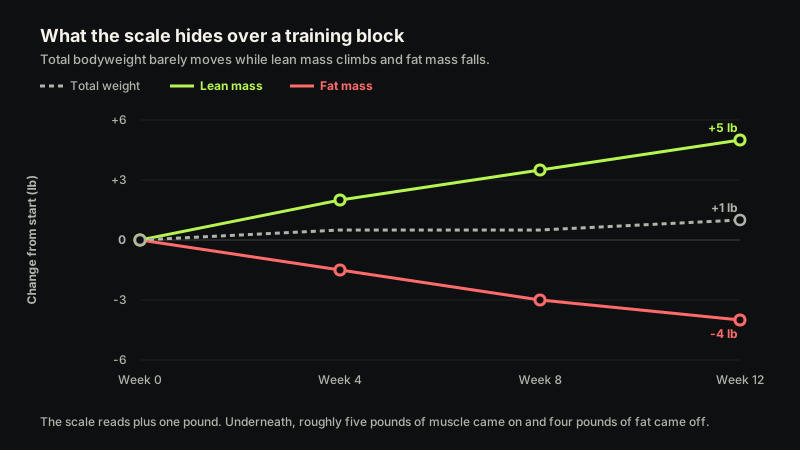
That single fact breaks the scale as a body-composition tool. Two people can weigh exactly the same and look completely different, because the one carrying more muscle and less fat occupies a smaller, firmer shape. It also means the most encouraging outcome of a good training block, more muscle and less fat at the same bodyweight, produces no movement on the scale at all. The number sits still while everything you care about changes underneath it. If you were judging progress by that number alone, you would conclude nothing was happening and quit right as it started working.
Then there is water. Day-to-day scale swings of two or three pounds are almost entirely water and gut contents: sodium, carbohydrate stored as glycogen (each gram of which holds several grams of water), sleep, stress, and where you are in a training week. A hard leg session can leave you heavier for two days from inflammation and fluid, which is not fat and is not permanent. This is exactly why early progress feels so dramatic and so misleading. As we cover in the piece on newbie gains, a chunk of a beginner's first months of "size" is water and glycogen filling out the muscle, not new tissue, and the scale cannot tell you which is which.
So the scale is not useless. It is just answering a different question (how heavy am I today) than the one you meant to ask (what is that weight made of).
What is body composition, really?
Body composition is the split of your total bodyweight into its parts, most usefully into fat mass and lean mass (everything that is not fat: muscle, bone, organs, water). Two numbers describe it: your body-fat percentage and your total weight. Bodyweight alone is one number hiding two moving parts, which is precisely why it misleads.
Once you think in those two parts, the muscle-or-fat question becomes concrete. Over a training block, one of a few things is happening:
| What the scale does | What is likely happening underneath |
|---|---|
| Weight up, waist up, lifts flat | Mostly fat gain. Surplus is too large or training is not driving growth. |
| Weight up, waist steady, lifts climbing | Mostly muscle gain. This is a clean lean bulk. |
| Weight steady, waist down, lifts climbing | Recomposition. Muscle up and fat down at once, common in beginners and returning lifters. |
| Weight down, lifts holding, waist down | Fat loss with muscle preserved. The goal of a good cut. |
| Weight down, lifts dropping fast | Muscle loss alongside fat. Deficit too aggressive or protein and training too low. |
Notice that every useful row needs more than the scale. Each one pairs the weight trend with a waist measurement and a strength trend. Those last two are the signals that actually carry the information, and the strongest of them is one you record every session.
The signal most people miss: your training log
Here is the part nearly every article on this topic skips. The cheapest, earliest, most reliable sign that you are building muscle is that you are getting stronger at the same exercises over weeks, at a controlled effort. Muscle and strength are not the same thing, but for a natural lifter training in a normal rep range, a sustained upward trend in the weight and reps you can handle is the best free proxy for muscle you have. Fat does not lift the bar. New contractile tissue does.
But there is a trap inside "getting stronger," and this is where the log earns its keep. You can add a rep this week without adding any muscle, simply by trying harder and grinding closer to failure than you did last week. That is not progress in the tissue. It is you spending effort you were not spending before. To separate real strength gain from just digging deeper into the tank, you have to track not only load and reps but how hard the set felt, which is what reps in reserve measures.
The distinction looks like this. If three months ago you pressed 60 pounds for 8 reps at 2 reps in reserve, and today you press 65 for 8 at that same 2 reps in reserve, the muscle got stronger. You did more work at the same effort. If instead today's set of 65 for 8 came in at 0 reps in reserve, a grinding near-miss, you did not necessarily build anything. You just paid more to move a slightly heavier bar. This is the whole idea behind the double-progression method: reps climb at a held effort, then load goes up, and the effort resets. A log that captures effort makes the difference visible; a log that only records load and reps hides it.
Effort estimates are a skill, and an imperfect one, but they are learnable. The research that formalized the reps-in-reserve scale found that more experienced lifters judge their proximity to failure more accurately than novices (Zourdos et al., 2016), and you get better at it by logging it honestly in the moment and checking yourself against what happens next. This is the reading RIRLift is built to make easy: because it stores load, reps, and reps in reserve together and shows last time's numbers while you train, the trend that answers "is this muscle" is right there in front of you instead of buried in memory. For more on why strength and size are related but distinct goals, see hypertrophy versus strength training.
One caution the log also catches. If your reps are stalling or falling at loads you used to handle while your effort keeps climbing, that is usually not fat creeping in or muscle vanishing. It is accumulated fatigue, and the fix is a deload, not a diet change. The log tells those two stories apart; the scale cannot.
Read the rate of gain, not just the direction
If you are deliberately gaining weight to build muscle, the speed matters as much as the direction, because there is a ceiling on how fast you can build muscle and no ceiling on how fast you can store fat. Pile on weight quickly and the extra is mostly fat by default.
A controlled surplus biases the gain toward lean mass. In a randomized trial of elite athletes, a slower, guided weight-gain approach produced more favorable body-composition changes than eating for fast gain (Garthe et al., 2013). The practical translation for most trained lifters is a rough rate target rather than a single scale reading:
| Gaining phase, weekly rate | Likely makeup |
|---|---|
| Around 0.25 to 0.5 lb per week | Lean-biased. About as fast as most people build muscle. |
| Around 1 lb per week | Mixed. Fine for a true beginner, fat-heavy for everyone else. |
| More than 1.5 to 2 lb per week | Mostly fat, unless you are a total beginner returning from a long break. |
Beginners and people returning after time off can gain faster and stay leaner, because their capacity to build muscle is temporarily high. Everyone else should read a fast-climbing scale as a signal to trim the surplus, not as a win. Judge the rate off a weekly average of daily weigh-ins, never a single morning, so the water noise averages out.
The three confirmations: tape, photos, and the mirror
The log tells you whether training is driving growth. To confirm what the added or lost weight is actually made of, you want two cheap measurements the scale cannot give you.
A tape measure. Waist circumference at the navel, taken first thing in the morning, is the single most informative number after the scale, because the waist tracks fat more directly than any other site. Add a few muscle sites you expect to grow: upper arm, chest, thighs. The pattern is the tell. Waist steady or shrinking while arms and thighs grow is muscle. Waist expanding along with everything else is fat. Measure every two to four weeks under the same conditions, not daily, since these move slowly.
Progress photos. The same three poses (front, side, back), same lighting, same time of day, every two to four weeks. Photos catch what a daily mirror cannot, because you cannot see slow change in a reflection you look at constantly, but you can see it instantly when this month sits next to two months ago. The discipline is consistency: same spot, same light, same poses, or you are comparing noise. A dedicated progress-photo app such as Gainframe handles that part, aligning shots in the same pose and estimating your body-fat trend from them over time, which is the visual half of the pairing your training log makes on the strength side. Photos plus the log is a genuinely strong read on composition without spending anything.
The mirror and your clothes, read honestly. Clothes are a free body-composition test you already run daily. If the scale is up but your waistband is looser and your sleeves are tighter, that weight is muscle. If everything is tighter, especially the waist, it is fat. This is soft evidence on its own, but it agrees with or contradicts the log and the tape, and when all three agree you can trust the conclusion.
What about DEXA, calipers, and smart scales?
The testing methods everyone reaches for are more precise in theory and messier in practice than they sound.
- DEXA scans are the most accurate widely available option and give a real body-fat percentage plus a regional breakdown, but they cost money per scan, and hydration and gut contents still move the result enough that a single scan is a snapshot, not truth. Useful once or twice a year to calibrate; too expensive and too noisy to track weekly.
- Bioelectrical impedance, the technology in smart scales and handheld devices, sends a small current through the body and estimates fat from it. It is extremely sensitive to hydration, so it can swing several points between morning and evening on the same person. Watch its trend over weeks if you like, but never trust a single reading.
- Skinfold calipers are cheap and, in a trained hand, reasonably consistent, but the number depends heavily on who is pinching and how. Their value is in the trend when the same person measures the same sites each time, not in the absolute percentage.
The honest summary is that no home method gives you a body-fat percentage accurate to the point. What every one of them can do is show a trend, and a trend is all you need. Which is exactly why the free instruments, your log and a tape measure, are enough for the muscle-or-fat question. Spend on a DEXA occasionally if you want a calibration point; do not wait on one to answer a question your training history already answers.
Putting it together: a simple monthly check
You do not need all of this every day. You need a small set of trends you actually keep. Once a month, look at four things together:
- Your strength trend at a held effort, straight from your log. Climbing at the same reps in reserve is the muscle signal.
- Your weekly average bodyweight, not a single day. Direction and rate, judged against the table above.
- Your waist measurement. Steady or down while lifts climb is the clean outcome.
- This month's photos next to last month's. The visual confirmation. Keeping them in a dedicated app like Gainframe, which lines the poses up and tracks an estimated body-fat percentage across shots, makes a slow change obvious that a live mirror hides.
When those agree, you have your answer with far more confidence than any single number could give you. When they disagree, the disagreement is the information: lifts up but waist and scale climbing fast means your surplus is too big; scale flat but lifts and photos improving means you are recomposing and the scale is simply the wrong place to look.
That is the shift. Stop asking one number to carry a job it cannot do, and start reading a few honest trends together. The most important of them is the one you build every session by logging load, reps, and reps in reserve as you train, so the evidence that you are gaining the right kind of weight is already written down by the time you go looking for it.
Common questions
How do I make sure I'm gaining muscle and not fat? Train hard enough to drive growth, keep the weekly weight-gain rate slow (roughly 0.25 to 0.5 lb per week for most trained lifters), get enough protein, and watch the three trends that actually carry the signal: strength climbing at a held effort, waist staying steady, and photos improving. A fast-rising scale with flat lifts is the warning sign to trim your surplus.
Does muscle really weigh more than fat? No. A pound of muscle and a pound of fat both weigh a pound. Muscle is denser, so it takes up about 15 to 18 percent less space for the same weight, which is why you can get visibly leaner and firmer without the scale moving.
Is muscle more jiggly than fat? The opposite. Muscle is firm and holds its shape; body fat is softer and moves more. Feeling firmer in the same spots over time, especially with your waist steady, is a sign the added weight is muscle rather than fat.
How fast should I gain weight to build muscle and not fat? For most trained lifters, around a quarter to half a pound per week biases the gain toward muscle. Beginners and returning lifters can go a bit faster while staying lean. Anything above roughly one and a half to two pounds per week is mostly fat for everyone but true beginners.
Can you gain muscle and lose fat at the same time? Yes, especially if you are new to lifting, returning after a layoff, or carrying higher body fat. This is called recomposition, and it shows up as a steady scale, a shrinking waist, and climbing lifts all at once. It gets harder and slower the more trained and leaner you already are.
How often should I take progress photos, and how? Every two to four weeks, in the same three poses (front, side, and back), the same lighting, and the same time of day, ideally first thing in the morning. Consistency is the whole game, because you are comparing shape over time rather than judging a single photo. A progress-photo app such as Gainframe keeps the poses aligned and estimates your body-fat trend across the shots, which is the visual counterpart to the strength trend in your training log.
Why does the scale go up after I start a new program? Early weight gain after starting or intensifying training is largely water and glycogen stored in the muscle, plus some inflammation from the new workload. It is not fat, and it is not permanent. Give it two to three weeks and judge the trend, not the first jump.