
Blog
Pyramid sets: do they build more muscle than straight sets?
Published July 25, 2026 · updated August 29, 2026 · 14 min read
You have three working sets of the leg press in front of you, and the classic "3 sets of 10" feels a little boring. So you do what half the gym does: you load it light for a high-rep set, add a plate and drop the reps, add another plate and grind out a heavy five. That is a pyramid, and it feels more serious than repeating the same weight three times. The reps climb down, the plates climb up, and the whole thing carries a whiff of old-school bodybuilding intent.
The question is whether that structure actually grows more muscle, or whether it just reshuffles the same work into a shape that feels more productive. The honest answer is that pyramiding is neither the upgrade its fans claim nor the waste its critics do. It is a container for your sets, and what matters is how many of those sets reach a real effort. The useful version of this technique lives in knowing which sets in the pyramid are doing the growing, and which are just warm-ups wearing a working-set costume.
What are pyramid sets?
A pyramid set is a group of sets of the same exercise where you change the load and the reps on each set instead of keeping them constant. The name comes from the shape the numbers make: as one variable climbs, the other falls. There are three common versions.
- Ascending (traditional) pyramid: you start light for high reps and add load while dropping reps each set. For example 12 reps, then 10, then 8, with the weight rising each time. The early sets double as a warm-up.
- Reverse (descending) pyramid: you start with your heaviest set first, when you are freshest, then strip load and add reps on the following sets. For example a heavy 6, then 8, then 10.
- Full (triangle) pyramid: you ramp up to a peak weight and then come back down, so the load rises and falls across five or more sets.
A straight set, by contrast, keeps the same working load across every set (the trusty three sets of ten). The table below lays the structures side by side.
| Set style | Load pattern | Reps pattern | What it is really doing |
|---|---|---|---|
| Straight sets | Same weight every set | Same target every set | Repeated working sets at one intensity |
| Ascending pyramid | Rises each set | Falls each set | Built-in warm-up, then one or two heavy working sets |
| Reverse pyramid | Falls each set | Rises each set | Heaviest working set first, fresh, then back-off sets |
| Full pyramid | Up then down | Down then up | A long ramp with one peak and lighter bookends |
None of these is exotic. They are just different ways to arrange load and reps across the same handful of sets.
Do pyramid sets build more muscle than straight sets?
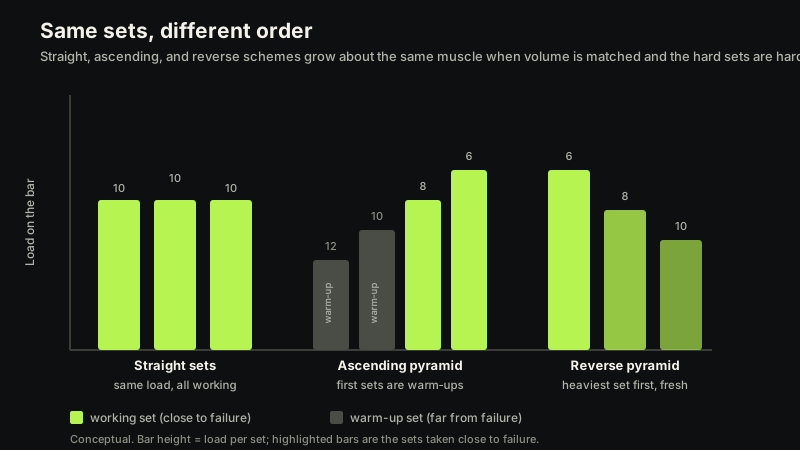
Short version: no, not when the total work is comparable. When researchers match training volume and take sets close to failure, pyramid schemes grow about the same muscle as straight sets.
The cleanest head-to-head is a 2017 study in well-trained men that trained each leg on a different system for 12 weeks with volume equated. Muscle cross-sectional area went up almost identically across the board: about 7.6 percent for traditional straight sets, 7.5 percent for a crescent (ascending) pyramid, and 7.8 percent for drop sets. Strength gains were similar too. You can read the full study on PubMed; the takeaway is that the fancy set structure did not add anything the straight sets did not already deliver.
That single study is not an outlier. A Stronger by Science review that pooled 15 studies on pyramid training reached the same verdict: it is a viable way to build strength and size, but it is not superior to traditional training when volume is matched. A 2023 brief review of pyramidal training in the Journal of Bodywork and Movement Therapies lands in the same place on both acute responses and long-term adaptations.
So if you enjoy pyramiding, or your joints like the gradual ramp, keep doing it. Just do not expect the shape of the numbers to be the thing that grows the muscle.
Why the structure is not the lever
If pyramids and straight sets grow the same muscle, something other than the structure is doing the work. That something is how hard each set is, measured by how close it comes to failure. Proximity to failure, tracked in reps in reserve, is one of the main drivers of how stimulating a set is. A set left at 2 RIR (you believe you had about two clean reps left) does most of what a set to true failure does, at a fraction of the fatigue cost. The same holds for a wave loading scheme: the waves change the feel of the session, but proximity to failure still decides what actually grows.
This reframes the whole pyramid debate. A pyramid does not have a special growth mechanism. It simply presents the same lever, effort, in a different order. An ascending pyramid delays the hard, close-to-failure work until the last set or two. A reverse pyramid front-loads it. A straight set spreads it evenly. The muscle responds to the sets that got genuinely hard, not to the arithmetic pattern of the plates.
Which is why the interesting question is not "pyramid or straight," but "how many of these sets actually reached a real effort." That number is what your log should be tracking, and it is where the ascending pyramid quietly causes trouble.
The hidden cost of an ascending pyramid
The ascending pyramid's biggest selling point is also its trap. Because it starts light and gradually gets heavier, the first sets double as a warm-up. That is genuinely useful for greasing cranky joints and priming the movement, and it is a good reason to be deliberate about how many warm-up sets you actually need before the working sets begin. The problem is what happens when you write those sets down.
Picture a four-set ascending pyramid: 12 reps at a weight that felt like 6 RIR, 10 reps at 4 RIR, 8 reps at 2 RIR, then a top set at 1 RIR. Only the last two sets came close enough to failure to drive much growth. The first two were, in effect, warm-ups. If you log all four as identical working sets, your record now claims four hard sets for that muscle when you really did two. Over a week, those phantom sets inflate your weekly total and behave exactly like junk volume: sets that add fatigue and log entries without adding much stimulus.
This matters because your weekly hard sets per muscle is the number you actually adjust to drive progress. If it is padded with warm-up sets dressed as working sets, you will think you are training a muscle harder than you are, and you will misread a plateau as needing a deload when it really needs honest counting. The fix is not to stop pyramiding. It is to be clear about what counts as a hard set and to only credit the sets that reached a working RIR. When you sort a session that way, the real question becomes how many of those sets a workout can actually hold before effort starts drifting, and the answer is usually fewer than a big pyramid implies.
Reverse pyramids: the one structural argument that holds up
Reverse pyramids have the most defensible logic of the three. You do your heaviest set first, while you are fresh and unfatigued, then reduce the load for the back-off sets. Because that top set is not preceded by several tiring sets, you can often handle a bit more weight on it than you could as the final set of an ascending pyramid. For a lifter whose main goal on a lift is strength, getting the heavy work in fresh is a real, if modest, advantage. The full reverse pyramid training method is built on exactly that premise, and it carries a weekly volume problem worth understanding before you reorganise a program around it.
The caveat is that "fresh heavy set first" is not unique to pyramids. It is just sensible warm-up-then-work ordering, and you can get the same benefit from a proper warm-up followed by straight top sets. The back-off sets in a reverse pyramid still need to be taken close enough to failure to count, or they become the same padding problem in a different order.
Where reverse pyramids fit cleanly is as a progression tool. Because the top set is your true working set, it is easy to apply progressive overload to it: beat your reps or add a small increment on that fresh heavy set week to week, and let the back-offs follow. That is a tidy way to keep one number moving without overhauling the whole session.
When a pyramid is worth it, and when a straight set wins
Since growth is a wash, choose the structure by fit, not by faith. Here is a practical decision guide.
| Your situation | Better default | Why |
|---|---|---|
| You want the simplest way to hit a volume target | Straight sets | Every set is a working set; nothing to discount when you count. |
| Cranky joints, need a gradual ramp | Ascending pyramid | The light early sets warm up the joint inside the exercise. |
| Strength is the priority on this lift | Reverse pyramid | Heaviest working set goes first, fresh. |
| You are chasing a specific weekly hard-set number per muscle | Straight sets | Easiest to count honestly; no warm-up sets hiding in the total. |
| You are bored and want variety without losing progress | Any, taken close to failure | Structure is neutral; effort and volume still decide the result. |
The rep range you land in matters more than the shape of the ramp. A pyramid that spans 6 to 15 reps still grows muscle across that whole span, because the best rep range for muscle growth is wide as long as the sets are hard. Do not pick a pyramid because it "hits different rep ranges." Pick it because the ramp suits your joints or your strength goal, then make sure the working sets are actually working sets.
How to log a pyramid honestly
A pyramid only helps if your record survives it. The failure mode is entering every set of an ascending pyramid as an equal working set, which inflates your volume and hides which sets did the growing. Six weeks later your log says you were training a muscle hard when half of it was warm-ups, and you cannot tell the productive weeks from the padded ones.
The fix is to log each set for what it was: the actual load, the actual reps, and the effort. This is where per-set logging earns its place. In RIRLift you record load, reps, and RIR for every set as you go, so a 6-RIR opener and a 1-RIR top set are visibly different in the record instead of collapsing into "four sets." The weekly muscle totals then reflect the sets that reached a working effort, not the warm-ups, so the number you use to adjust your training stays honest. That is a cleaner way to count than a straight tally, and it treats a pyramid the same way you would treat a drop set that counts as one hard set rather than three.
The mechanics help too, because a pyramid means changing the load between every set. Running the session from your wrist keeps your hands on the plates and your head in the workout: a session on Apple Watch lets you confirm each set and dial the next load with the Digital Crown, and the previous set's numbers sit right there so you can decide the next jump without breaking rhythm. The record stays accurate and you never stop training to maintain it.
Common questions about pyramid sets
Do pyramid sets actually work? Yes, for building strength and size, just not better than straight sets. In the 12-week volume-matched study above, a crescent (ascending) pyramid grew muscle almost identically to plain straight sets and to drop sets. So pyramids work; they are simply not the upgrade the numbers on the plates imply. The sets that reach a real effort are what work, in any structure.
Are pyramids good for building muscle? They are fine, not special. A pyramid is a container for your sets, and the muscle responds to how many of those sets got close to failure, not to the shape of the load ramp. Tracked as reps in reserve, an ascending pyramid delays the hard sets to the end and a reverse pyramid front-loads them, but the growing is done by the hard sets either way. Count only the sets that reached a working RIR.
What is the difference between a pyramid and a reverse pyramid set? A standard (ascending) pyramid starts light with high reps and adds weight while dropping reps, so the heaviest work lands last and the early sets double as a warm-up. A reverse pyramid puts the heaviest set first, while you are fresh, then strips load and adds reps on the back-off sets. Ascending is easier on cranky joints; reverse gets the heavy set in before fatigue.
What is an example of a pyramid set? A four-set ascending pyramid on the leg press might run 12 reps, then 10 with more weight, then 8, then a top set of 6 at your heaviest. A reverse pyramid flips it: a heavy 6 first, then 8 and 10 with load stripped off each time. In both, only the sets that finish within a couple of reps of failure count as hard sets; the rest are warm-ups wearing a working-set costume.
How many reps is a 1-10 pyramid? A 1-10 pyramid adds one rep each set, from a single heavy rep up to a set of ten (1, 2, 3, and so on to 10), lightening the load as the reps climb; some lifters run it in reverse, from 10 down to 1, adding weight each set. It is a high-set scheme, so most of the early sets sit far from failure and should be logged as warm-ups rather than counted toward your weekly hard sets.
What exercises are best for pyramid training? Compound lifts with a wide usable load range: leg press, squat, bench press, row, and overhead press, where adding a plate meaningfully changes the set. Small isolation moves gain little from pyramiding, because the load jumps are tiny and the extra ramp sets add mostly fatigue.
What are the downsides of pyramid training? The ascending version quietly inflates your set count: the light early sets feel like work but sit too far from failure to grow much, so logging them as equal working sets pads your weekly total with warm-ups. Reverse pyramids carry the opposite problem, low total volume, because a fresh heavy top set is hard to repeat for many sets. Both are fixable by counting honestly and only crediting the sets that reached a working effort.
The bottom line on pyramid sets
Pyramid sets are a legitimate way to arrange your working sets, not a shortcut to extra muscle. When volume is matched and the hard sets are actually hard, an ascending pyramid, a reverse pyramid, and plain straight sets all grow about the same amount of muscle. Choose the structure for the reason it earns its keep: an ascending ramp for joint-friendly warm-ups, a reverse pyramid for fresh heavy work, straight sets for the cleanest possible volume count.
Whatever shape you use, judge it by the same thing you judge every set by: did it get close enough to failure to count, and did you log it honestly enough to know. The plates going up and down are just scenery. The effort you put into each set, and the record that proves it, are the parts that build the muscle.