
Blog
DC training (Doggcrapp): why the logbook is the program
Published August 19, 2026 · 11 min read
Almost every write-up of DC training hands you the same thing: a three-day split, a rest-pause protocol, and a note about stretching. Copy the template, they imply, and the results follow.
They are describing the car and skipping the engine. DC training has one rule its creator would not bend on, and it is not about sets or splits. You must beat your logbook every single session. Add a rep, add a little weight, or the workout did not count. The split is scaffolding around that one demand.
That makes DC a strange thing to run out of a paper notebook or a typical logging app, because the program lives or dies on whether last session's numbers are in front of you and whether you can prove you beat them. This post covers what DC training actually is, how a session runs, and the part the guides leave out: how to run the logbook honestly, and how a rest-pause set fits into the weekly volume you are already counting.
What is DC training?
DC training (short for Doggcrapp, the forum handle of its creator Dante Trudel) is a high-intensity bodybuilding method built on rest-pause sets, extreme loaded stretching, a low-volume high-frequency split, and one strict logbook rule: every working set must beat the last one you recorded. It trades the usual "more sets, more exercises" approach for one all-out set per exercise, done more often, with the load pushed up relentlessly.
Trudel published the system, which he called Doggcrapp training, on bodybuilding forums in the early 2000s, and it spread by word of mouth among advanced lifters rather than through any study. The reputation is real; the evidence base is testimonial. Treat Trudel's original writing as the primary source for what DC is, not as proof that it beats a well-run conventional program.
The pieces fit together like this.
| Element | DC prescription |
|---|---|
| Main working set | One rest-pause set to failure per exercise |
| Load | Heavy, in the 7 to 12 rep range, then extended by rest-pause |
| Rep goal | A target total (e.g. 15 to 30 across the rest-pause) that triggers a load increase |
| Extreme stretching | A loaded stretch of the trained muscle, held around 60 seconds after the set |
| Split | Three-way, each session hitting roughly half the body |
| Frequency | Each muscle trained about every fifth day |
| Blast and cruise | 6 to 12 weeks of hard "blasting," then 10 to 14 days of lighter "cruising" |
| Progression | Beat the logbook every session, add load once you hit the rep goal |
The one line that carries the whole method is the last one. Everything else is a delivery mechanism for progressive overload you are forced to document.
How a DC workout actually runs
The split is the easy part. You rotate three different workouts (call them A, B, and C), training three days a week on non-consecutive days. Because each workout covers about half your muscle groups and you cycle through all three roughly every eight days, each muscle gets trained close to twice a week, far more often than a classic one-body-part-a-day routine.
Inside a session, you do very few exercises, and each one gets a single rest-pause set that you take to genuine failure.
A rest-pause set is one set with short pauses baked in, not three separate sets. It runs like this:
| Phase | What you do | Effort |
|---|---|---|
| Burst 1 | Reps to failure at your chosen load | 0 reps in reserve |
| Rest | About 15 deep breaths (roughly 20 seconds) | recover briefly |
| Burst 2 | More reps to failure at the same load | 0 reps in reserve |
| Rest | Another 15 breaths | recover briefly |
| Burst 3 | A final few reps to failure | 0 reps in reserve |
Add up the three bursts and you might hit 15 to 20 total reps from a weight that gave you 9 or 10 on the first burst. When your total reaches the rep goal for that exercise, the load goes up next time. After the working set, you load a deep stretch of the muscle you just trained and hold it for about a minute. Trudel credited this "extreme stretching" with everything from fascia expansion to hyperplasia. The honest read is that stretch-mediated hypertrophy is a live research area but the specific fascia claims are not established, so keep the stretch if it feels productive and do not bank growth on it.
If you want the full mechanics of taking a set past the first point of failure with short pauses, we cover them in the dedicated post on rest-pause sets; DC is essentially that technique turned into an entire program.
The part everyone copies and no one explains
Here is the sentence Trudel repeated more than any other: you are always trying to beat your logbook. Not sometimes. Not when you feel good. Every set, every session.
That rule is doing something specific. It is double progression run at zero reps in reserve. You keep the load fixed and chase more total reps until you hit the rep goal, then you add weight and start climbing again. The rep goal is the trigger; the logbook is the referee. Without a record of exactly what you did last time, "beat it" is a feeling, and feelings inflate. Most lifters remember their good sets and forget the grinder that actually happened.
This is where load and reps alone quietly fail you. Say your log reads "incline press, 185 for 16 total." Next session you get 185 for 17. Progress, clearly. But if that 16 was three near-perfect bursts and the 17 was you cheating the last four reps with a heave and a bounce, you did not beat the logbook, you beat the bookkeeping. The number went up and the stimulus went sideways.
The fix is to record how hard the set was, not just what it weighed. Reps in reserve is the workable estimate, and on a rest-pause set the target is blunt: each burst ends at 0 RIR, so the honest question is whether the reps were clean at that effort. Logging effort per set is how "beat the logbook" stays honest instead of becoming a story you tell yourself. RIRLift shows the previous set's load, reps, and RIR inline as you enter the next one, on your wrist, so the number you are trying to beat is already in front of you when it matters. You can see how a session runs from your wrist if that is new to you.
How a rest-pause set counts toward your weekly volume
DC looks like almost no volume, and that scares people who have absorbed the "10 to 20 sets per muscle per week" guidance. One rest-pause set per exercise, a couple of exercises per muscle, twice a week. On paper that is a handful of sets. Where is the growth supposed to come from?
The resolution is in how you count. A rest-pause set is one hard set, not three, even though it has three bursts. It is one working set that you extended past the first failure point, the same way a drop set or a myo-rep set is one set, not several. When researchers matched total volume and compared these techniques to plain straight sets, the growth was similar. Enes and colleagues' 2021 study put rest-pause and drop-set training head to head with traditional sets at equal volume and found comparable strength and hypertrophy. So a rest-pause set buys you a hard set's worth of stimulus in less time, not a hidden triple dose.
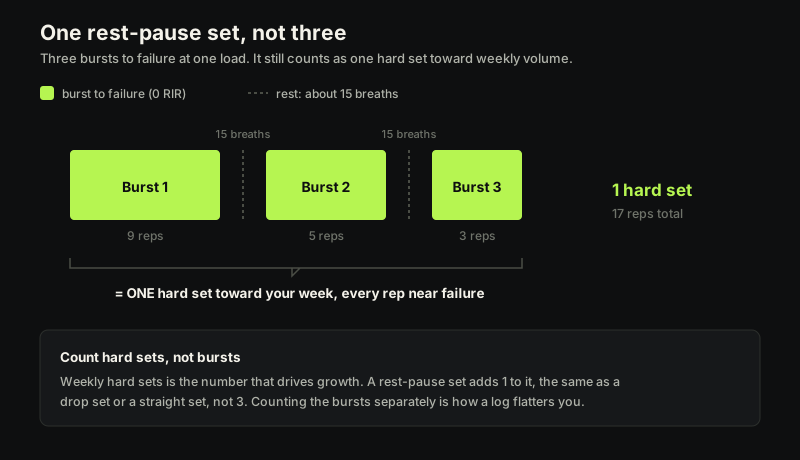
Count DC honestly and the weekly math looks like this:
| Muscle | DC sessions per week | Rest-pause sets per session | Hard sets per week |
|---|---|---|---|
| Chest | ~2 | 1 to 2 | 2 to 4 |
| Back | ~2 | 2 | ~4 |
| Quads | ~2 | 1 | ~2 |
Those are lean numbers, deliberately. The dose-response evidence on volume shows more weekly hard sets tends to mean more growth, so DC is betting that maximal-effort sets at the low end of the volume range, run frequently, beat a pile of easier sets. That is a defensible bet for an advanced lifter, and it is the opposite of junk volume: DC keeps almost nothing that is not a hard set. If you track weekly hard sets by muscle the way our volume guide describes, you can watch a DC block land in the 2 to 6 sets-per-muscle range and decide for yourself whether that is enough stimulus for you, rather than trusting that "high intensity" covers it.
Why DC is low volume, high frequency, and when it breaks
The structure is not arbitrary. It falls straight out of the zero-buffer sets.
Every DC working set finishes at 0 reps in reserve, then gets dragged further by the rest-pause. That is about as fatiguing as a single set gets. Refalo and colleagues' 2023 meta-analysis on proximity to failure found little extra hypertrophy from training all the way to failure versus stopping a rep or two short, which means DC's zero buffer is not a growth requirement. It is a choice, and the price of that choice is recovery. You cannot spend the buffer on every set and also do twenty sets a muscle, so DC cuts the volume to afford the intensity.
The high frequency is the other side of the same coin. Because each session leaves so few sets on a muscle, you can come back to it sooner, which is why each muscle gets trained roughly every fifth day. Low volume per session is what makes high frequency survivable.
Blast and cruise is the release valve. You cannot run 0-RIR training forever; fatigue accumulates faster than a single week can clear it. So DC blasts for 6 to 12 weeks, then cruises for 10 to 14 days at lighter loads. That is a crude mesocycle with a built-in deload, and the crude part is that the timing is fixed by the calendar rather than by you. Some lifters need the cruise at week seven, some at week ten.
This is where a log earns its keep. If your rest-pause totals stop climbing across two or three sessions on lifts that were moving, and your estimated 1RM has gone flat while your effort feels higher than ever, the block is telling you to cruise now, not on whatever week the template printed. A DC lifter chasing the logbook into the ground for three extra weeks because "the plan says twelve" is the most common way the program stops working. The log sees the stall before the calendar does.
Who DC training is for, and who should skip it
DC is a specialist tool, and it is honest about that.
It fits an advanced lifter with a few years of clean progression already behind them, joints that tolerate heavy loads to failure, and the discipline to record every set and actually try to beat it. If you are the kind of person who will log the grinder honestly and stop when the log says stop, DC can be a very efficient way to train: little time in the gym, every set meaningful, progression you can prove.
It is a poor fit for a few people. Beginners do not need it, because ordinary progression is still handing them gains without the fatigue cost of constant failure. Anyone managing cranky joints or a nagging injury should be wary of a program that takes every set past failure. And if you will not log, DC is pointless, because the logbook is not a nice-to-have here, it is the mechanism. A DC program you do not record is just some hard sets with no memory, and the whole method was built to have a memory.
The verdict on DC training
Strip DC training down and what is left is not the rest-pause set or the three-way split or the loaded stretch. It is the logbook and one rule: beat it or the session did not count. The rest is a well-designed way to make that rule survivable, low enough volume to recover from, frequent enough to progress often, cyclical enough to not blow up.
Run it if you are advanced, durable, and honest with your numbers, and give the logbook the weight the method demands: record load, reps, and real effort for every set, then go beat them next time. RIRLift keeps that logbook on your wrist and puts last session's numbers in front of you as you lift, which is the difference between beating the logbook and beating your memory of it. If you want to see whether DC's lean, high-effort volume is actually enough for you, log a block and read your weekly hard sets by muscle at the end of it.