
Blog
Should you train to failure? A research-based guide
Published August 14, 2026 · 10 min read
The last grinding rep, the one where the bar barely moves and your face contorts, feels like the rep that built the muscle. So it is tempting to answer "should you train to failure?" with a simple yes: if a little effort is good, maximum effort must be better. Zoom out from the single set to the whole training week, though, and that logic breaks. For most of your sets the honest answer is no, you should stop a rep or two short, and the reason is not that failure is useless. It is that failure is expensive, and you have a fixed recovery budget to spend.
This is a decision, not a rule you follow blindly. Below is what "failure" actually means, what the research shows about growth and strength, what a failure set costs you later in the session and the week, and a simple framework for deciding, set by set, whether to push all the way or leave a buffer.
What "training to failure" actually means
Training to failure means taking a set to the point where you cannot complete another repetition with good form, no matter how hard you try. That is technical failure, or momentary muscular failure, and it is the true zero of effort. It is not the same as feeling finished. Most lifters, especially newer ones, call a set at the point of discomfort or when the rep slows down, which is often two to four reps short of the real limit.
The cleanest way to describe effort short of that limit is reps in reserve, or RIR: the number of clean reps you believe you had left when you stopped. A set left at 2 RIR means about two reps in the tank. Zero RIR is failure. Framing the question this way turns "should you train to failure" into something you can actually decide and record: what RIR should this set end at?
There are also softer versions people lump in with failure. A set can hit form failure (your technique breaks before the muscle gives out) or you can push past failure with intensity techniques like drop sets. Those are different tools with different costs, and they are not what most people mean when they ask whether every working set needs to bottom out.
What the research actually says
The research picture is more nuanced than "failure builds more muscle." Two findings matter most.
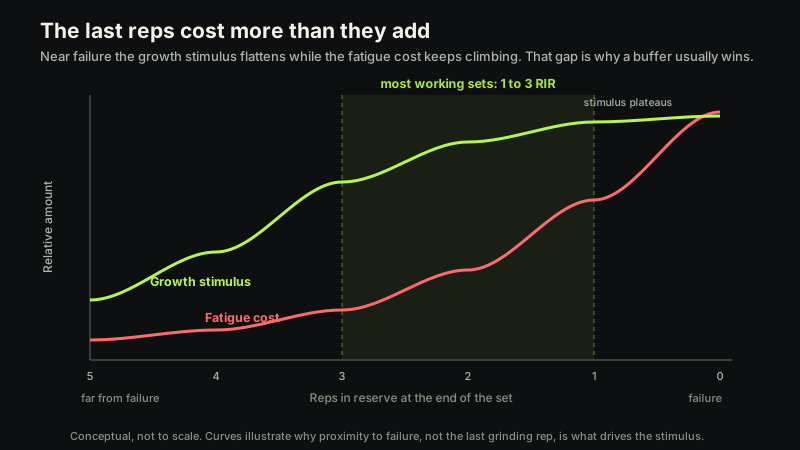
First, when the goal is training to failure for muscle growth, training close to failure captures nearly all of the growth stimulus, and going the last couple of reps to true failure adds little. Proximity to failure is one of the main drivers of how stimulating a set is, which is what actually drives muscle growth at the mechanical level. But once you are within a few reps of your limit, the marginal set-to-failure returns shrink while the fatigue keeps climbing. A well-known 2016 review concluded that resistance training to muscular failure is not strictly necessary for hypertrophy in trained lifters, as long as the sets are taken sufficiently close to it.
Second, the growth-versus-strength picture is not identical. Summarizing the more recent evidence, a Florida Atlantic University research review noted that training closer to failure appears more important when your goal is muscle size, while for maximal strength how close you go matters less than the load you lift and the quality of each rep. In plain terms: chasing failure buys you more for hypertrophy than for strength, and even for hypertrophy it is a case of diminishing returns, not a switch that turns growth on.
There is a third, quieter point worth naming. The main thing failure reliably does that stopping short cannot is verify effort. If you never go to failure, you never actually confirm where your limit is, so your RIR estimates can drift for weeks without you noticing. That is a real benefit, but it is a calibration benefit, not a growth benefit, and it needs one honest set now and then rather than a maximal grind on everything. Confusing the two is how "failure verifies effort" quietly becomes "take every set to failure."
The practical read across the literature is consistent with what a good coach would tell you. Keep most working sets hard and close to failure, roughly 1 to 3 RIR, and treat true failure as an occasional tool rather than the default setting on every set. The exact buffer that is right for you varies by exercise, by how well you recover, and by the day, so the number matters less than the habit of leaving a deliberate, recorded margin instead of grinding on autopilot.
The real cost of a failure set
If close-to-failure gets you almost all of the stimulus, the whole decision comes down to what the last couple of reps cost. They cost more than they look.
- Fatigue compounds. Sets taken to failure take disproportionately longer to recover from, both within the session and across days. That quietly reduces the quality volume you can complete afterward, which ties directly into the stimulus-to-fatigue ratio: extra fatigue with no extra stimulus is the definition of a set that stopped paying for itself.
- It eats your later sets. Go to failure on your first set of squats and your remaining sets suffer, so your total hard-set count for the session drops. You traded a broader base of good sets for one maximal one.
- Form drifts. The final grinding rep is usually the ugliest, and on big compound lifts that is exactly where technique and joints are most exposed.
- Estimates get noisy. When every set is a maximal effort, you lose the ability to tell a genuinely hard day from an easy one, because they all feel like the ceiling.
- It pushes you toward a deload sooner. Failure everywhere, week after week, is one of the fastest ways to accumulate the systemic fatigue that decides when to take a deload week.
None of this makes failure bad. It makes failure a purchase. Sometimes the purchase is worth it, and the framework below is about knowing when.
When you should train to failure
Failure is a tool that earns its place in a few specific spots. Reach for it deliberately, not by default.
- On the last set of an exercise. Once you are not going to spend the fatigue on any following sets of that movement, a set to failure costs you the least. This is the classic place to cash in.
- On isolation and machine work. A leg extension, a cable curl, or a lateral raise to failure is cheap to recover from and safe, because a failed rep just stops. This is also where using a drop set as a finisher fits, as a structured way to spend failure work on purpose.
- To recalibrate your effort sense. A few honest sets to failure each block reset your internal ruler, so your everyday RIR estimates stay accurate. If you take a set you thought was 1 RIR and grind out four more reps, you just learned your estimates are drifting.
- When you genuinely cannot gauge effort yet. Newer lifters often stop far short of failure while believing they are close. Occasionally training to true failure on a safe exercise teaches what the limit actually feels like.
When you should not train to failure
The mirror image matters just as much. Leave a buffer in these situations.
- On heavy compound lifts. Squats, deadlifts, and heavy presses to failure carry the highest fatigue and technique cost and the real injury risk, especially without a spotter or safety pins. Keep 2 to 3 RIR here.
- On early sets of an exercise. Failing your first set sabotages every set after it. Save the intensity for the end.
- On high-volume days or for a muscle you train frequently. The more total hard sets you are trying to accumulate, the less you can afford to blow out early sets with maximal fatigue.
- When recovery is already compromised. Poor sleep, high life stress, or the back end of a hard training block are all reasons to bank effort, not spend it.
- While you are still learning a lift. Grinding to failure with a movement you have not yet grooved trains bad reps, not the target muscle.
Should you train to failure? A simple decision rule
Put the two lists together and the decision collapses into something you can apply on the gym floor. The question is rarely "failure, yes or no?" for a whole workout. It is "what RIR should this set end at?" and the answer depends mostly on where the set sits and what implement you are using.
| Set context | Train to failure? | Suggested RIR | Why |
|---|---|---|---|
| Heavy compound, any set | No | 2 to 3 | Highest fatigue, technique, and injury cost |
| Machine or cable, working set | Rarely | 1 to 2 | Stable and safe, but save the ceiling for last |
| Last set of an isolation lift | Optional yes | 0 to 1 | Cheap to recover from, safe near failure |
| Early sets of any exercise | No | 2 to 3 | Failing here sabotages the sets that follow |
| Calibration set (occasional) | Yes | 0 | Resets your effort estimate on purpose |
Notice this is the same decision as choosing how hard each set should be in the first place, which is why it overlaps with when to leave reps in reserve. Failure is just the 0 RIR end of that scale. The goal you are chasing tilts the dial: for pure size, living around 1 to 2 RIR with occasional failure on isolation work is a reasonable default; for strength, the load and rep quality matter more than shaving off that last rep, so a slightly larger buffer on the main lifts costs you little.
Should you train to failure on every set?
No. Training every set to failure is the most common way lifters turn productive weekly training volume into accumulated fatigue. The pattern that holds up is to keep the majority of your sets hard but short of the limit, then spend true failure on a handful of safe, well-placed sets. "Two sets to failure" on your last isolation movement of the day is far more defensible than ten sets to failure spread across heavy compounds.
How to actually make the call: log the RIR
Every decision above is an RIR judgement, and RIR is only useful if you record it. The problem is that effort is invisible after the fact. Load and reps get written down automatically in your head ("225 for 8"), but how close that set was to failure fades within minutes, and by the time you would reconstruct it you are guessing.
That is the gap RIRLift is built to close. You set a target RIR per exercise when you build a routine on iPhone, then log the actual load, reps, and RIR for every set on Apple Watch as you train, in the moment, while the sensation is still fresh. Over a block that history becomes an honest readout of effort: a set you planned at 2 RIR that came in at 4 tells you there is room to add load next time, while a string of 0 RIR sets on a lift is a signal that you are spending fatigue faster than you are banking stimulus. You can see how the RIRLift workflow runs a session from the wrist, phone-free.
So, should you train to failure? Usually not, and not by default. Keep most sets close to the limit but with a rep or two in reserve, spend true failure deliberately on the last set of safe isolation work and on the occasional calibration set, and keep it off your heavy compounds and your early sets. Then log what actually happened, because the whole point of leaving a buffer is being able to see, week over week, that the buffer is doing its job.