
Blog
How to use reps in reserve (RIR) in your workouts
Published August 28, 2026 · 12 min read
You already know what reps in reserve means. The number counts how many clean reps you could still do when you rack the weight: 2 RIR means you had two left, 0 RIR means you had nothing. Knowing the definition is the easy part. The part that actually changes your training is using it rep to rep, set to set, without either sandbagging every set or grinding all of them to a shaking, technical-breakdown zero.
That gap is where most lifters lose the value of RIR. They read that hypertrophy lives somewhere around 1 to 3 reps shy of failure, nod, and then go train exactly the way they always did, guessing. This post is the other half: how to pick an RIR target for a given set, run a whole session on those targets, calibrate the estimate as it drifts, and keep a record honest enough to make your next decision from. If you want the ground-up definition first, the full guide to reps in reserve covers what RIR is and where it came from. Everything below assumes you have that and want to put it to work. RIRLift is built around exactly this loop, and here is how a session runs from your wrist if you want to see the logging side first.
Why train with reps in reserve
Load and reps alone do not tell you how hard a set was. Three sets of eight at 100 pounds could be a near-death grind or a comfortable warm-up depending on what 100 pounds means for you today. RIR is the missing third number, and it buys you three concrete things.
The first is autoregulation. A fixed percentage of your max assumes you are the same lifter every day, and you are not. Sleep, stress, food, and the session before all move your strength around. When you train to an RIR target instead of a fixed weight, the target absorbs the bad days and the good ones: feeling strong, you add load to still land on 2 RIR; feeling flat, you drop it and hit the same 2 RIR at a lighter weight. The stimulus stays where you want it while the number on the bar floats.
The second is fatigue management. Proximity to failure is one of the main drivers of how stimulating a set is, but the last rep before failure costs far more fatigue than it adds stimulus. Leaving a small buffer keeps almost all of the growth signal while cutting the recovery bill, which is what lets you repeat the work often enough to grow. When Schoenfeld and colleagues reviewed the evidence in 2021, equated-volume training a few reps shy of failure produced hypertrophy comparable to training all the way to it, at a lower fatigue cost.
The third is an honest history. An RIR you write down while the set is fresh is a real record of how hard the work was. Over a block, that history is what tells you whether last week's session was genuinely harder or you just added weight and lost reps. Without it you are progressing on vibes.
What each RIR level feels like
The scale only helps if the numbers mean the same thing every time you use them. Here is the practical translation, from the top of the effort scale down.
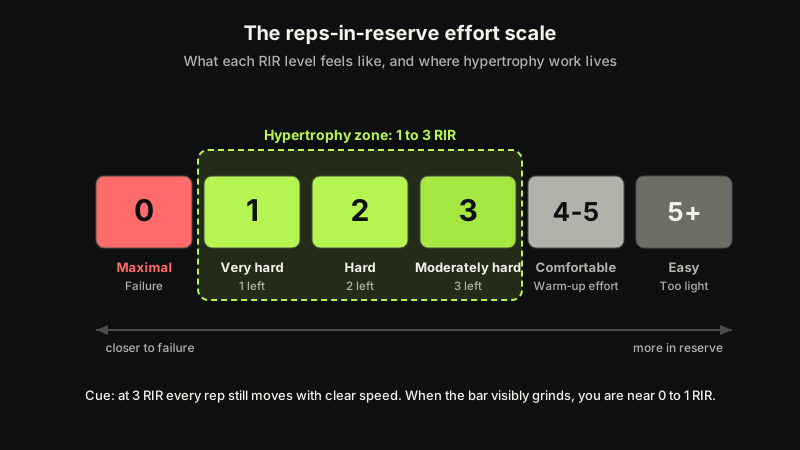
| RIR | Effort | What it feels like |
|---|---|---|
| 0 | Maximal | The rep grinds to a stop. You could not complete another with good form no matter what. |
| 1 | Very hard | You are certain you had one more, and equally certain the second would have failed. Bar speed on the last rep is clearly slowing. |
| 2 | Hard | A confident two left. The last rep moved slower than the first but never felt in doubt. |
| 3 | Moderately hard | Three in the tank. The set is real work, but you finish it composed, with clear speed to spare. |
| 4 to 5 | Comfortable | Several reps left. Useful for warm-ups, technique work, and the early sets of a training block. |
| 5+ | Easy | The set felt light. Below your working effort for building muscle. |
The most useful anchor is bar speed. As you approach failure, the concentric slows even when you are trying to move it fast, and that slowdown is the most reliable cue you have. "What does 3 RIR feel like" has an honest answer: it is the last set that still moves with obvious speed on every rep. If your final rep already looks like a grind, you were closer to 0 or 1 than 3.
What RIR to aim for by goal
There is no single correct RIR; the right buffer depends on the lift and the goal. These are working ranges, not laws, and the ideal shifts with the exercise, the person, and where you are in a block.
| Situation | Target RIR | Why |
|---|---|---|
| Most hypertrophy work (8 to 15 reps) | 1 to 3 | High stimulus, manageable fatigue, repeatable across the week. |
| Heavy compounds (squat, deadlift) | 2 to 3 | Technical, systemically taxing lifts where the last rep is the riskiest. Keep a buffer. |
| Isolation work (curls, lateral raises, extensions) | 0 to 2 | Low skill and low systemic cost, so you can push these closer to failure safely. |
| First week or two of a training block | 3 to 4 | Start with more in reserve and let effort climb as volume accumulates. |
| Last set of the last exercise | 0 to 1 | Nothing to save it for, so it is a reasonable place to touch failure if you want to. |
The pattern is that safer, smaller, less fatiguing movements can run closer to zero, while big and risky lifts keep more in the tank. This is the applied version of the failure question; if you want the full case for where a buffer beats going all-out, see RIR vs going to failure. For how many of these hard sets to accumulate per muscle each week, how many sets per workout covers the volume side.
A worked example: one push session on RIR targets
Numbers make this concrete. Here is a single push session run on RIR targets rather than fixed weights, showing how the load moves to keep effort where you want it. The lifter planned 2 RIR on the compounds and 1 RIR on the isolation.
| Exercise | Set | Load | Reps | Target RIR | Actual RIR | Next-time note |
|---|---|---|---|---|---|---|
| Bench press | 1 | 185 | 8 | 2 | 3 | Too easy, add weight |
| Bench press | 2 | 195 | 8 | 2 | 2 | On target, hold |
| Bench press | 3 | 195 | 7 | 2 | 1 | Fatigue crept in, expected |
| Overhead press | 1 | 115 | 9 | 2 | 2 | On target |
| Overhead press | 2 | 115 | 8 | 2 | 2 | On target |
| Incline DB press | 1 | 60 | 12 | 2 | 3 | Add weight next set |
| Incline DB press | 2 | 65 | 11 | 2 | 2 | Dialed in |
| Lateral raise | 1 | 20 | 15 | 1 | 1 | On target |
| Lateral raise | 2 | 20 | 14 | 1 | 0 | Slight overreach, fine on isolation |
| Triceps pushdown | 1 | 50 | 14 | 1 | 1 | On target |
Read what the RIR column did. On the first bench set the target was 2 but the lifter had 3 left, so the weight went up and the next set landed on target. By the third set, accumulated fatigue pulled actual RIR down to 1 at the same load, which is normal and not a mistake to correct. The lateral raises drifted to 0 on the second set, which is fine on a small isolation muscle. None of this is visible from load and reps alone. The RIR column is what turns a list of numbers into a set of decisions for next week: where to add weight, where to hold, and which lifts are already at the edge.
How to get your RIR estimate right
RIR is an estimate, and early on it is a noisy one. That is the honest limitation, and it is fixable. When Zourdos and colleagues validated an RIR-based effort scale in 2016, more experienced lifters estimated their proximity to failure more accurately than novices, and accuracy improved the closer the set was to failure. Both findings point to the same practical advice.
Reference failure now and then. If you have never taken a given exercise to 0 RIR, you have no calibration point for what 2 RIR feels like on it. Occasionally, on a safe isolation lift, push a set to genuine failure so your internal scale has an anchor. You do not need to do this often, and you do not need to do it on squats or deadlifts.
Use last session's rep count as a check. If you got 10 reps at a weight last week stopping at what you called 2 RIR, and this week the same weight stops you at 8, either you are more fatigued or your estimate slipped. The written history is the tie-breaker, which is the whole reason to record RIR rather than just feel it.
Expect drift within a session too, exactly as the worked example showed. The same load moves you closer to failure as the workout goes on, so identical numbers on set three represent a lower RIR than on set one. That is a feature of fatigue, not an error to fix. For the deeper mechanics of judging the buffer honestly, the reps in reserve guide goes further into common estimation mistakes. And if your program is written in RPE rather than RIR, the two scales convert cleanly; RPE vs RIR has the full mapping. Helms and colleagues laid out how to apply that RIR-based scale across a resistance-training program.
Log RIR while the set is fresh
An RIR estimate is only worth as much as the record you keep of it, and memory is the weak link. Reconstructing "was that 2 or 3 RIR" hours later, from your phone at home, is a guess layered on a guess. The value comes from capturing effort in the moment, between the rack and the rest timer, while the feel of the last rep is still in your hands.
That is what RIRLift is built for. You set a target RIR per exercise when you build a routine on iPhone, then on Apple Watch you log actual load, reps, and RIR for every set as you train. The values pre-fill from last time, so a set that went to plan is a single tap to confirm, and a set that drifted is a quick turn of the Digital Crown. The phone stays in your bag. Afterward, RIRLift totals your weekly hard sets by muscle, so the effort you logged rolls up into a picture of where the work actually went. Proximity to failure matters more than the exact rep number you hit, which is the same reason the best rep range for muscle growth is wider than most lifters think: effort, logged honestly, is the throughline.
Common questions
Does 3 RIR build muscle?
Yes. Working sets taken to about 1 to 3 RIR sit squarely in the effective range for hypertrophy. 3 RIR is a productive target for most of your volume, especially on heavy compounds and in the early weeks of a block. If every set of your entire program stops at 3 or more RIR you may be leaving stimulus on the table, but 3 RIR as a working target builds muscle.
Is 2 RIR enough?
For hypertrophy, 2 RIR is close to ideal for most working sets. It keeps you near enough to failure to drive growth while leaving a buffer that protects your form and your recovery, so you can train the muscle again soon. Most evidence-based guidance centers hypertrophy work in the 1 to 3 RIR range, and 2 sits in the middle of it.
What does 3 RIR feel like?
It feels like a hard set you finish composed, with every rep still moving at clear speed. If your last rep slowed to a grind, you were nearer 0 or 1 RIR than 3. Bar speed is the most reliable cue: at 3 RIR the concentric is still brisk, and the obvious slowdown only starts in the final reps you did not do.
Is RIR good for strength training?
Yes, with a slightly larger buffer. On heavy, technical lifts most guidance keeps working sets around 2 to 3 RIR, because the last rep before failure carries the most technical and fatigue risk on a squat or deadlift. RIR still works as the dial; you just set it a touch further from zero than you would on isolation work.
RIR only earns its keep when you actually train to it and write it down. Pick a target per set, let the load float to hit it, calibrate the estimate against your own history, and log it while the set is fresh. Do that for a block and your training notebook stops being a list of weights and becomes a record you can reason from. If you are still deciding where to keep that record, which lifting app fits how you train walks through the options, since not every tracker treats RIR as a value you can log. If cost is what decides it, a free workout tracker that logs RIR narrows the field further.