
Blog
The best workout log apps for lifters (2026), compared
Published August 31, 2026 · 12 min read
Picking the best workout log app sounds simple until you open the App Store and find fifty of them, each claiming to be the one. Most of that noise misses the point. The job of a log app is not to entertain you between sets or sell you a program. It is to capture what you actually did, quickly and honestly, so the next session is an informed decision instead of a guess. Judged that way, the field thins out fast.
This is a comparison, not a hands-on lab test. We have not run a controlled trial of every app below, and we are not going to pretend otherwise. What follows is a lifter's read of where each app is genuinely strong, based on documented positioning, platform support, and pricing model as of this writing. Fitness apps change their features and prices often, so confirm the current details on each app's own listing before you commit. RIRLift is our app, and we have included it and ranked it honestly in the one category it is built to win rather than crowning it best at everything.
What actually matters in a workout log app
Before the list, the criteria. A log app earns its place on your home screen when it does these things well:
- Fast logging during the session. You are logging 20 or more sets in an hour with chalky hands and a rest clock running. Every extra tap is friction you feel. Pre-filled values from last time and large tap targets matter more than any dashboard.
- Apple Watch execution, not just a companion. Pulling a phone out between sets breaks focus and invites the scroll. An app that runs the whole session from your wrist keeps your head in the workout. Many apps have a watch app; fewer treat the watch as the primary surface.
- Effort captured, not just load and reps. Weight and reps alone do not tell you how hard a set was. Reps in reserve (RIR) does, and it is the input that makes progression honest. Logging it in the moment beats reconstructing it from memory hours later.
- Weekly volume you can see. Hard sets per muscle across the week is the number that predicts whether you are under or over training a body part. An app that totals it for you saves a spreadsheet.
- Your data, exportable. A log is only useful if you can keep it. CSV export and a backup path matter for anyone who plans to train for years.
- No bloat. Social feeds, streaks, meal tracking, and readiness scores are things to scroll, not train. The narrower the tool, the faster it stays.
Two of those criteria are backed by the training literature. Weekly volume is one of the clearest dose-response levers for hypertrophy, which is why seeing your weekly hard sets by muscle is worth more than most features (Stronger by Science summarizes the more-is-more volume picture well). And how close you take a set to failure drives much of its stimulus, so logging effort as RIR is not a nice-to-have; it is the data point most apps quietly drop (review on training to failure and muscle growth).
The comparison at a glance
| App | Best for | Apple Watch | Pricing model | RIR-native |
|---|---|---|---|---|
| RIRLift | Watch-first RIR logging | Yes, primary surface | See App Store listing | Yes |
| Hevy | Broad free tracking | Yes, companion | Free + Pro subscription (lifetime listed) | No |
| Strong | Clean strength logbook | Yes, companion | Free + subscription (lifetime option) | No |
| Boostcamp | Free program library | Yes | Free + Pro | No |
| Alpha Progression | Science-based plan generator | Not yet (roadmap) | Subscription | Yes (planning) |
| RP Hypertrophy | Coached hypertrophy programs | No (iPhone only) | Subscription (premium) | Feedback-based |
| Fitbod | AI workout generation | Yes | Subscription | No |
| Jefit | Large exercise database | Yes | Free + Elite subscription | No |
| Liftosaur | Scriptable power users | Yes | Free / open-source + paid extras | Partial |
| Setgraph | Minimalist logging | Yes | Free + Pro (lifetime option) | No |
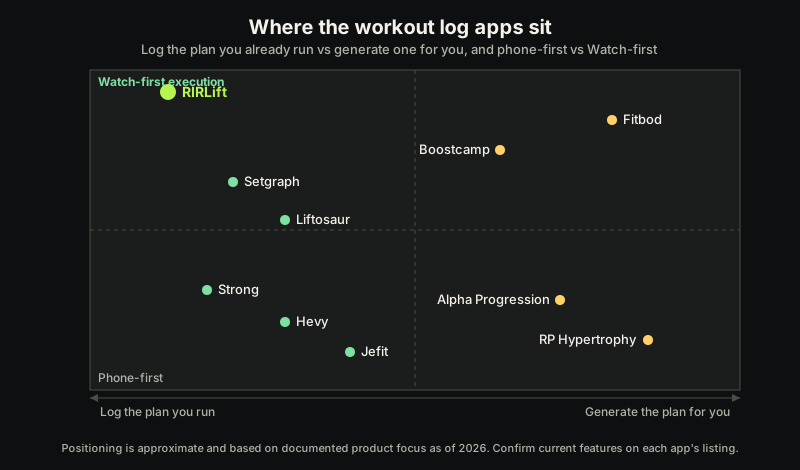
Now the category winners, with the honest caveat on each.
Best for Watch-first RIR logging: RIRLift
This is the category we built for, so read the rest of the list to check us against it. RIRLift is a Watch-first hypertrophy logbook. You plan routines on iPhone, then run the whole session from Apple Watch: log load, reps, and RIR per set, run the auto-start rest timer, and swap an exercise when a machine is taken, all without touching your phone. Values pre-fill from last time, so most sets are a tap or a Digital Crown dial.
The two things that separate it: RIR is a first-class logged value on every set rather than an afterthought, and weekly hard sets by muscle sit on the dashboard so you can see where the work actually goes. Active workouts are local-first, so a dropped Bluetooth signal or a phone left in the locker never costs you the session. It is deliberately narrow: no social feed, no streaks, no AI workout generator, no nutrition. If you want the app to invent your program, this is the wrong tool. If you already train with a plan and want to run it fast on your wrist, that is the whole workflow.
Caveat: iPhone and Apple Watch only. No Android, no web app. If you are not in the Apple ecosystem, stop here and look at Hevy or Jefit.
Best broad free tracker: Hevy
Hevy is the app most lifters have heard of, and for good reason. The core logging is fast and polished, the free tier is generous, the App Store rating is strong, and the routine-sharing ecosystem is large. It has an Apple Watch app and a real community around shared routines. If you want a widely used tracker with a social layer and you are logging on your phone, Hevy is the safe default.
Caveat: it is phone-first with a watch companion, RIR is not a central logged value, and the social feed is exactly what some serious lifters are trying to get away from. Pro is a subscription (a lifetime option has been listed), and it gates unlimited routines, full history, and custom exercises.
Best clean strength logbook: Strong
Strong is the other name that comes up constantly, and it deserves the reputation. Logging is clean and quick, the brand is trusted, it supports Apple Watch, and it has offered lifetime pricing. For general strength training where you want a no-nonsense logbook, Strong is excellent.
Caveat: it is broad and general strength rather than hypertrophy-specialized. Weekly volume by muscle and RIR are not the point of the product, and the workflow is phone-first.
Best free program library: Boostcamp
Boostcamp is the best place to find and run a named program for free. The catalog is huge (PHUL, PHAT, various Reddit and coach programs) with auto-progression built in, and it has an Apple Watch app. If your problem is "I do not have a program," Boostcamp solves it better than anything else on this list.
Caveat: it is program-discovery-first, not session-execution-first on the wrist. Once you have picked a program, the actual per-set logging loop with RIR and per-muscle volume is not the core focus. Many lifters pair a program library like this with a dedicated logbook.
Best science-based plan generator: Alpha Progression
Alpha Progression is the closest philosophical neighbor to RIRLift. It is genuinely hypertrophy- and RIR-oriented, generates progressive-overload plans, and has an evidence-based reputation and high ratings. If you want the app to build and adjust a science-based plan for you, it is a strong pick, and it runs on both iOS and Android.
Caveat (time-sensitive): as of this writing, Alpha Progression has no Apple Watch app; watch support has been on the roadmap rather than shipped. If wrist logging matters to you, that gap is the reason a lot of RIR-minded lifters end up looking elsewhere. It is also subscription-based and plan-generator-first rather than log-what-you-run-first.
Best coached hypertrophy programs: RP Hypertrophy
Renaissance Periodization's app is built on Dr. Mike Israetel's methodology, with a large template library, technique videos, and autoregulation driven by post-session feedback like pump and soreness. For lifters who want a credible science brand to hand them the whole mesocycle, it is a serious option.
Caveat: it is the premium end of the category on price, subscription-only, and iPhone-only (no watch app), so logging happens on the phone. It sells you a program; it is not built for someone who already has one and just wants to log it fast.
Best AI workout generator: Fitbod
Fitbod scores muscle "freshness," cross-references your available equipment, and outputs a session for you. The exercise library is big and the Apple Watch experience is polished. If you want the app to decide what you do today, Fitbod is the best-known option.
Caveat: it generates workouts, which assumes you do not have a plan. Most serious hypertrophy lifters do. RIR is not the logging model, it is a recommendation engine, and it is subscription-based. RIRLift takes the opposite stance: it will not invent your program, though its Coach does read your logged sets to propose the next loads, and we measured that model against real work before trusting it with Coach.
Best big exercise database: Jefit
Jefit is a long-running, database-heavy tracker with a very large exercise catalog, cross-platform watch support (including Wear OS), and deep analytics. If you want the widest exercise library and you are not on Apple hardware, it is a strong cross-platform pick.
Caveat: it is broad and can feel cluttered, it is not RIR-native, and the best analytics sit behind an Elite subscription.
Best for scriptable power users: Liftosaur
Liftosaur is the tinkerer's choice. Its scripting language can express essentially any progression scheme, it ships dozens of built-in programs, it is free and open-source at the core, and it runs on iOS, Android, web, and Apple Watch. For a coder who wants total control of their progression logic, nothing else comes close.
Caveat: writing your own progression in a scripting language is a real barrier for most lifters. It is a programmable engine, not a fast, opinionated RIR-and-volume logbook.
Best minimalist logger: Setgraph
Setgraph is a clean, minimalist strength logger with fast logging, supersets, auto-start rest timers on the Lock Screen and Dynamic Island, smart plate math, and Apple Health sync. If you want simple and fast without much else, it is a nice tool, and it has offered a lifetime option.
Caveat: simplicity-first and general strength rather than hypertrophy-specialized. RIR as a first-class value and weekly hard sets per muscle are not the focus.
How to choose, by the lifter you are
The best workout log app is the one that matches how you actually train:
- You already run a hypertrophy plan and want fast, honest logging on Apple Watch. Start with RIRLift. RIR and weekly volume by muscle are the point, and the session runs from your wrist.
- You want the most popular, broadly capable free tracker. Hevy or Strong. Both are excellent general logbooks with large user bases.
- You do not have a program yet. Boostcamp for the free library, or Fitbod if you would rather the app generate one, or Alpha Progression / RP if you want a science-based plan built and adjusted for you.
- You are a power user who wants to script your own progression. Liftosaur.
- You are on Android or want the biggest exercise database. Jefit.
If you are running something like an upper/lower or push/pull/legs split, the deciding factor is usually the logging loop, not the feature list: how fast you can get a set down and how clearly you can see the week's volume adding up. That is where a focused logbook pulls ahead of a broad one.
Frequently asked questions
Do workout log apps actually help?
Yes, if they change your behavior. The benefit is not the app itself; it is the record. A log lets you apply progressive overload deliberately instead of guessing, and it lets you see weekly volume by muscle so you can fix an imbalance. An app you check but never log in does nothing. Pick the one you will actually use every session.
What is the best free workout log app?
Hevy and Boostcamp have the most capable free tiers for broad tracking and free programs respectively. Most apps on this list have a free tier that covers real logging, with a paid tier on top. What sits behind each paywall, including ours, moves often enough that the App Store listing is the only current answer. Free is a fine place to start; the question is which logging loop fits your training. If you are weighing only the no-cost options, the best free workout tracker apps breaks down what each free tier actually includes.
What is the best workout log app for Apple Watch?
If the watch is your primary logging surface, you want an app that runs the whole session from the wrist rather than mirroring the phone. RIRLift is built that way, and Hevy, Strong, Boostcamp, Fitbod, and Setgraph all have capable watch apps of varying depth. If wrist logging is the priority, why logging on your wrist beats the phone covers what to look for.
Do I need to track RIR, or are weight and reps enough?
Weight and reps tell you what you lifted; RIR tells you how hard it was, which is what you need to progress without digging a fatigue hole. If your app does not capture effort, you are missing the input that makes autoregulation possible. Using RIR across a whole session is straightforward once the app makes it a one-tap value.
The bottom line
There is no single best workout log app, only the best one for how you train. If you want a broad, popular tracker, Hevy and Strong are the safe picks. If you want a program handed to you, Boostcamp, Fitbod, Alpha Progression, and RP each do that in their own way. And if you already train with a plan and want the fastest, most honest way to log RIR and weekly volume from your wrist, that is the gap RIRLift was built to fill. Whichever you choose, the app only pays off when you log every set. The record is the point.