
Blog
Macrocycle, mesocycle, microcycle: the three training cycles
Published August 30, 2026 · 11 min read
Periodization has an intimidating vocabulary and a simple idea underneath it. A macrocycle, a mesocycle, and a microcycle are just three zoom levels on the same training plan: the season, the block, and the week. Once you can see them stacked, the words stop being jargon and start being useful, because each one answers a different planning question.
For a hypertrophy lifter, the middle and bottom layers do almost all the work. The microcycle is the training week you actually repeat. The mesocycle is the four-to-six-week block where growth accumulates. The macrocycle is the long view most lifters barely need to think about. This post walks the hierarchy from the bottom up, shows how a week rolls into a block, and explains how to run all of it from an honest log instead of a spreadsheet you dread opening.
What is a microcycle?
A microcycle is the shortest repeating unit of a training plan, almost always a single week. It is the rotation of sessions you run before anything changes: your Monday push, Wednesday pull, Friday legs, and the rest days between them. Rearrange the sessions or the rest days and you have designed a different microcycle.
The word comes from periodization, the practice of organizing training into planned phases rather than turning up and doing whatever feels right. In that framework the microcycle is the brick. It sets how your individual workouts fit together across seven days: which muscles get trained, how the hard and easy days alternate, and where recovery lands. For a lifter chasing size, a good microcycle delivers each muscle its share of weekly hard sets at a sensible training frequency, then leaves enough recovery for the next week to be at least as productive.
Most strength-training microcycles run seven days because that is how our calendars and gyms are organized. Some run six, eight, or ten if a rolling split does not line up with the week, which is common on push/pull/legs. The number of days matters less than the principle: a microcycle is one full turn of your routine, and it is the unit you repeat and progress.
Macrocycle, mesocycle, microcycle: how the three cycles nest
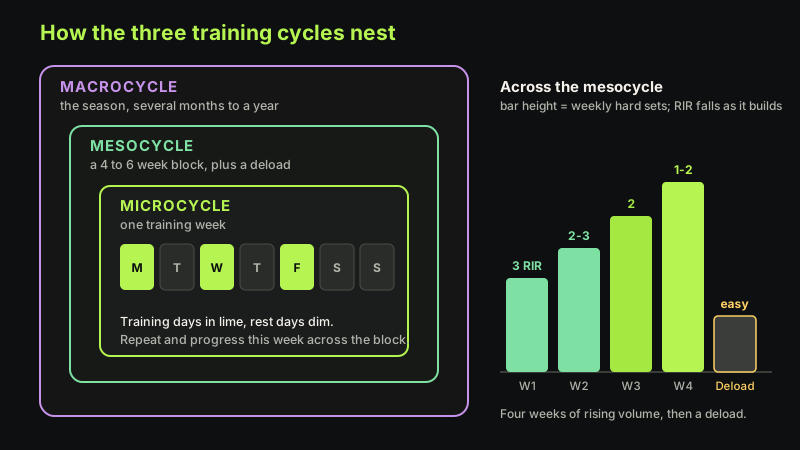
The three terms describe the same plan at three scales. Stack them and the hierarchy is obvious.
| Cycle | Typical length | What it is | The question it answers |
|---|---|---|---|
| Microcycle | 1 week (sometimes 6 to 10 days) | One full rotation of your training sessions and rest days | What does a single week look like? |
| Mesocycle | 4 to 6 weeks plus a deload | A block of microcycles built around one goal, with volume and effort ramping across it | How does a block progress before I need to back off? |
| Macrocycle | Several months to a year | A season made of several mesocycles chained toward a larger objective | Where is the whole plan heading? |
You build a week (the microcycle), repeat and progress that week for a block (the mesocycle), and string several blocks into a longer plan (the macrocycle). Each layer contains the one below it: a macrocycle is a handful of mesocycles, and a mesocycle is a handful of microcycles. The idea is borrowed from sport-science periodization, and you will see the same three-tier picture in guides written for runners, swimmers, and football teams, where the three cycles of periodization organize a season around a race date.
Muscle building is where this vocabulary earns its keep, because growth is invisible session to session. A single workout is mostly noise. A coherent block is signal. Thinking in cycles gives progressive change somewhere to live: the week holds the dose, the block holds the ramp, and the season holds the direction.
Mesocycle vs microcycle: the difference that trips people up
The most common confusion is between the microcycle and the mesocycle, so it is worth stating plainly. A microcycle is one week. A mesocycle is the block of weeks. The microcycle is the pattern you repeat; the mesocycle is what changes across the repetitions.
Put concretely: your microcycle might be a four-day upper/lower week that stays structurally the same all block long. The same exercises, the same days, the same rough session shape. What changes from week to week is the dose inside it. In week one you might run 10 hard sets per muscle at 3 reps in reserve (RIR). By week four the same microcycle carries more sets and less buffer, sitting closer to failure. The week is the container; the mesocycle is the trend line running through four or five copies of it.
That distinction changes what you pay attention to. When you design a microcycle, you are solving a layout problem: which muscles pair well in a session, what order the exercises go in, where the rest days sit. When you design a mesocycle, you are solving a progression problem: how fast to add volume or load, when the effort should climb, and when to stop and recover. Get the week right once, and the block is mostly about steering the dose.
How to build a microcycle (your training week)
A hypertrophy microcycle is built backward from your weekly volume target, not forward from a template you found online. Start with roughly how many hard sets each muscle should get per week, a figure most evidence-based guidance puts somewhere in the range of 10 to 20 for trained lifters, then divide that across the training days you can actually commit to. Your weekly training volume is the input; the week is just how you deliver it.
A workable process:
- Pick your training days. Three, four, five, or six. This is a budget of sessions, not a moral choice. More days lets you spread volume thinner per session and hit each muscle more often.
- Assign muscles to days. Group them so no single session tries to do everything, and so each muscle gets its weekly sets at a frequency of at least two sessions a week where you can manage it.
- Set the dose per session. Split each muscle's weekly hard sets across the days it appears, keeping any one session below the point where late sets stop contributing.
- Place the easy and hard days. Alternate demanding sessions with lighter ones or rest so recovery keeps pace. The week should be sustainable at week one, because it has to survive getting harder.
- Order the exercises. Put the priority movement first while you are fresh, since fatigue late in a session quietly inflates your effort read.
That last point is why an honest microcycle is a logged one. The plan on paper says 10 hard sets for back this week; whether all 10 were actually hard, or the last two drifted to 4 RIR because you were cooked, is something only a per-set record can tell you. The week you designed and the week you trained are not always the same week.
How the microcycle rolls up into a mesocycle
Once the week works, the mesocycle is what you do to it over four to six weeks. The standard hypertrophy shape is to start manageable and build: open near the low end of your set range with a couple of reps in reserve to spare, then add a little volume or load each week so the workload climbs across the block. That is progressive overload applied at the block level rather than trying to beat every previous session in isolation.
Effort ramps alongside volume. Early weeks sit further from failure, around 2 to 3 RIR, so you bank productive volume without spending your recovery too soon. Later weeks push toward 1 to 2 RIR as you adapt, until the final accumulation week is genuinely hard. Then you back off. A deload week, usually a planned lighter week at the end of the block, lets accumulated fatigue drain so the adaptation underneath can show before the next mesocycle starts fresh.
The full block-level detail, including how long to run a block, how to read the signs it has run its course, and how deloads and autoregulation fit together, lives in our guide on how to structure a hypertrophy mesocycle. The short version: the microcycle is the repeating unit, and the mesocycle is the deliberate arc of volume and effort you steer across a handful of those units.
Where the macrocycle fits, and when to ignore it
The macrocycle is the season: several mesocycles chained toward a larger goal over months or a year. In sports with a competition date, this is where the real planning happens, because everything has to peak on the right weekend. A powerlifter counts backward from a meet; an endurance athlete counts backward from a race.
For a hypertrophy lifter with no competition date, the macrocycle is the layer you can mostly leave loose. It is really just a sequence of muscle-building blocks, maybe with a lighter maintenance phase or a strength-focused block worked in occasionally. You do not need a color-coded annual plan to grow. You need each block to progress and each block to follow the last without a long unplanned gap. Chaining productive mesocycles is a macrocycle, whether or not you ever draw it out.
The honest reason the middle layers matter most is that periodization's benefits are clearest for strength and peaking, where timing the taper is the whole game. For pure muscle growth, the evidence that one elaborate periodization model beats another is thin; what reliably drives size is progressive overload, enough weekly volume, and training close enough to failure. The cycles are a way to organize those levers over time, not a magic structure that grows muscle on its own. Sport-science texts that lay out several microcycle models are describing organization, not a shortcut around the work.
How to run the cycles in RIRLift
The three cycles are only useful if you can see them in your actual training, and that is a logging problem. RIRLift is built so the week and the block read straight off what you recorded.
The microcycle is your routine. You build your training days once on iPhone, setting a target rep range and RIR for each exercise slot, then run every session from your Apple Watch. Load, reps, and RIR come pre-filled from last time, so confirming a set is a tap and dialing a new value is a turn of the Digital Crown. If a machine is taken, you swap the exercise on the wrist and keep the set count, rep range, rest, and RIR target for the session, so a crowded gym does not break the week you planned.
The mesocycle is the arc across those weeks, and it becomes visible because the data is honest. RIRLift totals your hard sets per muscle for the week, so you can see whether the microcycle actually delivered the volume you designed. Across the block, your logged RIR is the readout that tells you when to add and when to back off: a planned 2 RIR that keeps coming in at 4 says add load, and a string of 0 RIR sets says fatigue is winning and a deload is due. That is autoregulation, and it runs on real per-set effort instead of memory. You can see how the whole workflow fits together from planning the week to reviewing the block.
If you want the plan written down before you run it, our post on building a progressive overload workout plan shows how to put a target RIR into every slot so the week is auditable rather than vibes.
Common questions
What are the three cycles of periodization? The macrocycle, the mesocycle, and the microcycle. The macrocycle is the long-term plan (months to a year), the mesocycle is a multi-week block built around one goal (commonly four to six weeks plus a deload), and the microcycle is the shortest unit, usually a single training week. They nest: a macrocycle is made of mesocycles, and a mesocycle is made of microcycles.
What is the difference between a macrocycle and a mesocycle? Scale. A mesocycle is one block of a few weeks aimed at a single goal, such as a hypertrophy phase. A macrocycle is the whole season made of several mesocycles chained together. The mesocycle is where week-to-week progression happens; the macrocycle is where blocks are sequenced.
How long is a microcycle? Usually one week. Some rolling splits, like a push/pull/legs run on a repeating three-day rotation, produce microcycles of six to ten days because the pattern does not line up with a calendar week. The defining feature is that it is one full rotation of your sessions before you repeat, not a fixed number of days.
How many mesocycles are in a macrocycle? It depends on the macrocycle's length and goal, but a typical year might hold roughly six to ten mesocycles once you account for deloads between them. For a hypertrophy lifter without a competition date, you can simply run one productive block after another rather than fixing the number in advance.
Do I need to plan a full macrocycle to build muscle? No. For muscle growth without a competition to peak for, the microcycle and mesocycle carry the load. Get the week right, progress it across a block, deload, and repeat. Chaining good blocks is already a macrocycle, even if you never formally map the year.