
Blog
Does soreness mean muscle growth? What DOMS actually tells you
Published July 16, 2026 · 14 min read
You try a new exercise on Monday. By Wednesday you cannot sit down without planning the descent, and some part of you is quietly pleased. That session must have counted.
Six weeks later you run the same exercise with more weight, better technique, and one more set. You feel nothing the next day. The obvious conclusion is that you have gone soft, that the session was wasted, or that it is time to switch things up and shock the muscle again.
Both readings come from the same mistake. Soreness feels like a scoreboard because it shows up after training, it scales with how hard the work felt, and it hurts in exactly the muscles you trained. But it is closer to a novelty detector than a growth meter, and it is loudest precisely when you are least adapted to what you just did. The lifter who is sore every week is often the lifter who changes their program every week.
This post covers what delayed onset muscle soreness actually measures, why the evidence points the other way (growth keeps accumulating after the soreness stops), where soreness is still worth reading, and what to judge a session by instead. That last part is where most articles on this question leave you standing.
What is DOMS?
Delayed onset muscle soreness is the dull, stiff ache that arrives 24 to 72 hours after training, peaks around the two-day mark, and fades over roughly a week. It is distinct from the burn during a set and from sharp pain during a movement, which is a different signal entirely and worth taking seriously.
DOMS shows up most reliably after unaccustomed work, and especially after eccentric work: the lowering half of a rep, where the muscle lengthens under load. Romanian deadlifts, deep lunges, and slow negatives are famous for it. The Cleveland Clinic's overview of DOMS gives the standard description of the timeline and the mechanism most people have heard: microscopic damage to muscle fibers, followed by an inflammatory response.
That standard story is worth a caveat, because it is less settled than it sounds. In a 2021 review, Wilke and Behringer argued that classical muscle-damage models do not explain DOMS well, and proposed that much of the pain may come from the fascia, the connective tissue wrapping the muscle, rather than the muscle fibers themselves. They suggest "delayed onset soft tissue stiffness" as a more accurate name. That proposal is not the final word. But it should make you cautious about treating soreness as a precise readout of what happened inside the muscle, when researchers are still arguing about which tissue is even generating the signal.
Does soreness mean muscle growth?
No. Soreness is not a reliable indicator of muscle growth, and the two can move in opposite directions for months at a time.
The strongest version of this argument comes from Damas and colleagues, whose 2018 review examined the role of muscle damage in resistance-training hypertrophy. Two findings matter here. First, the spike in muscle protein synthesis you get from the first few sessions of a new program is largely directed at repairing damage, and it does not correlate with how much muscle you eventually build. Second, and more telling, measurable hypertrophy accumulates mainly in the later phase of training, once damage has progressively attenuated.
Read that sequence again, because it inverts the folk model. Damage and soreness are highest at the start, when you are least adapted and growing least. They decline as you adapt. Growth arrives after they decline. If soreness were the growth signal, you would grow fastest in week one of every new program and slow down from there, and every experienced lifter knows that is not how it goes.
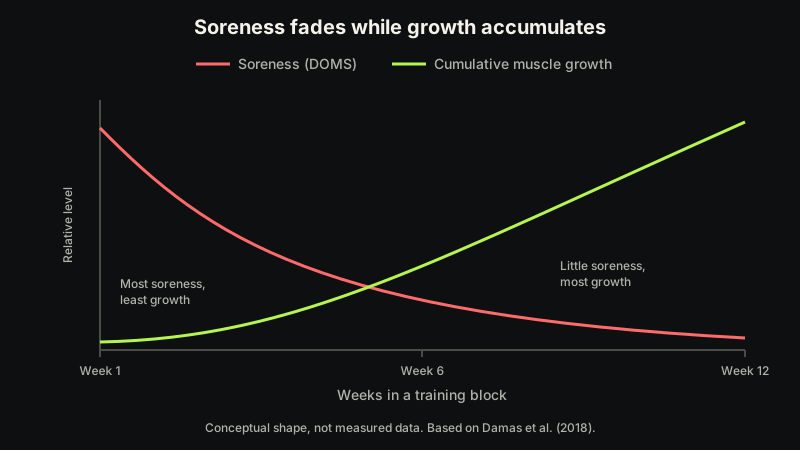
The practical version is simpler. You get sore when you do something your body has not calibrated to. You grow when you apply enough hard, progressively increasing work to a muscle and recover from it. Those two conditions overlap early in a block, which is exactly why the myth is so durable. Then they come apart, and the lifter who keeps chasing the first one stops satisfying the second.
Beginners get the most confusing version of this, because in the first months soreness, strength and visible size all move at once and none of them are measuring the same thing. That is worth untangling on its own, and why early progress is partly neural and partly swelling explains which of those signals survives the year.
What soreness actually tracks
Soreness responds to novelty, not to stimulus. The clearest way to see it is to line up the things that reliably make you sore against the things that reliably drive growth.
| Input | Makes you sore | Drives growth |
|---|---|---|
| An exercise you have not done in months | Strongly | Only if you keep it and progress it |
| Heavy eccentrics or a deep stretch under load | Strongly | Contributes |
| Two weeks off, then your normal session | Strongly | No |
| Adding a set to an exercise you already run | Barely | Yes |
| Adding load at the same RIR | Barely | Yes |
| Week six of a block you have been progressing | Rarely | Yes |
The bottom three rows are the whole problem. They are the things that actually build muscle, and they produce almost no soreness once you are adapted to the movement. Meanwhile the top three produce plenty of soreness, and two of them are not stimulus at all. Coming back from a holiday and being wrecked by your normal Tuesday session is not evidence that the session was productive. It is evidence that you were away.
The two ways this misleads lifters
Chasing it. If soreness is your success metric, you will keep doing novel things, because novelty is what produces soreness. So you rotate exercises constantly, hunt for new variations, and never run the same movement long enough to add weight to it. You have bought the sensation and sold progressive overload, which was the thing that was actually going to work. This is the more expensive error, and it is common in exactly the lifters who are most motivated.
Fearing its absence. The mirror image is the lifter who finishes a well-executed session, feels fine on Wednesday, and concludes they did not do enough. So they add sets. Then more sets. Volume creeps up, driven by a feeling rather than a number, and a good chunk of it is junk volume that is not buying any additional growth while it quietly accumulates fatigue. Growth stalls, and because the diagnosis was wrong at the start, the response is usually to add even more. It is the same error as treating a deep pump or a strong mind-muscle connection as proof a set counted: a sensation, not a number.
Both failures share a root cause. The lifter has no other measurement, so a bad signal wins by default. Take away the bad signal without replacing it and you have made things worse, which is where most articles on this topic stop.
What to measure instead
The honest question a session should answer is not "did that hurt afterwards" but "did the work get better." That is measurable, and it does not require a lab.
| Signal | What it tells you | How to read it |
|---|---|---|
| Load and reps at a stated RIR | Whether the set actually got easier | Same weight and reps at a higher RIR than last time is real progress, even with nothing else changed |
| Weekly hard sets per muscle | Whether the muscle got enough work to grow | Compare against your own landmarks over a block, not against a stranger's number |
| Estimated 1RM trend | Whether strength is moving across the block | Read it over four to six weeks; week-to-week noise means nothing |
| Soreness | Whether the work was novel to you | Useful for recovery context. Ignore it as a stimulus meter |
The first row carries most of the weight, and it is the one lifters usually skip. Load and reps alone cannot tell you whether a set got easier, because the same 80 kg for 8 reps can be a comfortable set with three reps left or a grinding near-miss. Reps in reserve is what separates those two, and it is the difference between a log that says what you lifted and a log that says how hard it was.
That distinction is what makes the whole scoreboard work. If you logged 80 kg x 8 at 3 RIR in week one and 80 kg x 8 at 1 RIR in week four, nothing improved. The set got harder for the same output, which is a fatigue signal worth acting on. Flip it around, and 80 kg x 8 at 1 RIR moving to 80 kg x 8 at 3 RIR is progress that the load column alone would have recorded as a flat line. This is also why the rep range matters less than the effort you bring to it: the numbers only mean something once you know how close to failure they were.
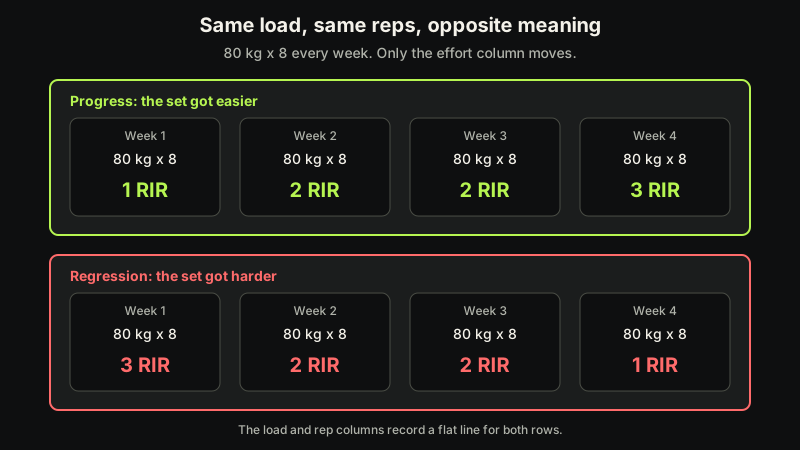
None of this requires you to train to failure to get a reading. In fact, a small buffer usually gives you a better read than a maximal set, because once everything is grinding, every set feels the same and your estimates go noisy.
Should you train sore muscles?
Usually yes, with judgement. Mild to moderate soreness is not a reason to skip a session, and training through it does not appear to compromise your results. Most lifters find the first few sets feel notably better than the warm-up suggested they would.
Three cases deserve more caution:
- The soreness is severe enough to change how you move. If you cannot hit your normal range of motion or your technique degrades, you are training a different exercise than the one you programmed, and the reading you get from it is worthless.
- It is sharp, joint-centred, or one-sided. That is not DOMS, and it is not what this article is about.
- It keeps arriving from sessions that used to be routine. This is the one people miss. Soreness from a new exercise is expected. Soreness from your normal Tuesday session, week after week, is a recovery signal rather than a novelty signal, and it belongs alongside stalling reps and drifting RIR in the list of signs you need a deload.
Where soreness is still useful
Soreness is not worthless. It is just answering a different question than the one lifters ask it.
It is a reasonable novelty check: if a movement you have run for two months suddenly makes you sore, something changed, whether that was the load, the range of motion, or how far you took the set. It is one input among several on recovery, which is why some programs collect it as part of a broader feedback picture rather than on its own. And it is a rough sanity check on the very first session of a new exercise.
It is also a poor timer. Lifters routinely wait for soreness to fade before training a muscle again, which is a different question from whether the muscle can perform, and the two come apart quickly once you are trained. The more reliable read is how long a muscle actually needs between sessions, which follows the size of the dose you gave it rather than how tender it feels.
What it cannot do is rank your sessions. It cannot tell you whether Tuesday was better than last Tuesday, whether a muscle is getting enough volume, or whether you earned the next load increase. Those are questions about numbers, and soreness is not a number. It is a sensation that peaks when you are least adapted and quietly disappears while you keep growing.
Keeping the real scoreboard without a spreadsheet
The reason lifters fall back on soreness is not stupidity. It is that soreness is free. It arrives on its own, requires no discipline, and is impossible to forget. The honest metrics ask something of you: you have to actually record the set.
That is the problem RIRLift is built around. You set a rep range and an RIR target per exercise on iPhone, then run the session from your wrist. Each set shows your previous load, reps, and RIR inline, so "did this get easier than last time" is answered while you are standing over the bar, not reconstructed a week later from memory. You log actual RIR in the moment with the Digital Crown, which is the only way the effort column stays honest. Your estimated 1RM and best set surface during rest, and your weekly hard sets per muscle total themselves against a target.
None of that decides your training for you. RIRLift keeps an accurate record of what you did and how hard it was, so the decisions stay yours and are based on something better than how your quads feel on Wednesday. If you want to see the whole loop, here is how a session runs from your wrist.
Soreness will still show up. Enjoy it when it does, note what caused it, and stop grading yourself with it.
FAQ
Are your muscles growing if they are sore?
Not necessarily, and not because of the soreness. Soreness mostly reflects how unaccustomed the work was, so it is highest when you try something new and lowest once you have adapted. Growth comes from progressively increasing hard work on a muscle over time, and it accumulates mainly after the damage and soreness of a new program have settled down. You can be very sore from a session that builds nothing (your first day back after a holiday) and grow steadily from sessions that never make you sore.
How can you tell if your muscle is growing?
Look at the numbers you can actually track week to week. The most direct is whether your sets are improving at a given effort: the same load and reps at a higher RIR, or more reps at the same RIR, means the work got easier and something adapted. Over a block, an upward trend in estimated 1RM and in the load you handle at a target RIR is the clearest available proxy. Body measurements and photos over months are slower but useful. Soreness tells you none of this.
Is it good for muscles to be sore?
It is neither good nor bad on its own. It is a normal response to unfamiliar work, it is not a target to aim for, and there is no evidence that maximising it maximises growth. Mild soreness is fine and expected when you introduce an exercise. Soreness so severe that it changes how you move for days is worth avoiding, because it costs you quality on subsequent sessions without buying extra muscle.
Does muscle soreness increase muscle growth?
No. There is no good evidence that soreness itself causes or amplifies hypertrophy. Muscle damage and growth are related but separable, and the research suggests that measurable growth shows up mainly once damage has attenuated over a training block. Deliberately chasing soreness usually means chasing novelty, which works directly against the consistent, progressive loading that does build muscle.
Why am I not sore anymore but still getting stronger?
Because that is the normal, healthy pattern. Your body has adapted to the movements you run, so they no longer produce much of a damage response, while the progressive loading you are applying continues to drive growth. Losing your soreness is usually a sign that you have stopped constantly switching exercises long enough to actually progress on them. It is a good sign, not a plateau.